The Rules Nobody Told You About Picnics (But Absolutely Should Have)
A century and a half of etiquette books, distilled into ten rules you'll actually want to follow.
Before you unroll that blanket - a quick word on picnic etiquette. Before you pop that cork, or place a single wedge of Somerset cheddar on a board - a quick question: are you sure you're doing this right?
No, I'm not asking whether you've packed enough napkins (though, for the record, you almost certainly haven't). I'm asking whether you've ever stopped to consider that picnics have been governed by a surprisingly robust set of social rules for a very, very long time.
Before there were Instagram aesthetics and branded wicker baskets, there were etiquette books — beautifully earnest, occasionally baffling, and completely sincere in their belief that how you conduct yourself on a blanket in a field says rather a lot about your character.
I've spent an unreasonable amount of time reading them so you don't have to.
Here's what 160 years of outdoor entertaining wisdom actually amounts to — translated, gently, for those of us who just want a lovely afternoon in the sunshine.
“One should not make the mistake of thinking that because he or she is ‘roughing it’ for a day, he or she can therefore leave behind his or her manners.”

William Kay Blacklock (1872-1924) - The Picnic
Amy Vanderbilt said it best, and honestly? She wasn't wrong. There's something rather liberating about knowing that picnic etiquette isn't about being stuffy — it's about being considerate. Which, when you strip everything back, is what all good manners come down to anyway.
The rules have softened considerably since Victorian times (you no longer need to worry about modesty at the seating arrangements, I'm relieved to tell you). But the spirit of them — thoughtfulness, care, a bit of grace — hasn't changed at all.
Ten Rules from the Etiquette Books.
RULE ONE: Leave the Manners Packed In, Not Out
The temptation, when you're surrounded by grass and fresh air and people you love, is to assume that because the setting is informal, the behaviour can be too. It can't. Or rather, it doesn't need to be.
The most generous reading of this rule is simply: don't let the great outdoors become an excuse to be less thoughtful than usual. Being relaxed and being considerate are not mutually exclusive.
THE MODERN TAKE: Relaxed doesn't mean careless. You can eat with your fingers and still be the most considerate person on the blanket.
Hat-tip to Amy Vanderbilt's Complete Book of Etiquette, 1952 — still one of the warmest reads on the subject.
RULE TWO: An Ant Is Not a Disaster. Panic Is.
Donald Ogden Stewart - writing in 1922 with his tongue almost entirely in his cheek - observed that "a picnic without at least one ant is incomplete." He was being funny. But he was also being right.
The ant is not the problem. The ant is the experience. Outdoor dining is not a controlled environment, and attempting to make it one is both exhausting and entirely beside the point.
Some of the loveliest picnics I've ever had involved a rogue wasp, a wind that arrived uninvited, and at least one glass of something fizzy sacrificed to the Somerset grass. They were perfect anyway.
THE MODERN TAKE: British weather is part of the story, not a flaw to correct. Pack a good sense of humour alongside the napkins.
Perfect Behavior by Donald Ogden Stewart, 1922. Genuinely worth reading if you find Victorian humour as charming as I do.
RULE THREE: Take Your Litter Home. Every. Last. Bit.
Emily Post — the grande dame of American etiquette — was absolutely unambiguous on this point back in 1922, and a century of picnickers has conspired to make it feel more urgent, not less.
Leaving litter is the single biggest breach of picnic etiquette. Full stop. No amount of beautiful styling, impressive cheese selection, or tasteful glassware will redeem you if you leave a bag of wrappers in a meadow.
Pack a dedicated "rubbish bag" before you leave the house. It's the most unglamorous item in your basket, and the most important.
THE MODERN TAKE: Take everything you brought. Then take a piece of someone else's as well. The countryside will thank you in wildflowers.
Emily Post, Etiquette in Society, in Business, in Politics, and at Home, 1922. Genuinely timeless advice.
“A well-chosen spot contributes greatly to the enjoyment and propriety of the picnic.”

Photo by Fox Photos on Getty Images
RULE FOUR: Location Is Half the Magic
John Cordy Jeaffreson was writing about Victorian picnics in 1877, but he absolutely understood something that still holds true: the where matters enormously.
A mediocre picnic in a genuinely lovely spot will outperform a magnificent spread beside a busy car park every single time. The food feeds the body; the setting feeds the soul. Invest in both.
Somerset is absolutely heaving with spots that will make even a very simple picnic feel rather extraordinary. A riverbank near Bruton, the slopes below Glastonbury Tor, a quiet corner of a working apple orchard in autumn. None of these cost a thing.
THE MODERN TAKE: The right location is free. The wrong one is unforgivable. Choose well, and bring the OS map.
The Book of the Table, John Cordy Jeaffreson, 1877. Unexpectedly wonderful on the topic of gathering.
RULE FIVE: Arrive on Time (Or Bring Good Reasons)
Mrs. Humphry — writing in 1897 in her wonderfully titled Manners for Men — pointed out that punctuality at a picnic is a virtue, because arriving late disrupts the entire rhythm of the gathering.
She's right, and this has only become more true. When someone has laid out a beautiful spread, chilled the wine, carried the basket across a field, and chosen a spot in the shade — your lateness is a very small unkindness.
There are, of course, exceptions. Somerset lanes in summer. Small children. The car key that was definitely in that pocket.
THE MODERN TAKE: Aim for on time. Accept that life happens. Always text.
Manners for Men, Mrs. Humphry, 1897. A surprisingly excellent and warmly funny read.
RULE SIX: Everyone Helps. That's the Whole Point.
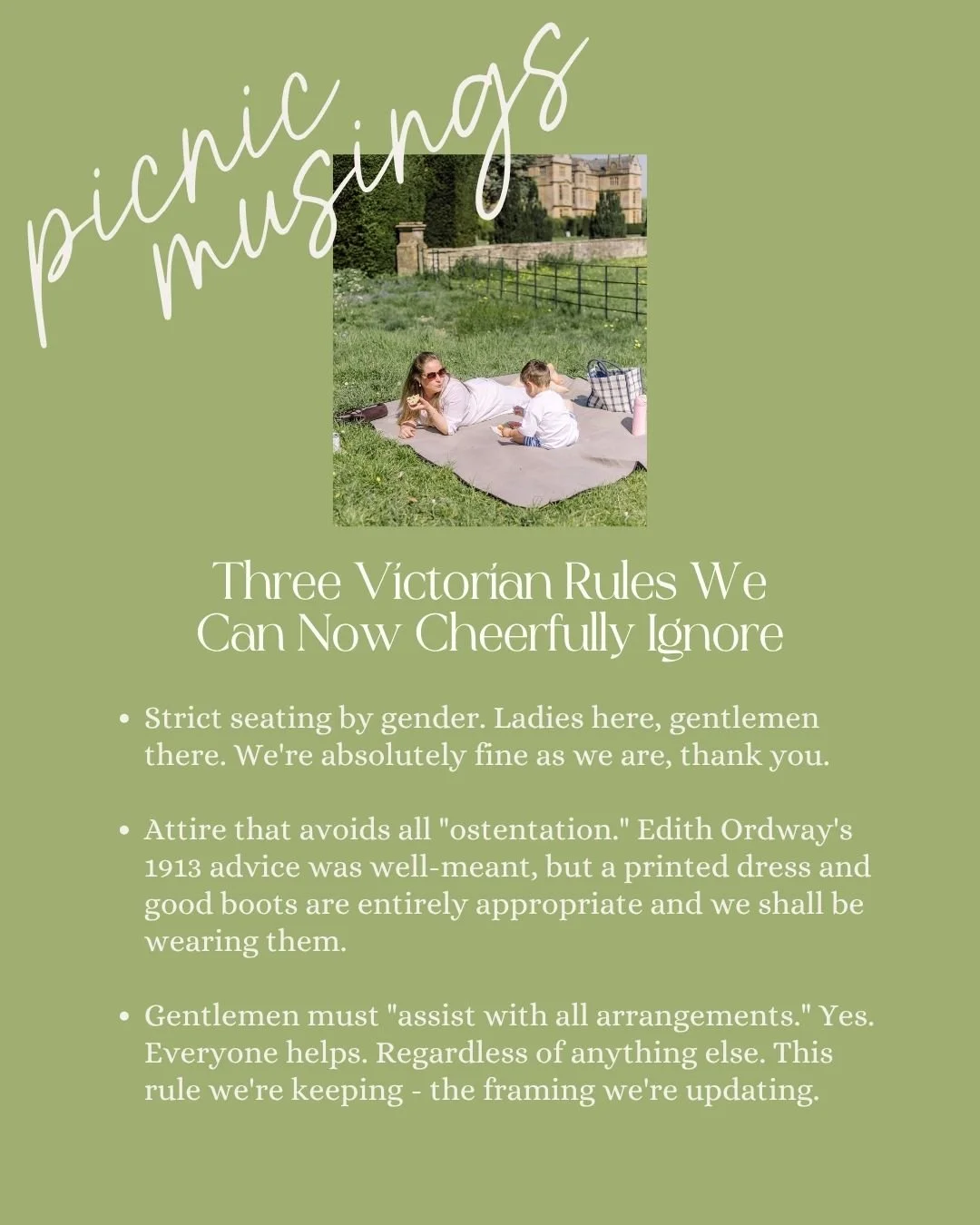
Cecil B. Hartley's 1860 Gentleman's Book of Etiquette was very specific about gentlemen helping to set up and pack away. The principle — if not the gendered framing — is one I'd happily cross-stitch onto a cushion.
The picnic works because everyone contributes. One person carries the basket, one spreads the blanket, one pours the drinks, one insists on finding the perfect spot and then changes her mind twice. Everyone has a role. The picnic is a little ecosystem.
When someone does all the work and everyone else sits back and accepts it graciously — that's not a picnic. That's a one-person catering service with no pay and damp knees.
THE MODERN TAKE: Ask what you can bring. Mean it. Turn up with something good.
RULE SEVEN: Dress for the Occasion - But Know Your Occasion
Edith Ordway's 1913 advice that "simplicity and comfort should guide the choice of attire" still stands, with one gentle update: simplicity doesn't mean boring, and comfort doesn't mean you've stopped caring.
There is an art to picnic dressing. It involves linen, good boots, and something that you won't mind getting a little grass on the hem of. It involves a layer, because this is Britain and the wind has opinions. It absolutely does not involve heels on soft ground, however convincing the flat section looked from the car park.
THE MODERN TAKE: Dress like you dressed on purpose, but like someone who has actually been on a picnic before.
The Etiquette of To-day, Edith B. Ordway, 1913.

Photo Credit: nellhills.com
RULE EIGHT: The Spirit of the Thing Matters More Than the List
Oliver Bell Bunce, writing in 1880 in a book called Don't (which is a marvellous title), cautioned against forgetting "the essence of a successful picnic lies in the spirit of camaraderie and mutual respect among participants."
This is the one that genuinely moves me. Because it's so easy, in the age of styled baskets and curated tablescapes, to lose the plot entirely and start optimising an experience that doesn't need optimising. It just needs people who actually want to be there.
A tin of something decent and a scratchy blanket in good company will always beat a Fortnum's hamper in bad spirits.
THE MODERN TAKE: You are not catering an event. You are gathering with people you love. Keep that front and centre.
“The picnic has always been a reflection of societal norms and etiquette, adapting to the customs of the time.”
RULE TEN: The Picnic Is Not the Point. The People Are.
Walter Levy's observation that the picnic has always reflected the customs of its time is, in 2026, perhaps the most interesting of all. Because right now, our customs include a desperate, collective, rather poignant hunger for genuine in-person connection.
We are so thoroughly online, so perpetually available, so exhausted by curated performance — that the picnic, that beautiful, low-tech, weather-dependent, ant-adjacent tradition — might actually be the most radical act of presence available to us.
Not the basket. Not the aesthetic. Not the reel you capture afterwards. The hour you spend fully present on a blanket, with bread and cheese and the people you chose to sit with.
That's the rule the etiquette books were always pointing towards, even when they were talking about punctuality and hat pins.
THE MODERN TAKE: The picnic is a permission slip. To slow down. To show up. To be here, right now, in the damp grass, with the people you love.
How we treat each other in moments of leisure - and how those moments, handled well, become the ones we remember.
The etiquette books got a lot right. They also got some things gloriously, hilariously wrong. But the through-line — be considerate, be present, contribute something, leave things as you found them or better — is as true on a Somerset hillside in 2026 as it was in a Victorian meadow in 1877.
Now go pack your basket. Bring enough napkins. And please, for the love of all things good and green, take your litter home.
Love Gemma x
The Piknic Club
Life is too short for boring picnics.
The Piknic Club is where the blanket-spreading, basket-packing, joy-seeking community lives. Seasonal boxes, curated picks, and the kind of picnic inspiration that makes you want to drop everything and go outside immediately.
Stay a while …


Come and be nosey …
The blanket is always out over on Instagram. Behind the scenes Picnicscapes, Somerset life as it actually happens, and the occasional opinion about gingham.