Picnic Icons: The Scotch Egg

Part of The Picnic Icons Series — the histories behind the objects, drinks, and dishes that make the British outdoor feast what it is.
A Delicious Celebration of Picnic History
There is a moment, known to every British person who has ever opened a lunchbox, unwrapped a napkin, or peered hopefully into a hamper on a Somerset hillside, when the golden orb of a Scotch egg appears.
Something happens when you see it. You know what it is. You know exactly how it will feel to bite through that crumb — the crunch, the yielding sausage, the soft egg beneath, the yolk that, if someone has done their job properly, is still just slightly jammy at the centre. You don't need to think about it. Some knowledge lives below thought.
This is what happens when a food has been around for nearly three hundred years.
But the Scotch egg has a secret. Several of them, actually. Its origin is disputed, its name is almost certainly wrong, its recipe has changed three times, and it once — in November 2020 — brought the British government to its knees in a parliamentary argument that would have baffled any foreign observer and delighted every single one of us.
This is the full story.
Before Britain: The Egg Wrapped in Meat Has Ancient Roots
Let's start where the food historians are reluctant to start: not in London, not in Yorkshire, but in the Mughal courts of 16th-century India.
The nargisi kofta — literally "narcissus meatball," named after the narcissus flower that it resembles when sliced in half, its white and gold eye gazing up from the meat — is a dish from the Mughal imperial kitchen. The first recorded recipe for nargisi kofta appears in cookery records from the Mughal court, and food historian Alan Davidson, writing in The Oxford Companion to Food, identifies it as the most plausible ancestor of what we now call the Scotch egg. A hard-boiled egg, wrapped in spiced minced lamb, fried or cooked in gravy. The resemblance is not superficial. It is structural.
The Mughal empire ran from 1526 to 1857. The British East India Company arrived on Indian shores in 1600 and was, for the following two and a half centuries, in the business of taking things home. Spices, fabrics, ideas, recipes. The theory — and it is a theory, not a certainty — is that the egg-wrapped-in-meat concept travelled back to Britain through the colonial kitchens of East India Company employees and officials who had spent years eating extraordinary food in India and wanted, on their return to Britain, to find some pale echo of it.
What they found was that if you replace spiced lamb with English sausage meat, and serve it cold rather than in gravy, and coat it in breadcrumbs and deep-fry it, you get something entirely different but structurally identical. Something that a British cook in the 1730s or 1740s might plausibly have invented, whether or not they'd ever heard of a nargisi kofta.
The egg wrapped in meat is, it turns out, an idea that occurs to brilliant cooks everywhere. Variants exist across the Middle East, across South Asia, across Eastern Europe. The Dutch vogelnestje — a meat-encased egg served warm — predates the British version. The idea belongs to everyone and no one.
What Britain did was fry it, crumb it, and eat it cold in a field. That part is entirely ours.
Fortnum & Mason, 1738: The Official Story (And the Problem With It)
Walk into Fortnum & Mason on Piccadilly today and ask about the Scotch egg and they will tell you, with the confidence of a firm that has been selling things to people with money since 1707, that they invented it in 1738.
The story is this: Fortnum's created the Scotch egg as a portable luxury for wealthy travellers setting off westward from London on the long carriage journey to Bath, Bristol, and the West Country. In the 18th century, the road was slow, the coaching inns were unreliable, and a wealthy traveller needed something that would survive a day's journey without a servant, a plate, or a sauce. The egg, wrapped in forcemeat and fried, was the answer. Durable, portable, self-contained. The original premium convenience food.
The original Fortnum's version, they say, was made with a small pullet's egg — a young hen's egg, slightly smaller and more delicate than a standard egg — wrapped in forcemeat (a seasoned minced meat mixture) that included, crucially, anchovies. This is where the word "scotched" may come in: "scotching" a meat mixture, in old English culinary terms, referred to the technique of adding anchovies to season and enrich it. The anchovy cuts through the fat, lifts the flavour, and — in the 18th century, before refrigeration — also acted as a mild preservative.
It's a plausible story. It fits the era. Fortnum's was already known for luxury provisions. The carriage journey west from Piccadilly was genuinely a thing.
The problem is the records. As Hettie Hen, the artisan Scotch egg company that has researched this history forensically, notes: "The records substantiating the 1738 date have, rather conveniently, been 'lost.'" Fortnum's maintains its position, but no one has produced the ledger, the recipe book, the letter, or the advertisement from 1738 that would settle the matter. The claim rests entirely on institutional memory and brand tradition.
This doesn't make it false. Institutional memory at a business that has been operating continuously for over three hundred years carries real weight. But any honest food historian has to mark this one as tradition rather than documented fact.
What is documented — confirmed by Alan Davidson in The Oxford Companion to Food, by the Oxford Reference source, and by the scholarly work around Maria Rundell's cookbook — is the first known printed recipe for a Scotch egg. And it doesn't appear until 1805.
Mrs Rundell and the First Printed Recipe, 1805
Maria Eliza Rundell was born in Ludlow, Shropshire in 1745 and died in Lausanne in 1828, and in between she wrote the most successful cookery book of the first half of the nineteenth century almost entirely by accident.
In 1805, when she was sixty years old, she gathered a collection of recipes she had been writing for her daughters and sent them, without expecting payment, to her friend's family publishing house — John Murray, who would later also publish Byron, Austen, and Darwin. Murray recognised what he had. He published it immediately under the title A New System of Domestic Cookery: Formed Upon Principles of Economy, and Adapted to the Use of Private Families, with the authorship credited simply to "A Lady."
It was an immediate, overwhelming success. Half a million copies sold during Rundell's lifetime. It ran to over sixty-seven editions. It stayed in print until the 1880s. Mrs Rundell — as the book became universally known — was the most famous cookery book in Britain for thirty years, until Mrs Beeton arrived and took the crown.
In the fourth edition, published in 1809, there appears the first known printed recipe for Scotch eggs. It reads, in full: "Boil hard five pullet's eggs, and without removing the white, cover completely with a fine relishing forcemeat."
That's it. No breadcrumbs. No deep-frying method. No specific instructions for the forcemeat. Five words where a modern recipe would have five paragraphs. This is because Mrs Rundell assumed her readers knew things — could make a forcemeat, knew what "relishing" meant as a culinary instruction, understood that "cover completely" implied pressing firmly. The 1809 reader had skills we have mostly lost.
Crucially: no breadcrumbs in the original Rundell recipe. The breadcrumb coating came later, appearing fully in print by the time Mrs Beeton included the dish in her Book of Household Management in 1861. The crumb, it turns out, is not ancient. It's Victorian. The most important textural element of the modern Scotch egg arrived fifty years after the first recipe.
The dish also appears in The Cook and Housewife's Manual by Mistress Margaret Dods, published in Edinburgh in 1826. Oxford Reference notes that this Scottish publication might be relevant to the "Scotch" in the name — though it could equally be evidence only that the dish had spread northward by the 1820s.
The Name: Scotland Had Almost Nothing To Do With It
"Scotch" egg. It sounds definitive. It sounds as if, at some point, a Scotsman was involved, or the dish came from Scotland, or there was a Scottish cook at the heart of the origin story.
Almost certainly none of these things are true.
The leading theories on the name are:
The "scotching" theory (most plausible): "Scotched" in 18th-century culinary English referred to the treatment of meat — either mincing it finely or adding anchovies to season and preserve it. Fortnum's own account leans on this. A scotched egg would be an egg that has been covered in "scotched" — prepared and seasoned — meat. Over time, "scotched egg" became "Scotch egg" in the same easy contraction that gives us "Scotch broth" and "Scotch whisky."
The William J. Scott & Sons theory: This is the Whitby, Yorkshire origin story. William J. Scott & Sons was a seafront fishmonger and food merchant in Whitby who sold eggs encased not in sausage meat but in fish paste, which they called "Scotties." The name evolved, over time, into Scotch eggs. The Whitby version predates the sausage-meat version in some accounts and may represent an entirely parallel invention. It's a good story, well-sourced, and the people of Whitby hold it with appropriate civic pride.
The lime-powder preservation theory: A third account suggests that eggs imported from Scotland to England were preserved for transport in a lime powder wash — a process sometimes called "scotching." The association between the name "Scotched" and eggs prepared for travel may have stuck. This theory is the weakest of the three but not implausible for the 18th century.
What is certain: the dish has no meaningful connection to Scotland as a country or a cuisine. The Scots did not invent it, do not claim it with particular enthusiasm, and the "Scotch" in the name is almost certainly a culinary adjective, not a geographical one.
Victorian Glory: The Picnic Makes It Famous
By the middle of the 19th century, the Scotch egg had found its people.
Mrs Beeton's 1861 recipe confirms that the breadcrumb coating had fully arrived, and her instructions show a dish recognisably close to what we eat today: hard-boiled egg, sausage meat, breadcrumb, fried. She serves it with gravy — still treating it as a hot dish rather than a cold one — but the architecture is there.
What made the Scotch egg iconic rather than merely popular was the railway.
The Victorian railway transformed British life in dozens of ways, but one of its most delicious consequences was the packed lunch. Day trippers to the seaside, families heading to the country, businessmen travelling between cities — all of them needed food that could be packed and carried and eaten without a kitchen at the other end. The Scotch egg, with its self-contained, hand-holdable, crumb-armoured construction, was the ideal answer.
Fortnum & Mason understood this completely. By the 1860s and 1870s, their hampers — specifically designed for train journeys, race meetings, regattas, and country house picnics — were famous, and the Scotch egg was among their signature contents. Charles Dickens wrote extensively about outdoor eating and the pleasures of the picnic in his journalism and fiction; the packed egg appears in various forms in the broader Victorian outdoor eating literature, not always by name but recognisably by description.
By the Edwardian era, the Scotch egg was a fixture of the hamper, the picnic basket, the shooting lunch, the cricket tea, and the race meeting. It had completed its journey from luxury convenience food for carriage travellers to beloved staple of the British outdoor feast.

The Dark Years: War, Mass Production, and the Petrol Station
Every icon has its wilderness period.
The First World War brought meat rationing and simplification of food across Britain. The Scotch egg survived, but in reduced circumstances. The Second World War was harsher: meat was rationed from January 1940 until July 1954, and the Scotch egg, which requires a meaningful quantity of good sausage meat, was not well suited to the age of austerity. Versions appeared using minimal meat, or reconstituted processed meat. They were not wonderful.
But the real fall from grace came in the 1970s.
Industrial food production discovered the Scotch egg and did to it what industrial food production does to everything it touches: it made it cheaper, faster, blander, and worse. The supermarket Scotch egg of the 1970s, 1980s, and 1990s — the kind found under cling film in petrol stations, airport food courts, and motorway service areas — became a byword for exactly the kind of beige, rubbery, flavourless food that gave British cuisine its international reputation for horror.
The yolk was grey. The sausage meat had the texture of wet chalk. The breadcrumb coating was the same ochre colour as the surrounding packaging. You ate it because you were hungry and nothing else was available, and afterwards you felt neither better nor worse, which is the most damning verdict you can give a food.
The original hadn't been this. The original was extraordinary. But the original had been forgotten.
The Revival: Gastropubs, Farmers' Markets, and the Runny Yolk
The resurrection of the Scotch egg is one of the great stories of early 21st-century British food.
It began in the gastropub movement of the late 1990s and early 2000s — the moment when British pub food stopped being a microwaved afterthought and started being a serious culinary project. Chefs who had trained in fine dining kitchens but wanted to cook for a broader audience arrived in pubs and began working through the canon of British food, asking: what is this, really, if it's done properly?
The Scotch egg was an obvious candidate. Take it back to basics. Use a good free-range egg. Make the sausage meat yourself from quality pork, seasoned properly, with fresh herbs. Panko breadcrumbs for a lighter, crispier coat. And — the revolution — don't hard-boil the egg. Soft-boil it. Six minutes. Ice bath. The yolk, when you bite into the finished Scotch egg, should be jammy, golden, just barely set, running slightly at the centre.
This small change — the soft yolk — transformed the dish. It made it feel alive. It made every bite different. It turned the Scotch egg from a solid, reliable, slightly dull object into something that required attention, care, and skill to achieve correctly.
By 2010, the artisan Scotch egg had appeared at farmers' markets and food festivals across Britain. By 2015, it was on the menu at Michelin-starred restaurants — occasionally with truffle in the sausage meat, or quail eggs instead of hen's eggs, or black pudding mixed through the meat, or a venison-and-juniper filling for autumn. The gourmet Scotch egg became a canvas.
And through all of this, the humble version — the one you make at home on a Saturday afternoon, wrapped in good pork sausage meat from the local farm shop, with a yolk that runs when you break it on the kitchen table — was reclaimed too. The good supermarkets started selling them properly again. The farmers' market versions were everywhere. The bad ones still exist in their cling film tombs at motorway services, but they feel anachronistic now. A relic of a worse age.
The Constitutional Crisis of November 2020
We cannot discuss the Scotch egg in 2026 without discussing the most important moment in its modern cultural history.
It is November 2020. England is navigating a system of tiered COVID-19 restrictions. Under Tier 2 rules, pubs are permitted to serve alcohol only to customers who are also eating a "substantial meal." The question of what constitutes a substantial meal has, somehow, become a matter of urgent national concern.
On 30 November, Environment Secretary George Eustice tells the nation that a Scotch egg "probably would count as a substantial meal if there were table service."
The following day, Cabinet Office Minister Michael Gove tells ITV's Good Morning Britain that a Scotch egg is "probably a starter."
Then Gove tells LBC that "a couple of Scotch eggs is a starter, as far as I'm concerned."
Then — in a reversal that will live in British political history — Gove tells ITV News: "A Scotch egg is a substantial meal."
He adds, memorably: "I myself would definitely scoff a couple of Scotch eggs if I had the chance, but I do recognise that it is a substantial meal."
Britain watched this with the delighted disbelief that only a truly absurd political moment can generate. The Scotch egg — a 300-year-old snack invented (possibly) in a Piccadilly luxury shop for people going to Bath — had become the instrument by which the British government revealed its complete inability to define a meal. Twitter had the time of its life. The pub trade was furious. The Scotch egg had never been more famous.
And somewhere in all of that, underneath the farce, was something rather true: we genuinely don't know what a Scotch egg is. Is it a starter? A snack? A main course? A meal in itself? The answer — the honest answer — is that it's all of these things, depending on how good it is and how hungry you are. It's a Scotch egg. It resists categorisation. It always has.
The Somerset Scotch Egg
I've eaten a lot of Scotch eggs in my life. I have strong opinions about them, not all of which my family shares.
The best I've ever had was from a small pork butcher at a farmers' market in Somerset — I won't name them because they'd be overwhelmed and I'm not ready to share — who make their sausage meat from rare breed pork, season it with fresh sage and apple, and achieve a yolk consistency that is, I can only say, transcendent. The breadcrumb is fine and golden. The whole thing is just warm when you buy it, which is the correct temperature: not fresh from the fryer, not cold from the fridge, but resting, settled, its best self.
The Somerset connection to the Scotch egg is not accidental. This county produces extraordinary pork — the pig has been central to Somerset farming since before anyone was writing things down — and the apple-and-sage combination that has lived in Somerset sausages for centuries is, it turns out, exactly what a Scotch egg wants around its egg. Not an innovation. A homecoming.
If you want to make your own, here is the recipe I use. It is unashamedly Somerset in its sensibility.
The Ultimate Picnic Partner
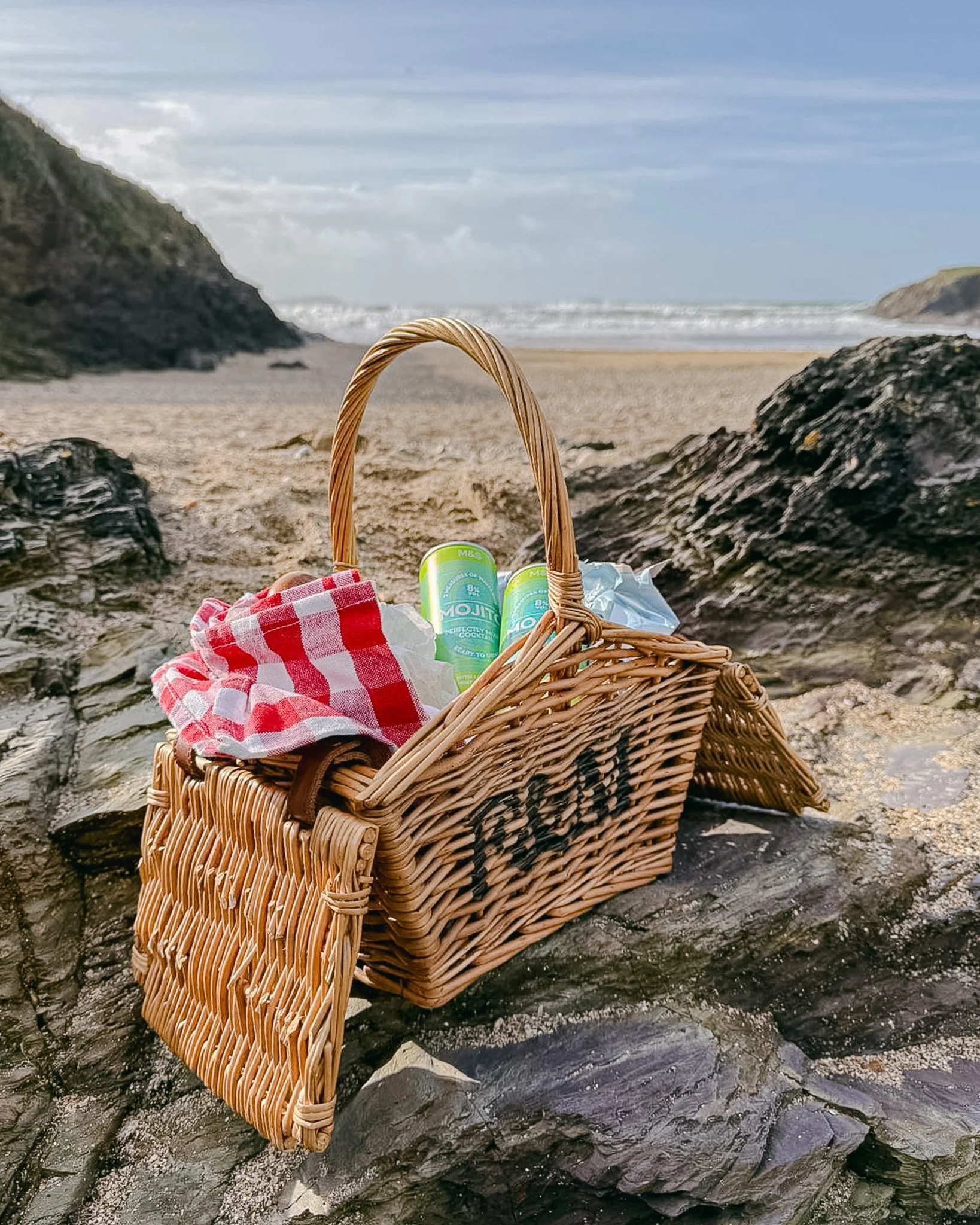
No picnic hamper is complete without a Scotch egg. Its perfectly layered textures — crisp breadcrumbs, juicy sausage, and creamy egg — make it a delight whether eaten warm or cold. Personally, I can’t imagine a countryside picnic without one. Just add a blanket, a flask of tea, and some fresh air, and you’ve got yourself a quintessentially British afternoon.
Fortnum & Mason’s Scotch eggs remain the gold standard, nestled alongside fine cheeses, chutneys, and smoked salmon in their iconic hampers. Modern picnickers, however, are getting creative. Scotch egg sliders? Mini versions for cocktail parties? Even sweet Scotch eggs for Easter? The possibilities are endless.
Fun Facts About the Scotch Egg
World Records: In 2017, a UK butcher created a 7kg Scotch egg featuring an ostrich egg - because why not?
Pop Culture: The Scotch egg has graced The Great British Bake Off and appeared on menus from Edwardian picnics to Michelin-starred restaurants.
Modern Twists: From truffle-infused sausage meat to panko breadcrumbs for extra crunch, chefs are taking the Scotch egg to new heights.
An Easter Twist: Fortnum & Mason even offer a confectionery version - a simnel praline Scotch egg with orange ganache!
The Recipe: Sage, Apple & Somerset Pork Scotch Eggs
Makes 6. Takes about an hour and a half including chilling time, half of which is not really active. Worth every second.
For the sausage layer:
500g good pork sausage meat (ask your butcher, or use high-meat-content sausages and remove the casings — at least 80% pork)
1 small eating apple, peeled and very finely grated (squeeze out any excess juice after grating)
1 tablespoon fresh sage leaves, very finely chopped
1 teaspoon English mustard
Salt and black pepper
For the eggs and coating:
6 medium free-range eggs, plus 2 more for the egg wash
80g plain flour, lightly seasoned
150g panko breadcrumbs (or good fresh white breadcrumbs — panko gives a crisper, lighter result)
Vegetable or sunflower oil for frying
Method:
Bring a pan of water to a rolling boil. Lower 6 eggs gently into the water and cook for exactly 6 minutes. Transfer immediately to a bowl of iced water and leave for at least 5 minutes. Peel carefully — they are soft inside and need gentle handling.
Mix the sausage meat with the grated apple, sage, mustard, salt, and pepper. Fry a small piece to test the seasoning (the only reliable way, this — eating raw sausage meat to test it is not recommended, and I speak from experience). Adjust accordingly.
Divide the sausage mixture into six equal portions. Working on a piece of floured cling film or damp hands, flatten each portion into an oval large enough to wrap around an egg. Place the peeled egg at the centre, bring the meat up around it, and press firmly and evenly until fully enclosed with no gaps. Smooth the surface.
Set up three shallow bowls: seasoned flour, beaten egg wash, breadcrumbs. Roll each Scotch egg first in flour (shake off the excess), then egg wash, then breadcrumbs, pressing gently so the crumb adheres. Refrigerate for at least 45 minutes, and up to overnight — the chill firms everything up and the crumb sets.
To cook: heat oil to 170°C in a deep pan (or use a deep-fryer if you have one). Fry in batches for 7–8 minutes, turning gently, until deep golden brown all over. If you'd prefer to bake: brush with a little oil and bake at 200°C for 25–30 minutes. The frying gives a better crust, but the baked version is excellent and significantly less dramatic.
Rest on kitchen paper for 2 minutes before serving.
Eat warm if possible, with a small pot of good chutney — apple, naturally — and cold butter, if you're at a picnic. If you're at home, brown sauce is also correct and I will not be persuaded otherwise.
Where the Scotch Egg Lives Now
The Scotch egg in 2026 is in a good place. The gastropub renaissance never really ended — the artisan version is permanent on menus and at markets, and the domestic Scotch egg is, thanks to a generation of cooks who grew up watching food television and shopping at farmers' markets, better than it has been for fifty years.
The black pudding Scotch egg has become a classic in its own right. The venison version appears reliably at autumn food festivals. The quail egg Scotch egg, served as a canapé at weddings and parties, has been around long enough to feel traditional rather than fancy. There are vegetarian versions using spiced lentil and walnut, which shouldn't work as well as they do.
Fortnum & Mason still sell theirs, in the shop and in their hampers. They are still very good. The original carriage-ride snack has, like the best inventions, outlasted the carriage.
What Three Hundred Years Means
Here is the thing about the Scotch egg that I keep coming back to.
We don't know who invented it. The records are either lost or never existed. The Fortnum's story is tradition; the Whitby story is local legend; the Indian influence is scholarly speculation based on structural similarity rather than documented transmission. The "Scotch" in the name is almost certainly not Scottish. The first recipe that survives in print appeared sixty years after the supposed date of invention, and it didn't even have breadcrumbs.
And yet.

The Scotch egg is there. It has been there — on the hamper shelf, in the picnic basket, in the school lunchbox, at the farmers' market, at the pub, in the petrol station, on the government minister's parliamentary record — for as long as anyone can trace it. It has survived wars and rationing and industrial food production and a constitutional crisis about whether it constitutes a meal. It has been elevated and debased and elevated again.
It endures because it is, at its best, a perfect thing. The crunch. The yielding meat. The egg — warm, soft, golden at the centre. The pleasure of eating something that requires no plate, no cutlery, no preparation, no table. Just hands, and hunger, and somewhere to sit.
Which is what a picnic always was.
With love (and a jammy yolk), Gemma xx
Photos: Found via Pinterest
Where to Go Deeper
Alan Davidson, The Oxford Companion to Food — the authoritative source on the Scotch egg's origins, including the nargisi kofta connection. First published 1999; third edition 2014.
Maria Rundell, A New System of Domestic Cookery — the book containing the first printed recipe. Available free on Project Gutenberg.
Oxford Reference: "Scotch egg" — short but authoritative. Includes the full 1809 Rundell recipe quote.
Hettie Hen (hettiehen.co.uk) — the artisan Scotch egg company whose forensic research into the Fortnum's origin story is the best readily available critical account.
Fortnum & Mason (fortnumandmason.com) — their own account of the 1738 origin. Beautifully told, and available in their food halls.
Isabella Beeton, Book of Household Management (1861) — free on Project Gutenberg. The Victorian Scotch egg recipe is in there, and the surrounding picnic and supper context is wonderful.
The Guardian: "The Triumph of the Scotch Egg" — excellent cultural history piece on the gastropub revival.
Sources:
Davidson, A. (1999/2014). The Oxford Companion to Food. Oxford University Press. (Scotch egg entry; nargisi kofta lineage)
Oxford Reference. "Scotch egg." oxfordreference.com. (First Rundell recipe in full)
Rundell, M.E. (1809). A New System of Domestic Cookery, 4th edition. John Murray. (First printed recipe)
Beeton, I. (1861). Book of Household Management. S.O. Beeton Publishing.
Dods, M. (1826). The Cook and Housewife's Manual. Edinburgh.
Kitchen Arts & Letters. "A New System of Domestic Cookery." kitchenartsandletters.com. (Publishing history and Scotch egg attribution)
Hettie Hen. "The Great Debate: Unravelling the Enigmatic Origins of the Scotch Egg." hettiehen.co.uk.
Rumwell Farm Shop. "The Surprising History of the Scotch Egg." rumwellfarmshop.com. (Naming theories)
Tasting Table. "The Mysterious Origins of Scotch Eggs." tastingtable.com.
Express & Star. "Government left with Scotch egg on its face over 'substantial meal' confusion." 1 December 2020.
Bloomberg. "Scotch Eggs Are UK's Hottest Snack." December 2020. (COVID tier rules context)
Guy Walters. "The Triumph of the Scotch Egg." Substack.
Wikipedia. "Scotch egg"; "Maria Rundell"; "A New System of Domestic Cookery"; "Nargisi kebab."
You may also like . . .