The Joy of Talking to Strangers
What my four year old knows about human connection that the rest of us have somehow forgotten.
Part of The Joy Edit - a series exploring the psychology and practice of joyful living.
My youngest will make you wait.
Not out of rudeness. Out of necessity. Because if we pass anyone, anyone at all, on a public footpath, in a farm shop, at a village fête, in a car park, at a school gate, in a queue for literally anything, he needs to say hello. And not a polite, performative, let's-keep-walking hello. A proper one. An interested one. The kind that comes with follow-up questions.
He is four years old.
I have watched him walk up to a man sitting alone on a bench with the expression of someone carrying the full weight of a difficult Tuesday, and ask him, with complete sincerity, what he was looking at. The man blinked. Looked at this small person who had appeared from nowhere with an entirely genuine question. And then, slowly, unmistakably, something in him rearranged.
His shoulders dropped. His face changed. He pointed at something in the middle distance, a bird, a tractor, I couldn’t hear and he and my son discussed it with the seriousness it apparently deserved. For four minutes. In May sunshine. Two people who will almost certainly never meet again, connected entirely and completely by a small boy who saw a person and simply could not think of a reason not to talk to him.
I stood a little way back and watched, as I always do in these moments, with something I can only describe as reverent jealousy.
Because my son is doing something the rest of us used to know how to do. Something we were all born knowing. Something that got quietly trained out of us over years of learning that strangers are to be navigated rather than met, managed rather than spoken to, passed rather than stopped for.
He hasn't learned that yet. And the world, in his presence, is noticeably softer for it.
The Four Year Old and the Frowning Stranger
He is simply there. With them. And that quality of attention — full, genuine, unperformed — is, it turns out, one of the rarest things one human being can offer another.
The shock before the softening
The thing I find most moving about watching him in these moments is not the warmth that follows. It's the split second before it. The flicker of surprise on the stranger's face. That involuntary blink — wait, is this for me? — before they decide, somewhere below conscious thought, to allow it.
Because we have built a world in which a stranger's genuine, unhurried interest in us feels surprising. We have learned to expect to be invisible in public spaces. To navigate the supermarket, the footpath, the waiting room, the queue — managed, efficient, separate. And so when a small person breaks that contract entirely and simply wants to know what you're looking at — the shock is real. And it is, I think, quietly heartbreaking.
We haven't forgotten how to receive warmth. We've just stopped expecting it.
His gift — his entirely unconscious, entirely genuine gift — is that he keeps expecting it. For him, every person is a potential conversation. Every stranger is someone whose story he hasn't heard yet. The idea that you might pass a human being without acknowledging their existence is, to him, simply bizarre.
He is, in this sense, operating exactly as the research says we are designed to operate. He just hasn't been told otherwise yet.
“We haven’t forgotten how to receive warmth. We’ve just stopped expecting it. Theo hasn’t got that memo yet — and the world is measurably softer for it.”
Right. Let's get the science involved. Because it is, as always, more interesting than you'd expect.
The commuter study — we predicted wrong
In 2014, psychologists Nicholas Epley and Juliana Schroeder at the University of Chicago ran a series of studies that have since become some of the most cited in social psychology. They asked commuters on trains and buses to do one of three things: strike up a conversation with the stranger next to them, sit in solitude, or do whatever they'd normally do.
Before the experiment, participants predicted — confidently — that talking to a stranger would be awkward, uncomfortable, and less pleasant than sitting quietly. They expected to be bothering someone. They expected it to feel like a social imposition.
They were wrong. Every group, across every study, across multiple forms of transport and multiple cities, reported that the conversation condition produced the most positive experience. People who talked to strangers reported higher wellbeing, more positive mood, and greater sense of connection than those who sat in silence.
And the strangers? Also happier. Also more positive. Also more connected. No one was bothered. No one felt imposed upon. Both people left the interaction better than they'd arrived.
We have been systematically, reliably, and completely incorrectly predicting the social risk of talking to strangers. The awkwardness we dread is largely a fiction our anxious brains have constructed to keep us safe from something that was never actually dangerous.
His brain hasn't built that fiction yet. Which is why he just walks up to the man on the bench.
Susan Pinker and the village effect
Canadian psychologist Susan Pinker spent years researching what she calls the village effect — the measurable, physiological impact of face-to-face human contact on health and longevity. Her findings, published in 2014, were striking enough to change how I think about the farm shop queue.
Face-to-face contact — including casual, brief micro-conversations with what sociologists call weak ties, the acquaintances, the regulars, the familiar strangers — is one of the strongest predictors of longevity and wellbeing we have found. More powerful than diet. More powerful than exercise. More powerful than giving up smoking.
Not deep, intimate, vulnerable conversations. Just contact. The woman you always see at the farm shop counter on a Friday. The man who walks his dog on your route every Tuesday morning. The neighbour you exchange a genuine few words with over the gate. These people are not peripheral to your wellbeing. They are, the research suggests, central to it. We have been dramatically, dangerously undervaluing the casual chat.
Somerset, it turns out, has been ahead of the science for centuries.
Mark Granovetter and the strength of weak ties
Sociologist Mark Granovetter's landmark 1973 paper — still one of the most cited in all of social science — introduced the concept of weak ties: the loose connections, the acquaintances, the people we know slightly rather than deeply. And his finding was counterintuitive enough that it's worth stating clearly:
Our weak ties contribute more to our sense of community, belonging, and even practical opportunity than our close relationships do. Not because they're more important emotionally, but because they connect us to a wider world. They are the threads that weave a community together. Without them, even close friendships begin to feel isolated.
This is why the Somerset village effect is real and measurable rather than merely nostalgic. The fête where you chat to someone you half-know and discover you both know the same family from three villages over. The footpath where you stop for five minutes with a farmer who turns out to have known your grandmother. The school gate conversation that turns into a friendship that turns into a supper club that turns into something neither of you could have predicted.
These are not small incidental pleasures. They are the connective tissue of a meaningful life. And they all begin with the willingness to stop. To speak. To be, for a moment, interested in the person in front of you.
There's a name, too, for what actually happens in your body during even the briefest of these exchanges. Psychologist Barbara Fredrickson calls it positivity resonance — the measurable, physiological syncing-up that happens between two people sharing even a fleeting moment of genuine warmth. It doesn't require history. It doesn't require depth. It requires two nervous systems, briefly, actually meeting. Which means the man on the bench and my son weren't just having a nice moment. For four minutes, their bodies were doing something real together.
The casual chat isn't small talk. It's the connective tissue of a meaningful life — and the science has the receipts.
The shared connection — when lives turn out to be orbiting each other
There's something specific to Somerset — to any community small enough and rooted enough — that I want to name, because I think it's one of the purest joy hits available in a place like this.
You start talking to a stranger on a footpath. Three minutes in, you discover you know the same person. Or the same farm. Or the same village hall from twenty years apart. Your lives have been quietly orbiting each other through people and places you both love, and you had absolutely no idea.
Psychologists call this a shared identity moment — the discovery of unexpected common ground with a stranger, which triggers an immediate, measurable increase in trust, warmth, and sense of connection. It is one of the fastest routes to genuine human contact available to us. Faster than a long conversation. Faster than gradual familiarity. The ah, you know them too produces something almost alchemical — the stranger is suddenly not quite a stranger, and the world is suddenly a little smaller and more coherent than it was five minutes ago.
I live for these moments. The conversation that reveals the invisible thread. The person you've passed on the footpath for two years who turns out to be connected to your life in ways neither of you knew. This is not coincidence. This is what a community is — a web of overlapping stories, visible only when you stop long enough to compare notes.
My son stops long enough. He always does. Which is probably why he finds the threads faster than any of us.
The Particularly British Problem
I want to acknowledge the elephant in the village hall, which is that we are British, and talking to strangers is not, traditionally, what we do.
We are a nation that will discuss the weather with extraordinary thoroughness and genuine emotional investment while carefully avoiding anything that could be construed as personal. We have elevated the art of the polite non-conversation to something approaching high culture. We will queue beside someone for twenty minutes, establish an entire temporary social relationship based on shared mild outrage about the queue, and then part ways without ever exchanging names.
And yet. Give us a village fête and the right conditions and we are, all of us, entirely different. The tombola produces conversations. The cake stall creates community. The slightly warm Pimm's removes approximately forty percent of the social calculation that normally runs in the background and suddenly everyone is talking to everyone and nobody is quite sure how it happened but it feels, unmistakably, like the world as it's supposed to be.
The conditions matter. May in Somerset, with blossom on every lane and the first outdoor events of the year and the particular quality of warmth that arrives in the second week and makes you feel like the whole county has exhaled — these are the conditions. The season does half the work for you. You just have to show up and take your cue from the four year old.
What we're actually afraid of
Epley and Schroeder's research gives us the precise answer. We're afraid of awkwardness. Of being thought odd. Of imposing. Of the social risk of initiating contact with someone who hasn't asked for it.
And that fear, while entirely understandable, is also entirely unfounded. The research is unambiguous: people want to be talked to far more than they want to be left alone. They enjoy the conversation far more than they predicted they would. They are not bothered. They are, almost without exception, glad.
We have built an enormous cultural architecture of mutual avoidance around a social risk that doesn't actually exist. And in doing so, we have made ourselves lonelier, more disconnected, and measurably less well than we need to be.
The solution is embarrassingly simple. It is, in fact, currently being demonstrated by a four year old in wellies on a public footpath in Somerset.
May in Somerset — The Season That Does It For You
May is the easiest month in the year to talk to strangers, and I don't think this is an accident.
The blossom is doing something completely unreasonable on every lane — great drifts of white and pink that make you stop mid-walk and look up, which means you are already paused, already present, already predisposed to notice the other person who has also stopped to look up. Eye contact happens. A comment is made about how ridiculous it all is, in the best possible way. A conversation begins.
The village fêtes start in May. The school fairs. The first outdoor events of the year where you see people you haven't seen since October and there is a genuine warmth of recognition — oh, you made it through the winter, me too, isn't this extraordinary — and conversations that would take weeks to arrive at in any other context happen in twenty minutes over a paper cup of something warm.
The footpaths fill up with people who look, for the first time since March, like they're walking because they want to rather than because they need the air. People make eye contact on footpaths in May in a way they simply don't in February. The season removes the last excuse. There is no weather to hide behind, no reason to keep your head down, no justification for the mutual invisibility we've maintained since November.
May says: you are allowed to stop. You are allowed to speak. You are allowed to be, briefly and beautifully, in community with the person coming the other way.
My youngest knows this. He operates in permanent May, regardless of the actual weather. The rest of us get one month a year where the conditions are right and the excuse to stop is available on every lane.
I'd rather we didn't waste it.
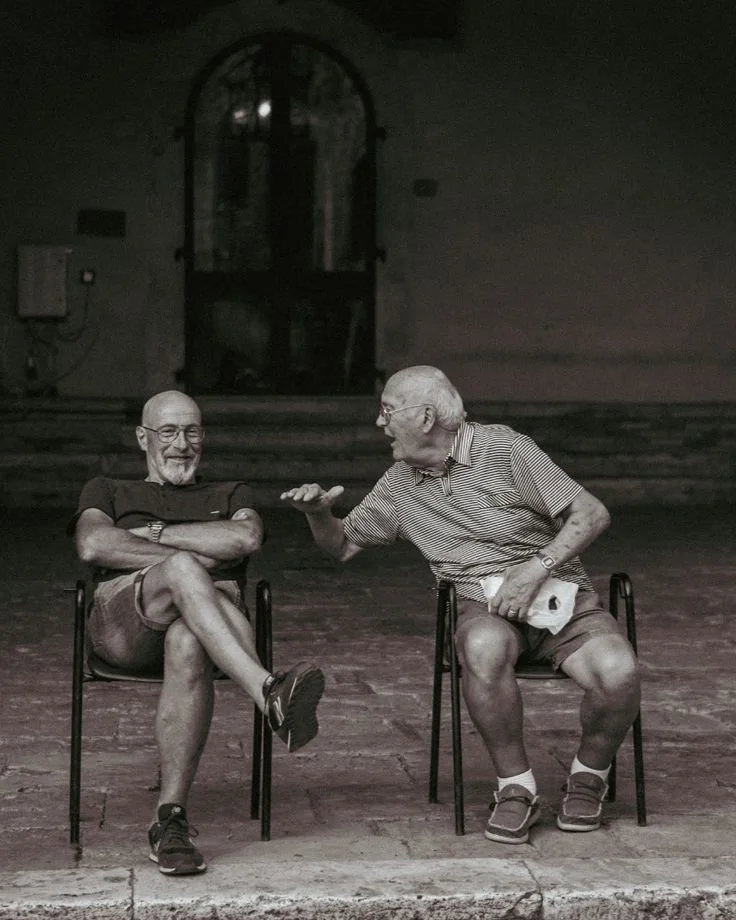
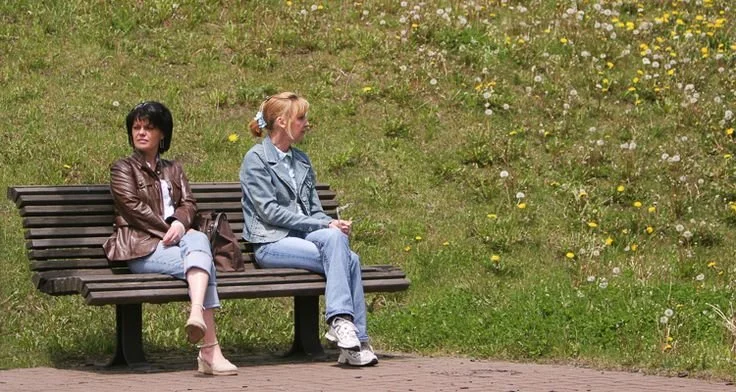

A Small Experiment
Your May Experiment — Three Options
This one asks you to do the thing Theo does naturally and the rest of us find inexplicably terrifying. Talk to a stranger. On purpose. Here's how, in three versions — pick the one that feels both possible and slightly uncomfortable.
Option A — The Daily Hello. One genuine conversation with a stranger or near-stranger every day for a week. Not a transaction. Not a polite acknowledgement. A real exchange — even two minutes. The farm shop counter. The footpath. The school gate. Notice what it does to the quality of the day.
Option B — The Fête Test. Go to one outdoor event this month — a fête, a fair, a farmers market, a village gathering — with the single intention of having one proper conversation with someone you don't know. Stay long enough to find the thread. The shared connection, the overlapping story, the unexpected orbit. They're always there. You just have to stop long enough to find them.
Option C — The Theo Method. For one week, operate on Theo's principle: see a person, be interested, ask something real. Not the weather. Not a pleasantry. Something genuine — what are you looking at, what are you making, where are you going. Notice the split second before they soften. Notice what happens to you when they do.
Any of these will produce the same result, which the research has confirmed in study after study: you will feel better than you expected. So will they. And somewhere in the chain of interactions that follows, someone will have a better day without ever knowing you were the reason.
What My Four-Year-Old Knows
I've been thinking about what I actually want to teach my children about joy. What the distilled version would be, if I had to get it to the essentials.
And I keep coming back to the fact that one of them is already teaching me.
He knows, without knowing that he knows, without having read a single research paper, without any of the elaborate psychological scaffolding I've built around the concept, that people are the point. Not what they achieve or what they own or how efficiently they move through the world. Just people. Their stories, their days, their small enthusiasms, the thing they're looking at from the bench on a Tuesday afternoon.
He knows that a stranger is only a stranger until you say hello. That the gap between two people in a public space is not a wall, it's just an unopened door. And that on the other side of it, almost every single time, is someone who is glad you knocked.
He will grow up, eventually. He will learn, as we all learn, some version of the social calculus that keeps us in our lanes and our headphones in and our eyes down on the pavement. I can't fully prevent that. The world will teach him what the world teaches everyone.
But I can keep taking him to the fêtes. I can keep walking the footpaths slowly enough to stop. I can keep watching his face when the frowning stranger softens, and remembering what that means, and trying, imperfectly and self-consciously and with considerably more internal deliberation than he requires, to do the same.
The joy is on the other side of hello. It always was.
Get to a fête this month. Walk the footpath slowly.
Ask someone what they're looking at.
Let him lead the way, or at least, let his spirit.
With love, Gemma x
PS: If Theo stops you on a footpath this May — you're welcome. Find me on Instagram and tell me what he asked you.🧺
This piece is part of The Joy Edit — a series exploring the psychology and practice of joyful living.
Read the full series: Joy Is Not a Destination (January) · You Are Not Your Thoughts (February) · Joy Lives in Ritual, Not Routine (March) · The Smile Ripple Effect (April) · The Joy of Talking to Strangers (May) · Joy in Gathering & Connection (June)
Research & Further Reading
Epley, N. & Schroeder, J. (2014). Mistakenly seeking solitude. Journal of Experimental Psychology: General, 143(5), 1980–1999.
Pinker, S. (2014). The Village Effect: Why Face-to-Face Contact Matters. Atlantic Books.
Granovetter, M. S. (1973). The Strength of Weak Ties. American Journal of Sociology, 78(6), 1360–1380.
Killingsworth, M. A. & Gilbert, D. T. (2010). A Wandering Mind Is an Unhappy Mind. Science, 330(6006), 932.
Tajfel, H. & Turner, J. C. (1979). An integrative theory of intergroup conflict. [On social identity and shared identity moments.] In W. G. Austin & S. Worchel (Eds.), The Social Psychology of Intergroup Relations. Brooks/Cole.
Parker, P. (2018). The Art of Gathering: How We Meet and Why It Matters. Riverhead Books.
Fredrickson, B. L. (2013). Love 2.0: Finding Happiness and Health in Moments of Connection. Hudson Street Press. [On positivity resonance and its physiological effects.]
Stay a while . . .
Come and be nosey …
The blanket is always out over on Instagram. Behind the scenes Picnicscapes, Somerset life as it actually happens, and the occasional opinion about gingham.