Joy in Gathering & Connection
Part of The Joy Edit — a series exploring the psychology and practice of joyful living.
On presence over performance, the gatherings we remember, and why the food is almost never the point.
On presence over performance, the gatherings we remember, and why the food is almost never the point.
My daughter's birthday party had a guest list of roughly forty children, zero decorations, and absolutely no clearing up.
This was not a failure of planning. It was the plan.
When my three were small, I discovered something that has quietly shaped everything I've done around gathering since: the best parties happen when you stop hosting them. We rocked up to the local park with a cake, a handful of party bags, and a picnic for just our three. Everyone else brought their own. The children ran and climbed and did what children do in parks in June when the grass is warm and nobody is telling them to stay clean. We sang happy birthday around a picnic cloth on the ground. We ate cake in the sunshine. And then we went home.
To a tidy house.
I want to let that land for a moment. Twenty children. A birthday. A tidy house.
But here is the part I remember most. I wasn't managing the event from the outside, monitoring the catering and watching the clock and mentally running through the list of things still to do. I was in it. Sitting on the grass with the other parents, laughing, present, genuinely part of the afternoon rather than responsible for it. My daughter's birthday is one of my favourite memories — not despite its simplicity, but entirely because of it.
That afternoon taught me something I've never unlearned: the gathering that gives everyone the most joy is almost never the one that cost the most effort. It's the one where the host put down the performance and picked up a paper plate and sat down.
Presence Over Performance — The Manifesto
We have, somewhere along the way, confused hosting with performing. We've made gathering into a production — a thing to be staged and executed and reviewed afterwards for quality. The table has to be right. The food has to be impressive. The house has to be clean to a standard it wouldn't meet on any other day of the year. And somewhere in the middle of all that preparation, the actual reason everyone came — the being together — gets quietly squeezed out.
I have attended dinners where the food was extraordinary and left feeling vaguely hollow. I have sat on picnic blankets with mismatched mugs and slightly warm rosé and supermarket sausage rolls and felt, unmistakably, like I was exactly where I was supposed to be.
The difference was never the food. The difference was whether the person who brought us together was actually there with us.
Brené Brown, whose work on vulnerability and belonging has shaped how I think about almost everything, draws a distinction I find quietly devastating in its accuracy: fitting in requires performance. Belonging requires presence. When we over-host — when we disappear into the kitchen and the logistics and the relentless management of an event — we are, paradoxically, making it harder for the people we love to feel they truly belong. Because belonging needs the host to be a participant, not a stage manager.
The cloth on the grass. The basket open. The flask poured. And then: sit down. Be there. That's the whole instruction.
“The gathering that gives everyone the most joy is almost never the one that cost the most effort. It's the one where the host sat down.”
The Blue Mat, the BBQ, and the Food That Was Only Okay
I need to tell you about a BBQ I attended as a child, because it has become, in my memory, the gold standard of everything I believe about gathering.
I have no idea whose garden it was. I don't know who hosted it, or how many people were there, or what county we were in. From what I can recall, the food was fine. Perfectly adequate. Unremarkable.
What I remember — with the kind of vivid, full-body clarity that very few memories carry — is the feeling. The garden absolutely full of people in good spirits. The ease of it. The laughter that seemed to come from everywhere at once. The particular quality of a British summer afternoon when it actually delivers on its promise and the air is warm enough to stay outside without a cardigan for once.
And then someone produced a blue mat. A giant sheet of blue plastic — a paddling pool liner, possibly, or something equally unglamorous — and it was laid out on the grass, and the garden hose appeared, and every child present spent the next several hours sliding across it in their underwear, shrieking with a joy so pure it had no edges to it at all.
I think about that afternoon often. Not because it was objectively remarkable. Because it was the opposite of remarkable and still managed to become one of the warmest memories of my childhood. Nobody planned the blue mat. Nobody planned the spontaneous joy. It arrived because the conditions were right: people who wanted to be together, a garden, a warm day, and a host who had stopped managing the afternoon and just let it become whatever it wanted to be.
Why the food being only okay is the most important detail
This is the part I want to press on, because it matters more than it might appear.
We remember almost nothing about what we ate at the gatherings that meant the most to us. We remember everything about how we felt. The warmth of the room. The particular sound of that group of people laughing together. The moment where something unexpected happened and everyone was briefly, perfectly aligned in their delight.
Robin Dunbar, the Oxford anthropologist whose work on human social bonding is some of the most important in the field, has found that shared meals are among the most powerful social bonding mechanisms available to humans. Not, on its own, the quality of the food. The act of eating together, at the same time, from the same spread — and, crucially, everything that happens around the eating. His research into what actually produces felt closeness at a shared meal points to laughter and storytelling as the real mechanism, with the food supplying the occasion rather than the effect itself. Eating together is not a social nicety. It's the excuse the endorphin system needed to get properly involved. (More on exactly which ingredients do the work, and which don't, in January's piece.)
This is why a picnic tastes better than lunch at your desk. Not because the food is better — it's usually considerably less convenient and at least slightly too warm. But because the laughing and the reminiscing that happen over it are doing something your solitary desk lunch simply has no opportunity to do.
This is also why the gatherings we remember are almost always ones involving food. Not because the food was remarkable, but because the shared table created the conditions for everything else to happen — and everything else is what made it vivid, warm, memorable. The food is the occasion. The connection is the point.
John Cacioppo and the hunger that isn't about food
The late John Cacioppo at the University of Chicago spent his career studying loneliness — not as a social failing or a personality trait but as a biological signal. His central insight, built over decades of research, was that loneliness isn't just an unpleasant feeling but an evolutionary alarm system: our bodies registering, correctly, that something essential to survival is missing. Separately, meta-analytic work by Julianne Holt-Lunstad and colleagues, synthesising 148 studies and over 300,000 participants, found that the health risk of lacking social connection is comparable to smoking up to fifteen cigarettes a day. It raises cortisol. It disrupts sleep. It suppresses immune function. It is the body telling you, with increasing insistence, that something essential is missing.
And what's missing is not company in the abstract. It is genuine connection. Shared presence. The experience of being in a room — or a garden, or a park, or a sandbank — with people who are also fully there.
The antidote to loneliness, this body of research makes clear, is not grand social performance. It is small, repeated, genuine gathering. A picnic. A supper. Bread and butter on a cloth on the grass with people you love, on an ordinary Tuesday in June when the light lasts long enough to stay outside until the children's bedtimes become notional rather than actual.
We don't need more events. We need more presence at the ones we already have.
Priya Parker on what makes a gathering matter
Priya Parker's The Art of Gathering is the book I recommend to everyone who has ever felt that the gathering they hosted didn't quite deliver what they hoped — and couldn't identify why.
Her central argument is one of the most useful things I've read about this subject: most gatherings fail not because of logistics, but because of a lack of intentional purpose. We gather out of habit, out of obligation, out of the calendar telling us it's time. We ask what but not why. And gatherings that lack a clear why tend to default to form over feeling — technically a dinner party, emotionally just a room of people being politely managed.
The gatherings that people remember for years are the ones where someone decided what they were actually for. Not the menu. The meaning. The birthday in the park worked not because it was convenient, but because it had a clear and simple purpose: to celebrate a child, together, outside, without fuss. Everything else fell away. What remained was the thing.
Sedikides and the memory that gathering creates
Constantine Sedikides at the University of Southampton has spent years researching nostalgia — not as sentimental indulgence, but as a psychological resource with a measurable function. His work has found that shared memories are among the most powerful sources of meaning and social identity we have, in part because nostalgia fosters what he calls self-continuity: the felt sense that your life has a thread running through it, connecting who you were to who you are now.
The memories we return to most readily, the ones that feel warmest and most defining, are almost always memories of being gathered with people we love.
Not the achievements. Not the solo moments. The afternoons. The tables. The blue mat summers. The birthday cakes eaten on the grass. These are the memories that tell us who we are and where we belong and what our lives have been for.
Which means that every gathering you host, however simple, however imperfect, however last-minute and underprepared — is an act of memory creation. You are not just having people round. You are building the archive that you and the people you love will return to for the rest of your lives.
“Every gathering, however simple, is an act of memory creation. You are building the archive your family will return to for the rest of their lives.”
The Permission Slip You've Been Waiting For
I want to say something plainly, because I think it needs saying and I think most of us need to hear it more than once.
You do not need a clean house to gather people.
You do not need a complicated menu.
You do not need to have it all sorted before anyone arrives.
You do not need to be ready.
The perfect gathering is not the one that was perfectly prepared. It's the one where everyone felt genuinely welcome. Where the host was actually present. Where something unexpected happened and nobody minded. Where the children slid across a blue mat in their underwear and everyone was briefly, perfectly, entirely alive.
The cloth on the grass is enough. The flask of something warm is enough. The invitation itself — the act of saying I want you there, let's be together — is enough, and more than enough, and possibly the whole point.
The hostess who disappeared into the kitchen
There is a version of hosting that I think many of us were raised on — the kind where the person who called the gathering spends most of it in the kitchen, reappearing periodically to check that everyone has what they need, managing the edges of the event while everyone else is inside it.
I understand this impulse completely. I have been this person. There is real love in it — the desire to feed people well, to make the table beautiful, to ensure that everyone is comfortable and nothing runs out. These are not small things.
But the kitchen is also, sometimes, a hiding place. A way of caring for people that doesn't require the more vulnerable thing: sitting down with them. Being seen. Being part of the afternoon rather than responsible for it.
The gatherings I remember most warmly — the ones I carry with me, the ones that shaped what I believe about connection — are the ones where nobody disappeared. Where everyone, including the person who called us together, was simply there. Present. Laughing. On the grass. Eating something unremarkable and feeling, somehow, like the luckiest people alive.
June in Somerset, The Month That Gathers You
June in Somerset is the month that does half the work for you.
The light lasts until nine o'clock, and then a little beyond that, and then a little beyond that, and every evening there is a window — between the end of the day and the actual dark — where the garden is golden and the air is warm and the only sensible response is to carry something outside and stay there.
The lanes are doing something extraordinary with the hedgerows. The elderflower is out, briefly and generously, smelling like every good summer you've ever had compressed into a single scent. The fields are that particular shade of green that only happens in June, before the heat of July presses the colour out of everything.
Everything about June says: go outside. Bring people. Stay longer than you planned.
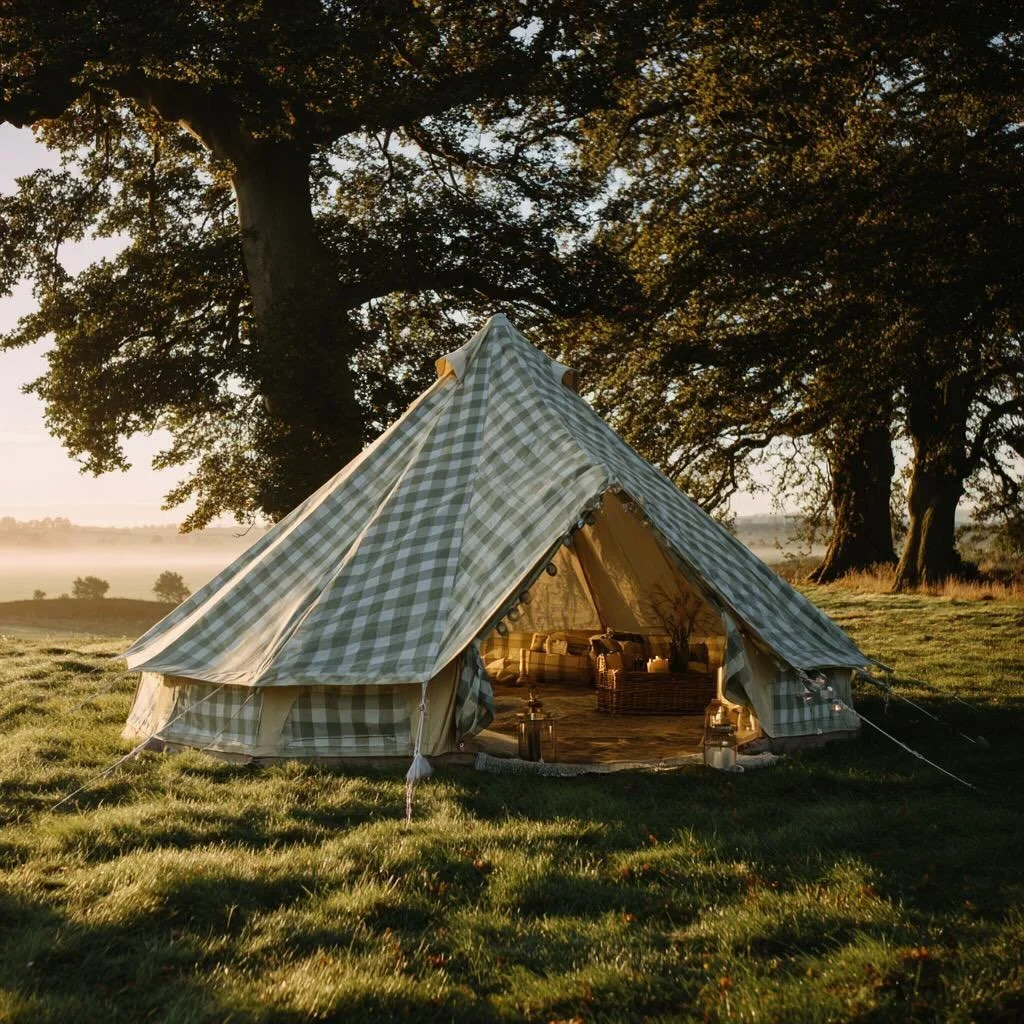
The enamel mug on the grass. The gingham cloth that has been in the cupboard since October and comes back out like an old friend. The picnic basket that smells faintly of last summer's adventures and is about to start accumulating the stories of this one. The village fête in the third week of the month where everyone arrives slightly formally and leaves slightly sunburned and considerably happier than they expected.
This is the month that invented the picnic. Not literally — that honour goes to the French, and we have happily claimed it as our own ever since — but spiritually. June is what picnics were made for. And picnics, I have come to believe with the confidence of someone who has thought about this for considerably longer than is strictly necessary, are what joy was made for.
Your June Experiment — Set the Date
This month's experiment is the simplest in the series. And the most important.
Set a date. This week. Before you've finished reading this.
Not a dinner party. Not an event. A gathering. One cloth on the grass, or a table in the garden, or a blanket in the park. Bread and butter. Something cold to drink. One good story each — something that happened recently that made you laugh, or think, or feel like the world was wider than your usual Tuesday.
Invite the people who make you feel most like yourself. Or the people you've been meaning to see since approximately last October. Or both, which in Somerset is usually the same group.
Do not deep clean. Do not spend three days on the menu. Do not wait until you feel ready, because the research — and four decades of my own direct experience — confirms that ready is not a prerequisite for a memorable afternoon. Present is. And present, as it turns out, is entirely within your reach.
The cloth goes down. The basket opens. The flask is poured.
Sit down. Be there. That's the whole instruction.
Mudeford, and the Memory We Hadn't Made Yet
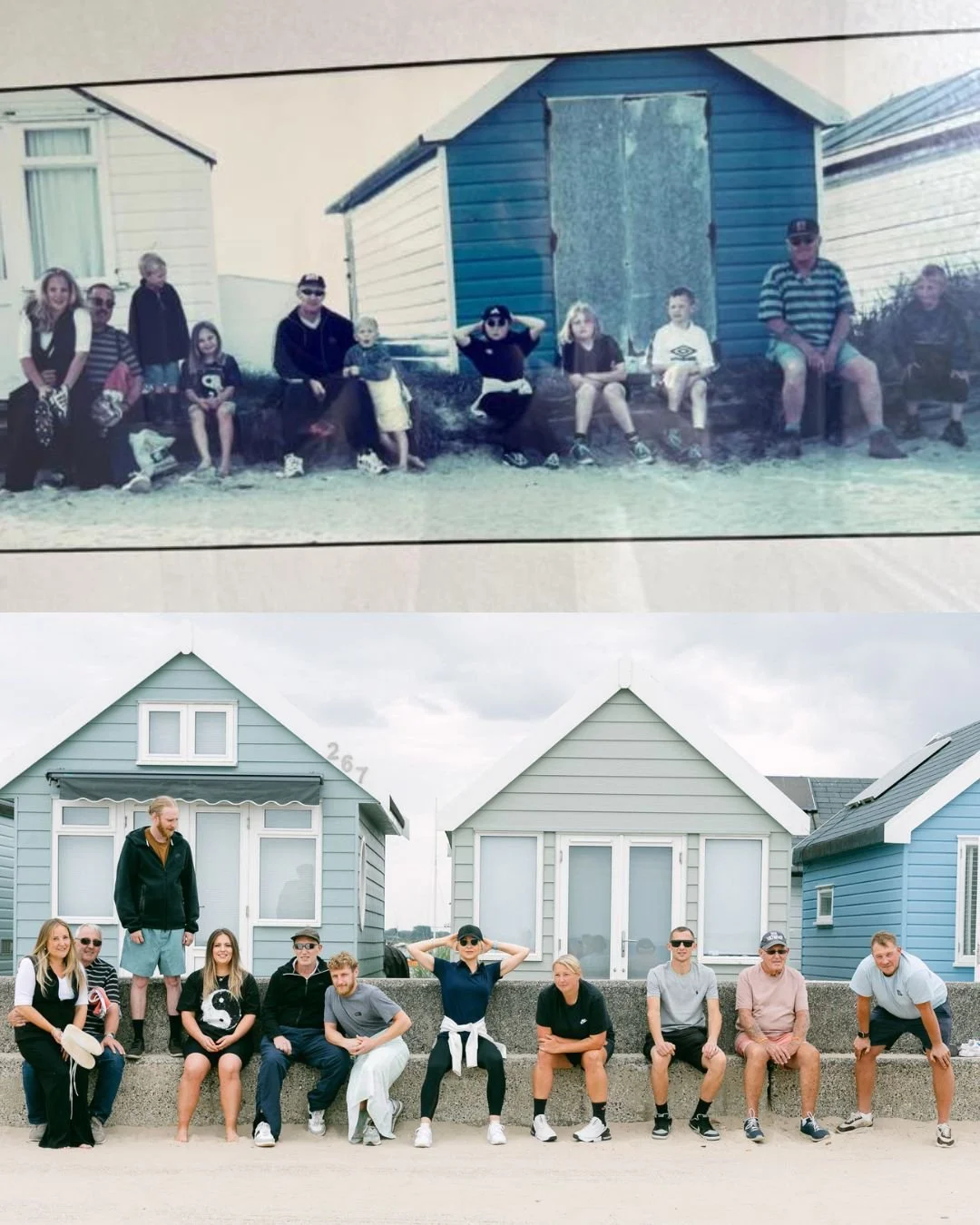
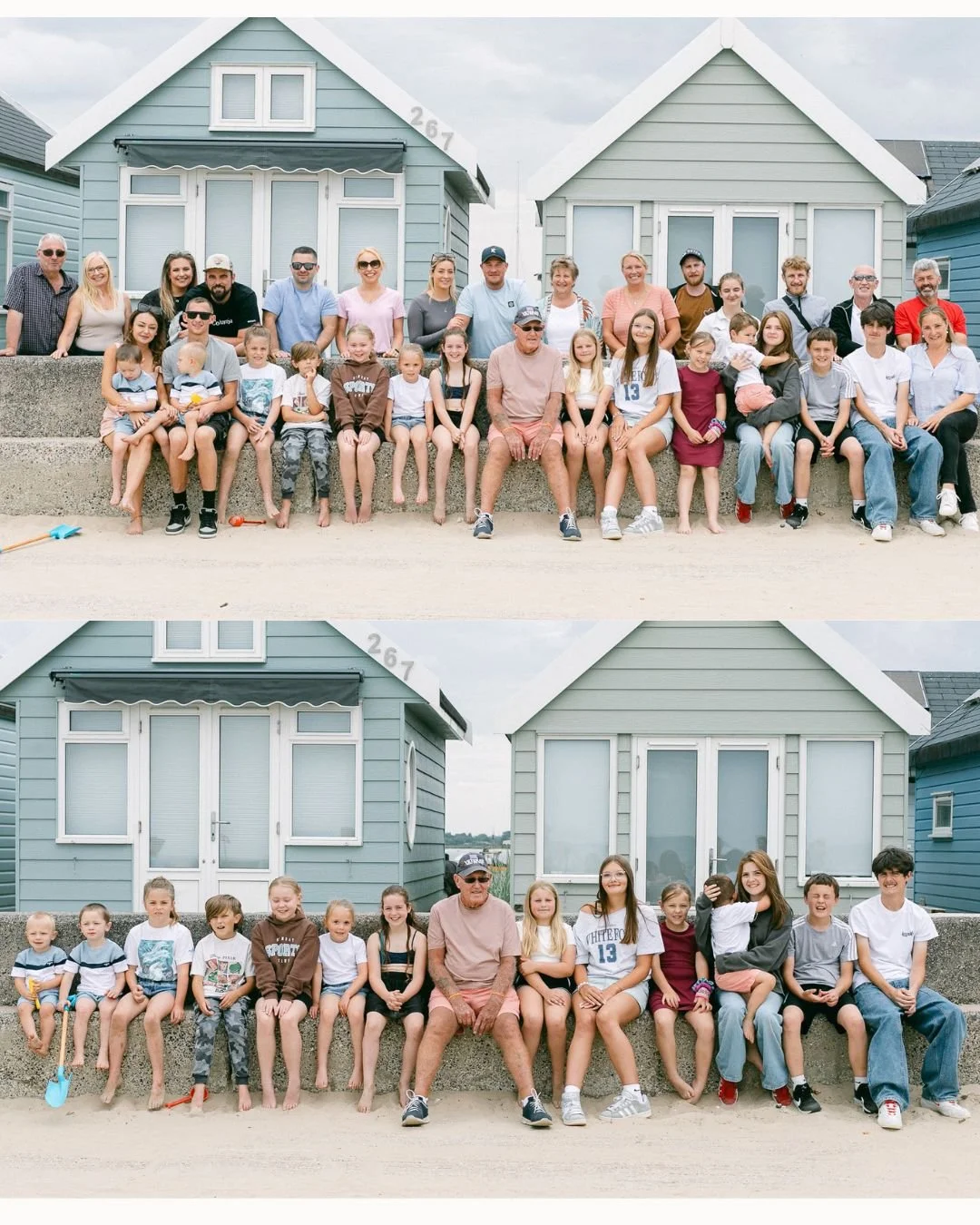
Last year we went back to Mudeford.
It's a place we visited often as children — my sisters and I, with our mum and dad and various cousins and grandparents, for crabbing over the harbour wall and a boat trip across to the sandbank. The particular smell of low tide and sun cream and the slightly competitive business of who had caught the most crabs. The sandbank that somehow manages to be one of the most joyful places on earth despite being, objectively, a long thin strip of sand with nowhere much to sit.
My eldest is seventeen now. So that tells you how long it had been since we were all together in that place. Minimum.
We went back. We crabbed over the harbour wall — the same wall, the same ritual, the same bait and the same buckets and the same entirely disproportionate celebration when something actually appeared on the line. We caught the boat across. We found a spot on the sandbank and we sat in the June sunshine and we were, all of us, briefly and completely, gathered.
And then someone suggested recreating the photograph. The one taken on the sandbank when we were children — the whole group of us, squinting into the sun, salt-dried and happy. We found the approximate spot. We arranged ourselves in something like the original order. Someone counted to three.
I have been thinking about that photograph ever since. Not just the new one, but what it means that there are two of them now. The original memory, and the recreation of it. The children we were, and the people we brought back to the same sand.
Sedikides' self-continuity research talks about the way shared memories create the felt sense that your life has a thread running through it — that the years between then and now are not a gap but a story. That the people you loved at the beginning are still, somehow, the people at the centre of everything.
Standing on that sandbank, I felt that thread so clearly it was almost physical.
And here is the thing I keep returning to, the thought I can't quite settle:
I don't know which memory will be greater. Which will live the longest in the people who were there. The original — the childhood summers, the grandparents, the crabs, the boat — or the recreation, the gathering of the same family a generation later, the proof that we are still here, still coming back, still choosing each other.
Maybe both. Maybe they need each other. Maybe the recreation is what gives the original its full meaning — the confirmation that it mattered enough to return to. That the gathering was worth repeating. That the cloth on the sandbank, the first time and the second time, was laying down something that will last far longer than either afternoon.
That is what gathering does, at its best and most true.
It doesn't just make a memory.
It makes a life.
With love, Gemma x
This piece is part of The Joy Edit — a series exploring the psychology and practice of joyful living.
Read the full series: Joy Is Not a Destination (January) · You Are Not Your Thoughts (February) · Joy Lives in Ritual, Not Routine (March) · The Smile Ripple Effect (April) · The Joy of Talking to Strangers (May) · Joy in Gathering & Connection (June)
Research & Further Reading
Dunbar, R. (2017). Breaking Bread: the Functions of Social Eating. Adaptive Human Behavior and Physiology. [Full discussion of the mechanism in January's piece.]
Holt-Lunstad, J., Smith, T. B. & Layton, J. B. (2010). Social relationships and mortality risk: a meta-analytic review. PLoS Medicine, 7(7), e1000316.
Brown, B. (2017). Braving the Wilderness: The Quest for True Belonging and the Courage to Stand Alone. Random House. [On the distinction between fitting in and belonging.]
Parker, P. (2018). The Art of Gathering: How We Meet and Why It Matters. Riverhead Books.
Sedikides, C., Wildschut, T., Cheung, W. Y., Hepper, E. G., Vail, K., Brackstone, K., Routledge, C., Arndt, J., Zhou, X. & Vingerhoets, A. J. J. M. (2016). Nostalgia Fosters Self-Continuity: Uncovering the Mechanism (Social Connectedness) and Consequence (Eudaimonic Well-Being). Emotion, 16(4), 524–539.
Stay a while …
Come and be nosey …
The blanket is always out over on Instagram. Behind the scenes Picnicscapes, Somerset life as it actually happens, and the occasional opinion about gingham.