Why You Feel Better After a Picnic (Even When Nothing 'Special' Happens)
On the afterglow, the nervous system, and what it actually means to feel human.
It's the Tuesday after. Nothing particular is happening. You're rinsing mugs or folding laundry or sitting in traffic and you notice — quietly, without quite being able to explain it — that you feel different.
Not transformed. Not fixed. Just . . . better. Lighter, somehow. More like yourself. As though a window got opened somewhere and the air has been different ever since.
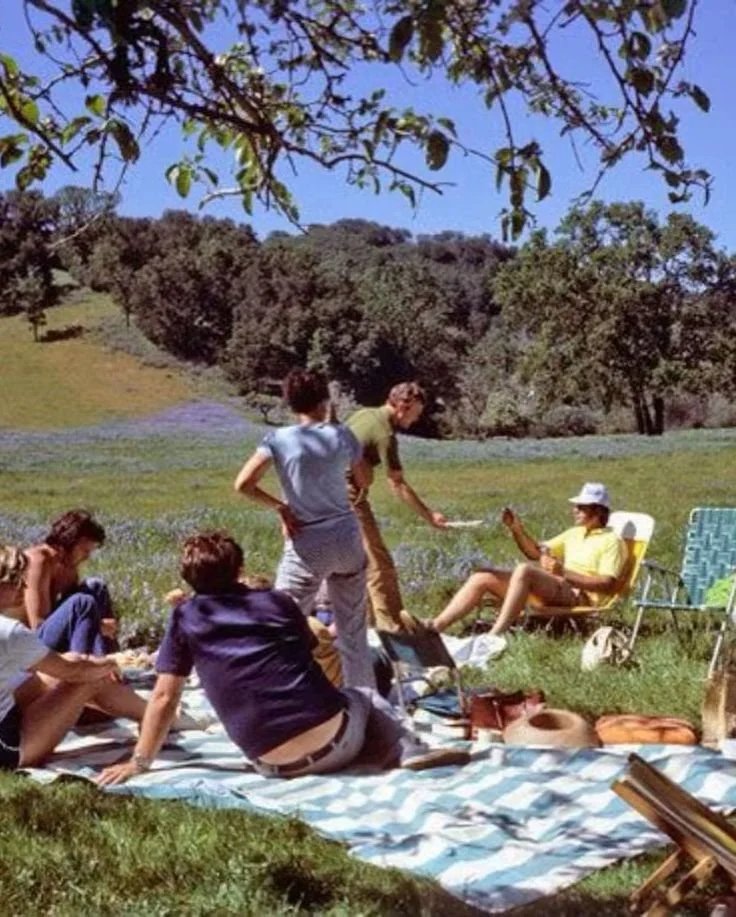
You think back. What changed? The weekend was ordinary. You went on a picnic, but nothing special, nothing planned to within an inch of its life. A blanket on the grass. Some friends. Children running about. Food that was good but not remarkable. Nobody said anything particularly profound. The wasp situation was, if anything, suboptimal.
And yet here you are on a Tuesday, feeling quietly, inexplicably, genuinely fine.
I have felt this so many times I stopped being surprised by it and started being curious about it. Because I think this Tuesday feeling — this specific, unearned, apparently sourceless sense of okayness — is one of the most important things the picnic gives us.
And I think we almost never talk about it.
Nothing Special Happened. So Why Do You Feel Like This?
Here is what we tend to think makes a good day: something notable. A milestone. A plan that came together. An experience worth photographing, worth recounting, worth noting, worth the caption.
But the research on happiness — and there is a great deal of it, and it consistently surprises people — tells a very different story entirely.
What actually moves the needle on human wellbeing isn't the notable. It's the ordinary done with presence. It's the unremarkable afternoon that you were actually in rather than documenting from a slight distance. It's the conversation that wandered where it wanted to go. It's the sitting next to someone you like, not saying much, watching the light change.
The psychologist Matthew Killingsworth's research at Harvard found that people are significantly less happy when their minds are wandering — even when they're doing something pleasant — than when they're fully present. The content of your day matters less than your relationship to it. Are you there? Are you actuallythere?
A picnic, almost by structural necessity, requires you to be there.
You are on a blanket. On the ground. With no desk to sit at, no room to leave, no screen. The usual exits from the present moment are, if not closed, at least less convenient. And so almost by accident, almost without trying, you end up being somewhere, properly, for an afternoon.
Your nervous system notices. And it files it away as: that was real. That counted.
“The picnic doesn't need to be special. It needs to be real. And real, it turns out, is exactly what we're starving for.”
Let me tell you about a few things that happen to your body and brain when you spend an afternoon outside with people you like. Because the Tuesday feeling isn't imaginary. It's biology.
Nature does something measurable. Time spent outdoors, particularly in green spaces, particularly without a screen, reduces cortisol, the body's primary stress hormone. It lowers blood pressure. It activates the parasympathetic nervous system, the one responsible for rest and restoration rather than vigilance and defence. Researchers call this Vitamin N — nature as a genuine physiological intervention. Two hours in a natural environment produces measurable wellbeing improvements that persist for days, not minutes. You didn't imagine the Tuesday feeling. You earned it on Sunday afternoon.
Your nervous system co-regulated. When we are physically present with other people, not on a call, not in a thread, but actually bodily present, our nervous systems begin to synchronise. Heart rate, breathing patterns, stress responses: they attune to one another. This is called co-regulation, and it's one of the oldest and most fundamental human capacities we have. A calm nervous system in the room genuinely calms other nervous systems. You cannot get this from a screen. You cannot get it from a text. You get it from sitting next to someone on a blanket while they pass you the strawberries.
You exercised your weak ties. Sociologist Mark Granovetter's research on what he called weak ties, the connections we have with acquaintances and near-strangers rather than our closest circle, showed that these lighter connections have an outsized impact on our sense of belonging and wellbeing. The person whose name you almost know. The friend of a friend. The neighbour you've been meaning to talk to properly. A picnic gathers them. It makes space for the conversation that wouldn't have happened otherwise. And those conversations, brief, unplanned, warm, contribute to a sense of being woven into something larger than your immediate life.
Your brain remembered it's not alone. Social baseline theory, developed by psychologist James Coan, proposes something profound: that the human brain evolved to treat social connection as its default operating state. We are not built to navigate the world alone. When we are isolated, the brain registers this as a form of threat and works harder, consumes more resources, stays more vigilant, experiences the ordinary difficulties of life as heavier than they are. But when we are with people, genuinely with them, the brain relaxes its load. It distributes the weight of being alive across more than one nervous system. It exhales.
A picnic, in other words, gives your brain exactly what it was designed to have.
“You don't feel better after a picnic because something special happened. You feel better because, for a few hours, you remembered how to be human.”

… But I Feel Tired Afterwards. And Sometimes a Bit Emotional. Is That Normal?
Yes. Completely. And I think this is worth talking about because it's the part nobody mentions and it can be confusing if you don't know what it is.
If you've been living in a fairly isolated or screen-heavy or low-contact way, and most of us have, to varying degrees, particularly since 2020, then real human connection can feel almost effortful at first. Overwhelming, even. Wonderful but exhausting. You come home from the picnic and you need to sit quietly for a bit. You feel a vague emotional wateriness that you can't quite name.
This is not a sign that something is wrong. It is a sign that something is right. That you used muscles you haven't used in a while. That your nervous system got a genuine workout, not from stress, but from presence. From being fully in a room — or a field — with real people, real emotions, real energy that you could actually feel rather than read on a screen.
Think of it like going back to exercise after a break. The first few sessions leave you more tired than you expected. Not because exercise is bad for you. Because your body is remembering what it's for. The more you do it, the more you'll notice: the tiredness shrinks AND that Tuesday feeling grows.
The Days After — What I've Noticed:
I've been paying attention to this for years now, and here is what I consistently observe — in myself, and in the people I talk to about it:
You have something real to think about.
Not a scroll, not a feed, not something someone posted.
A conversation. A moment. Something someone said that you're still turning over.
Something that happened between real people in a real place.
You feel the pull toward people rather than away from them. You want to see them again. You find yourself reaching out, sending the message, making the plan, suggesting the thing. The social impulse, which can atrophy when we don't use it, is awake again.
You feel seen. Not in the performed way, not because anyone documented you or validated you, but in the quiet, embodied way that only comes from being looked at by someone who was actually looking. From being laughed with rather than at. From being in something together, even something as small as an afternoon on the grass.
You feel alive in a way that's hard to articulate and easy to dismiss but absolutely real. Like the colour got turned up slightly. Like the ordinary Tuesday is more interesting than it was last week. Like you have a story, not a post, not content, but an actual story, when someone asks how your weekend was.
This is what it is to feel human. Actually, properly, connectedly human. And we are, I think, more starved of it than we know.

Here is the thing I want you to hold:
The picnic is not the point. The picnic is the vehicle. The basket and the blanket and the carefully considered cheese selection — all of it, wonderful as it is, is just the reason you left the house. The reason you got everyone onto a piece of grass together. The reason you stayed for two hours instead of thirty minutes.
What the picnic is actually delivering, every single time, regardless of whether the weather cooperated or the sandwiches were perfect or anything remotely notable occurred, is this:
Nature. Presence. Co-regulation. Connection. Belonging.
Five of the most well-evidenced contributors to human wellbeing, delivered simultaneously, on a blanket, for the price of a loaf of bread and the willingness to sit on slightly damp grass.
The picnic is, without drama or ceremony, one of the most efficient joy-delivery mechanisms available to us.
We just never framed it that way. We called it a nice thing to do on a sunny day.
It is so much more than that.
So, when did you last feel that Tuesday feeling?
When did you last come home from something, not tired from performance or obligation or the effort of being impressive, but tired in that quiet, replete, I was somewhere real today way?
When did you last sit on the ground with people you like and have a conversation that went where it wanted to go?
If the answer is a while ago, or I can't actually remember, then I want to gently, firmly, with complete love, suggest that this is not a coincidence.
We have outsourced so much of our human connection to screens. To feeds. To the low-hum of being adjacent to people online without ever being genuinely with them. And it is not enough. It has never been enough. The brain knows. The nervous system knows. The fact that you feel slightly flat and slightly disconnected and slightly like something is missing — that is not a personal failing.
That is a vitamin deficiency. And the vitamin is other people. Real ones. In the same physical space. Passing you the strawberries.
So here is my invitation, the same one I extend every time, because it never stops being the right answer: Go for the ordinary picnic.
Not the special one. Not the one you've been planning. Not the one that requires the perfect weather and the perfectly edited basket and everyone being available on the same day in August.
The ordinary one. This weekend. With whoever is available. On whatever patch of green is nearest.
Bring something to sit on. Bring something to eat. Leave the agenda at home.
And then notice — two days later, on a Tuesday, rinsing mugs or folding laundry or sitting in traffic — how quietly, inexplicably, genuinely fine you feel.
With love,
Gemma xx

The Piknic Club
Life is too short for boring picnics.
The Piknic Club is where the blanket-spreading, basket-packing, joy-seeking community lives. Seasonal boxes, curated picks, and the kind of picnic inspiration that makes you want to drop everything and go outside immediately.
Stay a while …


Come and be nosey …
The blanket is always out over on Instagram. Behind the scenes Picnicscapes, Somerset life as it actually happens, and the occasional opinion about gingham.