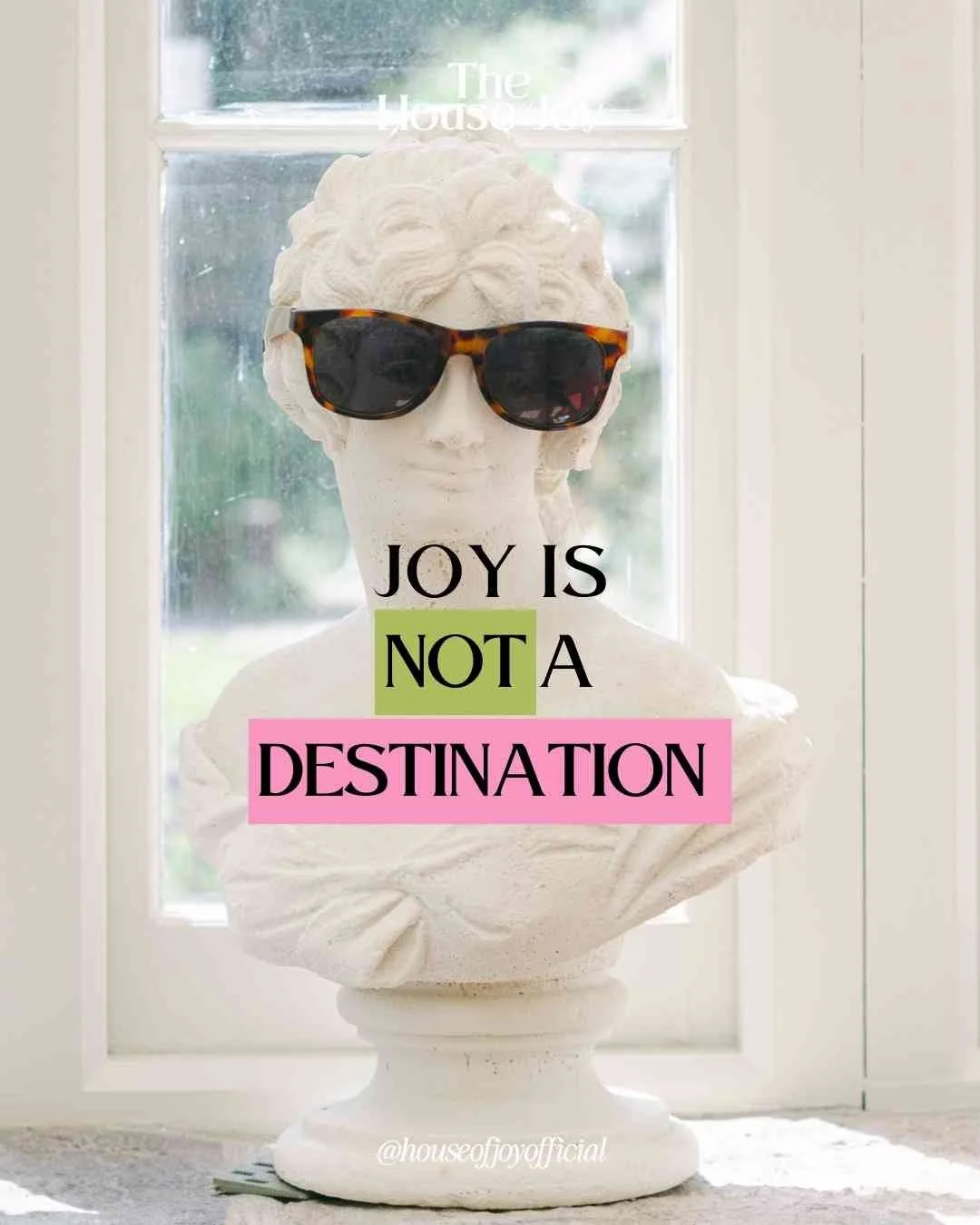
Joy Is Not a Destination

On the habit of postponing joy - and the quietly radical act of finding it right here, in the life you already have.
Part of The Joy Edit - a series exploring the psychology and practice of joyful living.
January has a particular smell about it. Damp coats. The faint ghost of Christmas candles. The very specific existential scent of a new planner you've filled in with optimistic colour-coding that will absolutely not survive contact with actual February.
It's also the month that arrives with the loudest instructions of any month in the calendar. Reinvent yourself. Set the goals. Transform the habits. Lose the weight. Find the purpose. Start the thing. Finish the other thing. Be, essentially, an entirely different and considerably more efficient person by the 31st.
And somewhere in the middle of all that noise — somewhere between the gym membership and the dry January and the sourdough starter you've named but haven't fed — joy is quietly waiting. Not in the future version of you. Not after the renovation, or the promotion, or when the jeans zip without a wiggle.
Right here. In this January. In this kitchen. In this actual, imperfect, slightly chaotic life.
I know. Deeply unsatisfying answer. Let me explain why it's also the most liberating one.
"I'll Breathe When . . ."
Be honest. You know this sentence. You've probably said it this week.
When the kitchen's spotless. When I've booked the holiday. When the children are slightly less feral. When the inbox stops multiplying overnight like something out of a horror film. When life feels less like I'm running for a bus I can never quite catch.
Sound familiar? You're not broken. You're not ungrateful. You're not even particularly unusual.
You're doing something psychologists have given the very unglamorous name of joy deferral - treating happiness as the destination at the end of a list of conditions that must first be met. Which would be a workable strategy if the list ever actually ended. It doesn't. You clear one condition and another appears. This is not a character flaw. This is a feature of the modern world, which has a very strong financial interest in making sure you always feel slightly incomplete.
Add children, a career, ageing parents, and the general ambient responsibility of caring for actual humans — and suddenly the only guaranteed me-time is standing by the back door with a bin bag, noticing it's somehow raining sideways again. Relatable? Same.
The research has a name for it too
Martin Seligman, the founder of positive psychology at the University of Pennsylvania, spent decades mapping the conditions of genuine human flourishing. His conclusion, and the conclusion of the field that grew around his work: joy is not a reward for getting life right. It is not waiting at the end of a completed to-do list. It is available, always, in the present moment - and our entire cultural framing of happiness as something to be earned or arrived at is quite spectacularly wrong.
Sonja Lyubomirsky, a psychologist at UC Riverside whose research on happiness has been replicated more times than most, found something that initially seems counterintuitive: only around 10% of our happiness is determined by our life circumstances. The house, the salary, the body, the kitchen renovation, the car upgrade. Ten percent!
Around 50% is genetic set-point - the baseline level of happiness you tend to return to regardless of what happens to you, up or down. And the remaining 40%? That's determined by intentional activity. By what you choose to notice, practise, and repeat. By the quality of attention you bring to the life you already have.
Which means the area in which you have the most power to change how joyful your life feels is not the one our culture spends the most time selling you. It's quieter than that. Less dramatic. Considerably less expensive.
Joy is not a reward for getting life right. It is available, right now, in the life you already have.
The Three Thieves of Right-Now Joy
So if joy is genuinely available in the present moment - and the science says firmly that it is - why does it keep feeling so elusive? In my reading and research, three culprits show up consistently.
Thief One: The Wandering Mind
Matt Killingsworth at Harvard built an app that pinged thousands of people at random moments throughout the day and asked two questions: what are you doing right now, and how happy do you feel? His dataset - gathered from 15,000 people across 80 countries - produced one of the most quoted findings in happiness research: we spend 47% of our waking hours thinking about something other than what we're actually doing.
Nearly half of every day. Gone. Not in the room. But composing the imaginary argument. Replaying the meeting. Planning tomorrow's packed lunches. Cataloguing the things we haven't done. Somewhere absolutely other than here.
And his second finding matters as much as the first: mind-wandering consistently predicts lower happiness, regardless of what the person is actually doing. It's not that the task is boring. It's that we've left it. The joy is in the room. We're just not.
Thief Two: Hedonic Adaptation
Here's the one that feels slightly unfair, because it's so entirely human.
We adapt. Relentlessly and quite quickly. To the new kitchen, the new coat, the new phone that felt miraculous on unboxing day. Psychologists call this hedonic adaptation - our extraordinary capacity to return to our baseline level of happiness regardless of positive changes in our circumstances. What felt like an upgrade becomes, within weeks, simply normal. And so we start scanning for the next upgrade that will surely, this time, do it.
The research on this is both humbling and quietly freeing. Humbling because it explains why buying things hasn't fixed anything yet and isn't going to start now. Freeing because it confirms that the relentless pursuit of better circumstances is not actually the path to a more joyful life - and you don't have to keep running it.
Scroll long enough and the most beautifully laid table starts to look average. Perfection is a moving target. Joy, the research is clear, has always avoided moving targets on principle.
Thief Three: The Comparison Trap
January makes this one particularly vicious. Because January is the month when everyone is loudly performing transformation, and social media is absolutely delighted to reflect that back at you in the highest possible resolution.
Leon Festinger's social comparison theory - proposed in 1954, terrifyingly applicable to 2026 - tells us we evaluate ourselves by comparing ourselves to others, constantly and largely without noticing. We were doing this before smartphones. We're doing it now with an audience of thousands, available at any moment, all apparently entering January with considerably more grace and considerably better activewear than the rest of us.
The comparison trap is not a vanity problem. It's a perception problem. We're comparing our ordinary Tuesday - our rain-sideways bin bag Tuesday - to someone else's highlight reel. And then wondering why we come up short.
What Actually Works (And It's Simpler Than You've Been Told)
This is the part where I'm supposed to give you a sweeping lifestyle transformation. I'm not going to do that, because the research doesn't support it - and also because you don't need one.
What the science of positive psychology consistently finds is something far less dramatic and far more do-able: small, intentional acts, repeated regularly, in the actual life you are already living. Not the future one. This one.
Presence is the practice
Killingsworth's research isn't just an interesting statistic. It's also an instruction. If nearly half our unhappiness comes from not being in the room, then being in the room is one of the highest-return investments in joy available to us.
Not meditation, necessarily. Not a forty-minute morning routine involving a cold shower and seventeen intentions. Just the deliberate, occasional return of your attention to the thing that's actually happening.
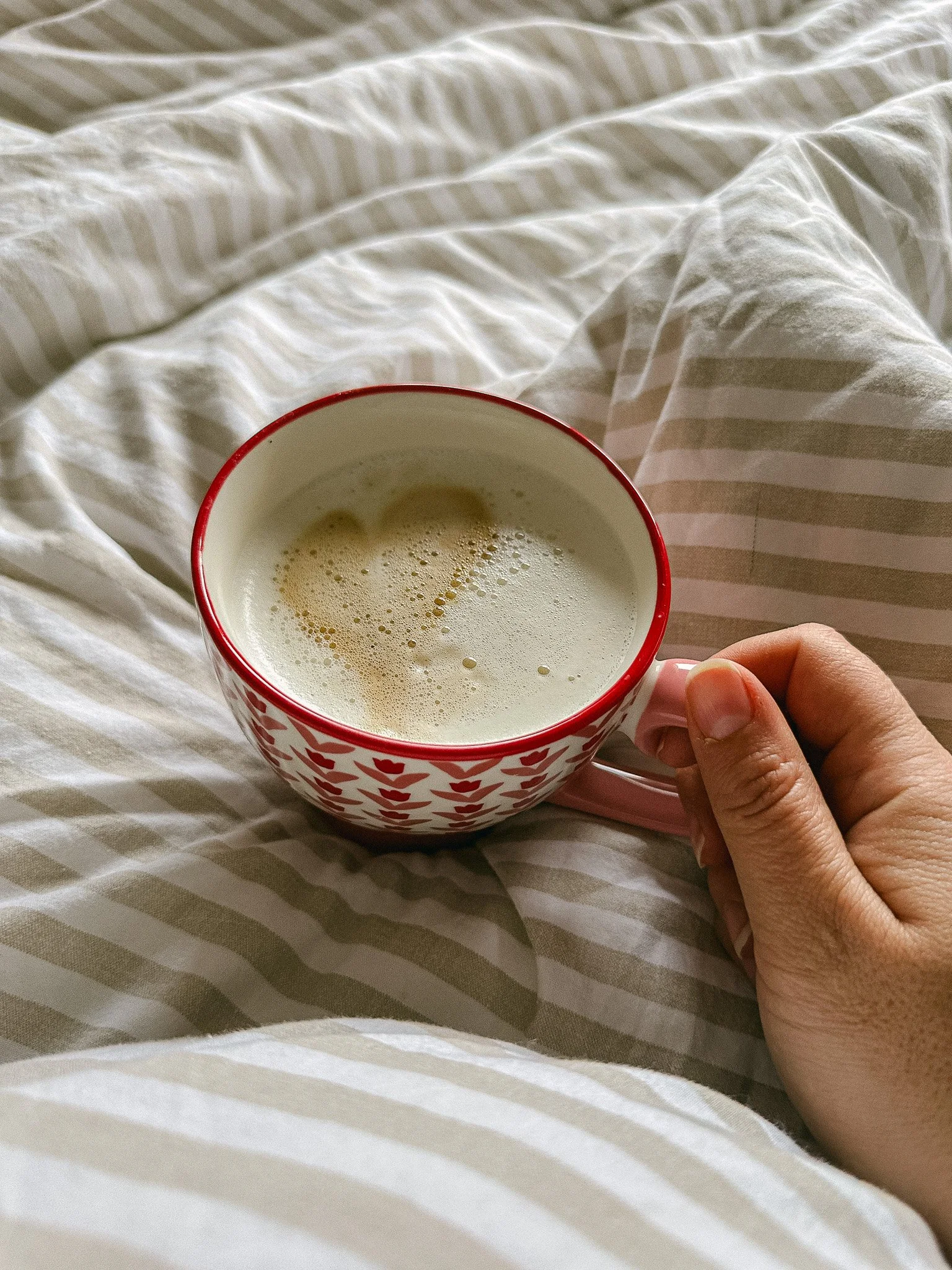
The taste of the soup. The weight of the mug in both hands. The particular sound of a Somerset January afternoon — birds you can't quite name, distant tractor, rain beginning again with considerable commitment. These are not small things dressed up as profound. They are, according to Barbara Fredrickson at the University of North Carolina, the actual building blocks of a flourishing life.
Small joys compound
Fredrickson's broaden-and-build theory is one of the most important ideas in positive psychology and one of the least discussed outside academic circles. The headline: positive emotions - even small, brief, entirely ordinary ones - do not just feel nice in the moment. They broaden our thinking, expand our perception of possibility, and over time build lasting psychological resources: resilience, creativity, stronger relationships, better health outcomes.
Joy is not frivolous. It is not a reward for completing the more important tasks. It is, the research shows, one of the most functionally significant things a human can experience regularly. The problem is it rarely announces itself with fanfare. It tends to arrive quietly, in moments we've usually already scrolled past.
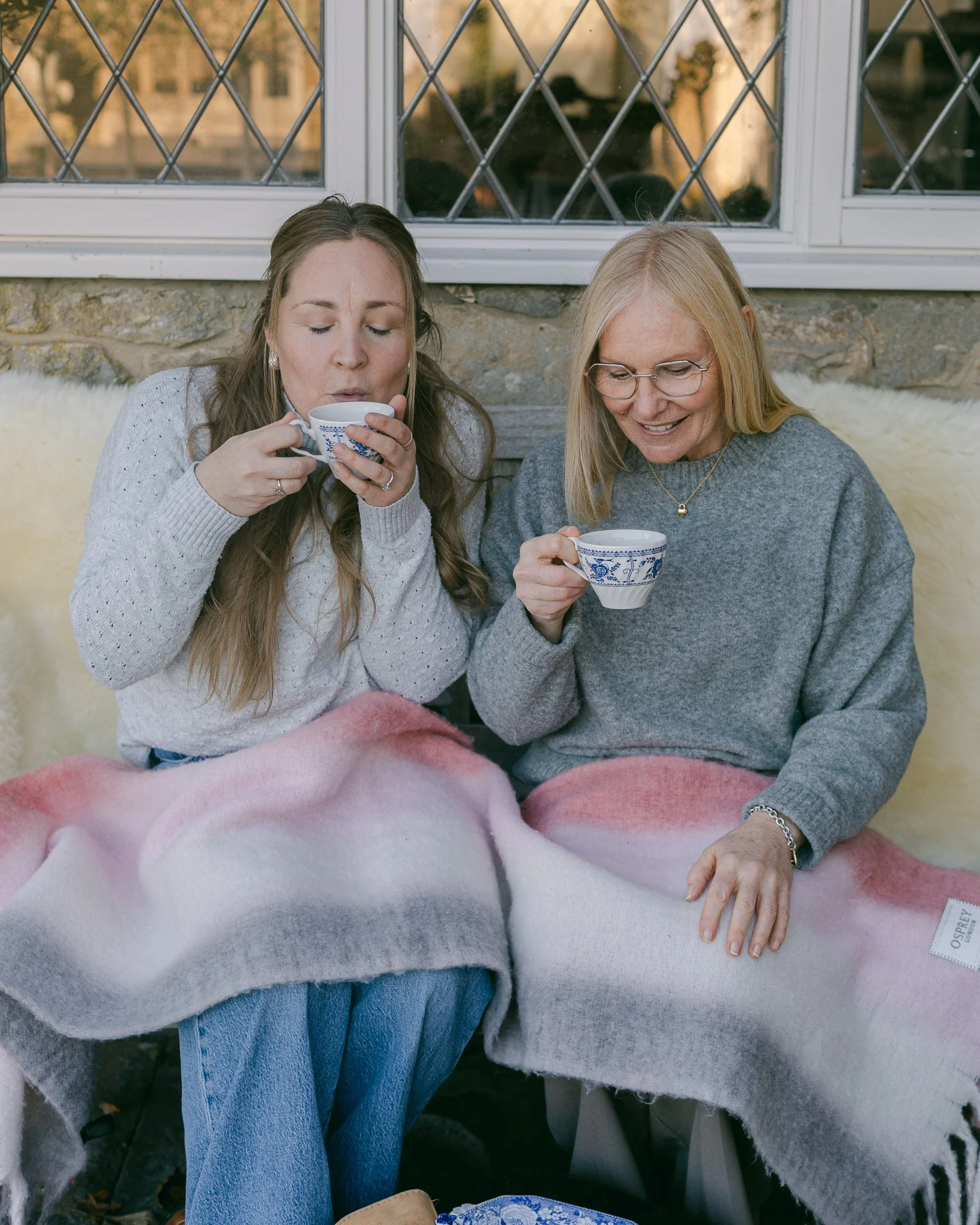
The cup of tea you forget you made and then rediscover. The cold handle of an enamel mug on a morning that's trying its best. The precise moment the school run ends and you have eighteen minutes to yourself and a clear sky. These are not nothing. These are everything, if you let them be.
Nostalgia is medicine, not mush
This one surprised me when I first encountered the research, because nostalgia has a slightly embarrassing reputation - as if being moved by a song from 1997 is somehow soft, or unproductive, or evidence that you peaked young.
Constantine Sedikides at the University of Southampton has spent years studying nostalgia as a psychological phenomenon. His findings: nostalgia increases feelings of social connectedness, meaning, and self-continuity. It quite literally makes today feel richer by connecting it to a thread of self that stretches back through time. It is not escapism. It is, neurologically and emotionally, a resource.
Angel Delight in a glass. The snap of an old Polaroid. A song that takes you somewhere specific, instantly, without asking permission. These are not indulgences. They are legitimate, evidence-backed routes to present joy. Pull on that thread freely and without apology.
Together is a superpower
There is a reason a village-hall quiz feels different from watching television. A reason that singing in a room full of people - even if you are, like me, doing it with considerable enthusiasm and questionable accuracy - produces something that solo activities simply cannot.
The research on collective joy is remarkable. Singing together, clapping together, moving together - these activities synchronise people physically and neurologically, producing surges of oxytocin and endorphins that have no equivalent in solitary experience. Priya Parker, in The Art of Gathering, and researchers in social neuroscience both point to the same conclusion: we are wired for shared joy in a way that individual joy, however lovely, simply cannot replicate.
The school fair singalong. The pantomime clapping. The village-hall quiz where everyone argues about the answer to question seven. These are not small cultural remnants. They are some of the most reliable joy-delivery mechanisms available to a human being.
Joy isn't hiding in someday. It's here, in the steam from your tea and the pile of muddy wellies by the door.

Use the Best China. Today.
I want to pause here and say something that feels both obvious and, apparently, quite hard to actually do.
The good china. The nice candles. The perfume you're saving. The dress that's waiting for a proper occasion. The tablecloth that only comes out when someone worth impressing is coming.
These things - all of them - are doing something psychologically damaging while they sit waiting. They're sending you a signal, quietly and repeatedly, that right now is not good enough. That you are not, yet, in a moment worth treating beautifully. That joy is coming, but it hasn't quite arrived, and it certainly hasn't arrived at this Tuesday in January with leftover soup and no particular plans.
It has. It absolutely has.
Using beautiful things is not an act of wastefulness. It is an act of radical presence - a declaration that this moment, ordinary as it is, is worth marking. That you are worth marking. That the Tuesday soup deserves the good bowl.
This is the January experiment I'd offer above all others: do one lovely thing now. Not when the kitchen is tidy. Not when you've earned it. Now. The good candle. The proper mug. The cloth on the table even if it's just you and whoever's most reliably underfoot.
Watch what it does to the room. Watch what it does to you.
Joy in January - The Somerset Version
January in Somerset has a particular quality of quiet that I find genuinely beautiful, even when - especially when - it's doing the thing where it rains for eleven days consecutively and the lane outside the house becomes a small tributary.
The farm shop smells of apples and earth and something baked earlier that morning. The fields are the colour of wet tea. The hedgerows are bare enough to see through, which means you can see the hills on a clear day in a way that summer never allows. And the light - when it comes, and it does come, low and amber and fleeting - is some of the most extraordinary light of the whole year.
There's a reason January suits pottering. The season is built for it - for noticing what's close, for staying in the lane rather than ranging wide, for the particular joy of coming inside from the cold to something warm. Hot soup. A bath at an unreasonable hour. A candle that has no justification beyond the fact that it smells nice and the afternoon is dark.
Muddy boots by the door are not a sign of disorganisation. They are evidence of a life that went outside, noticed things, and came back.
That's a good January.
Three Small Experiments Worth Trying
These are not resolutions. They require no subscription, no equipment, and no version of yourself that doesn't exist yet. They are simply invitations to be more present in the life you're already living.
1. The Kettle Ritual
While the kettle boils, put your phone down. Breathe in for four, out for six. Notice three things you can see, three things you can hear, one thing you can smell. When the tea is made, drink it without a screen. The whole cup. That's it. That's the practice.
2. The Mini Walk
Ten minutes. Out and back. After the school run, or before supper, or at the precise moment you feel most like not doing it — which is usually when it's most needed. Muddy boots strongly encouraged. Hedgerow report entirely optional. The point is not the walk. The point is the noticing.
3. The One-Song Kitchen Disco
One song. 1980s or 90s, non-negotiable on this. Wooden spoon microphone if required. Children and dogs not just welcome but actively recruited. The science on group movement and joy is remarkable. The living room evidence, in my experience, is even more so.
None of these will transform January. That's not what they're for. They'll do something more interesting than that: they'll begin to train your attention toward joy, rather than past it. And attention, it turns out, is almost entirely the point.
The Quietly Radical Conclusion
Here is what I have come to believe, after enough reading and research and honest reflection on my own habits:
Joy is not a personality type. It's not reserved for people who are naturally optimistic, or who have more time, or a tidier kitchen, or a gift for contentment that you somehow missed out on.
Joy is a practice. A muscle. A direction of attention. It gets stronger with use and weaker with neglect, just like everything worth having.
And the most important thing about it - the thing the research keeps returning to, from Seligman to Fredrickson to Killingsworth to Lyubomirsky - is that it is available now. In this January. In this kitchen. In the pile of muddy wellies by the back door and the leftover soup and the school run you've done for the four hundredth time and the flask of tea you brought outside this morning even though it was drizzling.
It's not waiting for your circumstances to improve. It never was.
The picnic doesn't have to be perfect. The day doesn't have to be sunny. The house doesn't have to be ready. You don't have to be ready. You just have to show up, lay something down, and notice that you're here.
That's where joy lives. It always has.
With love, Gemma x
PS: Come over and hang out with me on Instagram where we can share in the small joys of life.
This piece is part of The Joy Edit — a series exploring the psychology and practice of joyful living.
Read the full series: Joy Is Not a Destination (January) · You Are Not Your Thoughts (February) · Joy Lives in Ritual, Not Routine (March)
Research & Further Reading
Seligman, M. E. P. (2011). Flourish: A New Understanding of Happiness and Well-Being. Nicholas Brealey Publishing.
Lyubomirsky, S., Sheldon, K. M. & Schkade, D. (2005). Pursuing Happiness: The Architecture of Sustainable Change. Review of General Psychology, 9(2), 111–131. [The 10/50/40 happiness breakdown.]
Killingsworth, M. A. & Gilbert, D. T. (2010). A Wandering Mind Is an Unhappy Mind. Science, 330(6006), 932. [The 47% mind-wandering study.]
Fredrickson, B. L. (2001). The role of positive emotions in positive psychology: The broaden-and-build theory of positive emotions. American Psychologist, 56(3), 218–226.
Sedikides, C., Wildschut, T. & Baden, D. (2004). Nostalgia: Conceptual issues and existential functions. In J. Greenberg, S. Koole & T. Pyszczynski (Eds.), Handbook of Experimental Existential Psychology. Guilford Press.
Festinger, L. (1954). A Theory of Social Comparison Processes. Human Relations, 7(2), 117–140.
Parker, P. (2018). The Art of Gathering: How We Meet and Why It Matters. Riverhead Books.
Brickman, P. & Campbell, D. T. (1971). Hedonic relativism and planning the good society. In M. H. Appley (Ed.), Adaptation Level Theory. Academic Press. [The foundational hedonic adaptation paper.]
Discover more Joy . . . . .