A Stroll Through Picnic History
Here is something nobody tells you when you're sitting in a field eating a sandwich.
You are doing the oldest thing humans do.
Not farming. Not building. Not writing things down. Eating outside together. That instinct — to take food out of the house, find a good spot, and sit down with people you love — predates every civilisation we have records for. The Egyptians were doing it beside the Nile four thousand years ago. The Romans built their villa gardens specifically around it. The medieval French made it an art form. The Victorians nearly ruined it by making it require forty people and a shoulder of lamb.
And yet here we are. A blanket, a flask, a patch of Somerset grass. Still doing it.
The history of the picnic is, if you pull at the thread, the history of joy itself. Here's the short version — with signposts to the deep dives if you want to follow any thread further.
It Started in Egypt (and It Was Never Just About the Food)
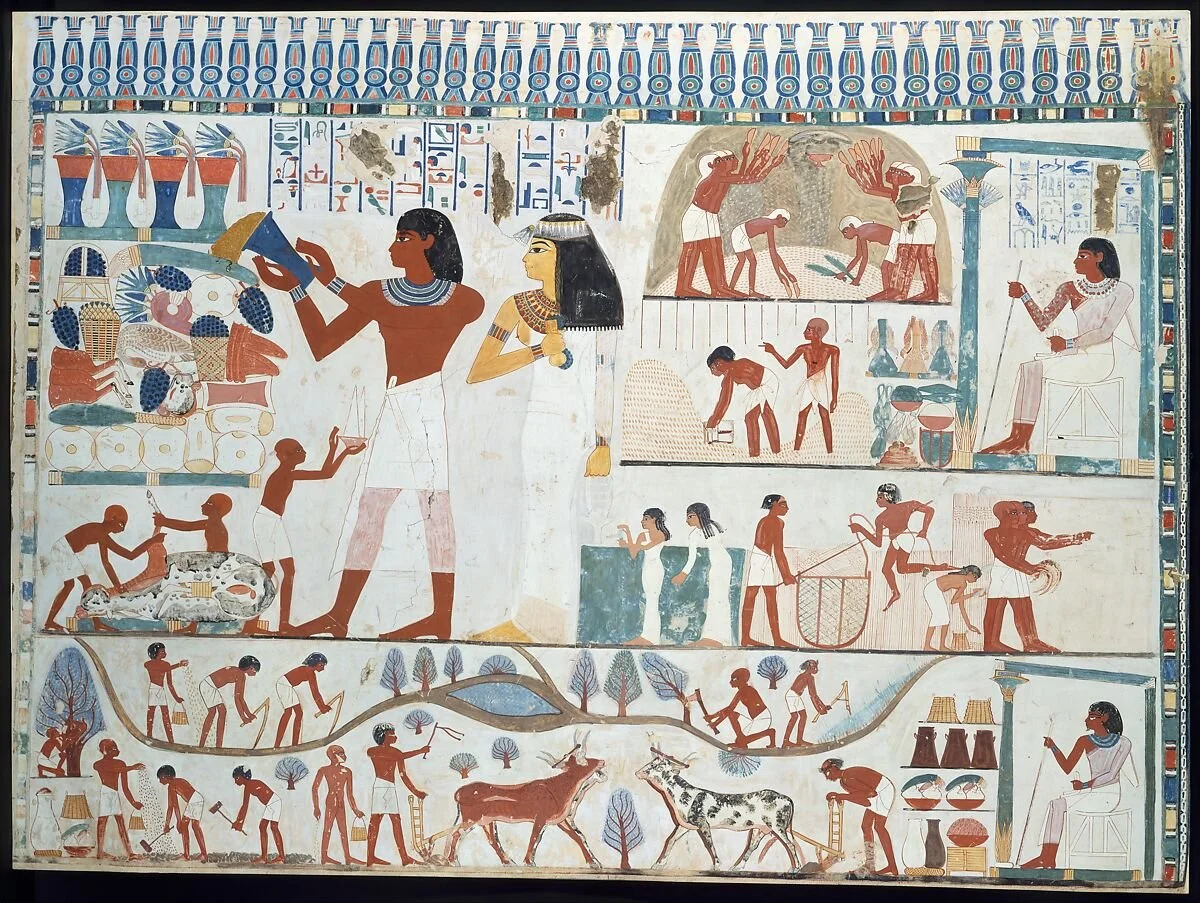
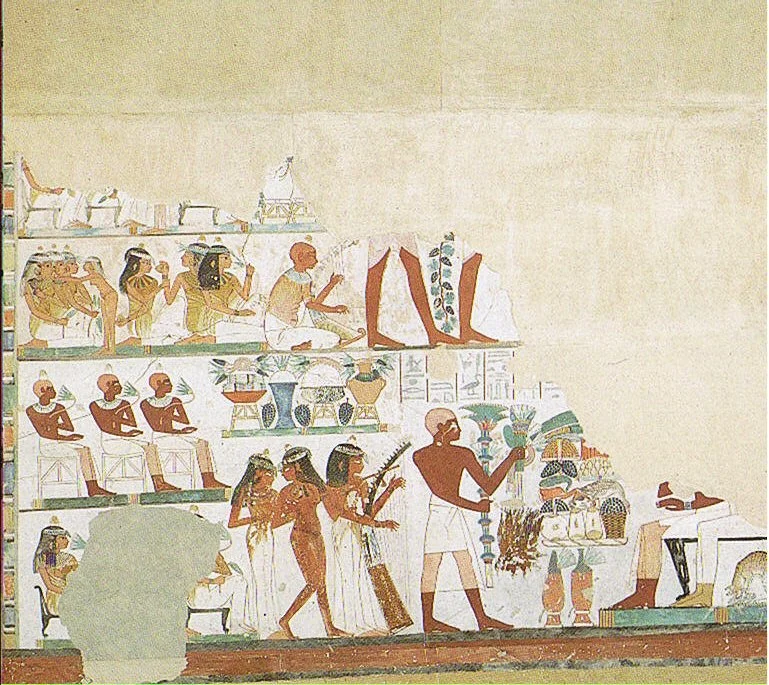
The oldest evidence of what we'd recognise as a picnic comes from ancient Egypt — specifically from the tomb paintings of a nobleman named Nebamun, painted around 1350 BCE and now in the British Museum. They show a feast: guests in fine white linen, musicians playing, servants carrying food, lotus flowers everywhere. It is, unmistakably, a gathering. A deliberate, beautiful, carefully organised gathering outdoors.
But the most extraordinary outdoor feast in Egyptian history wasn't for the living at all. The Beautiful Feast of the Valley was an annual event in which the entire city of Thebes — tens of thousands of people — crossed the Nile by boat to eat beside the tombs of their loved ones. They brought food, music, wine, and flowers. They ate with their dead, and they considered this completely natural. The feast ran for over a thousand years.
The Egyptians also packed food in the tombs themselves — honeyed bread, dried figs, wine sealed in clay jars — so the dead would have provisions for the journey. The first hamper, as it turns out, was packed for the afterlife.
→ The full Egyptian story is in The Picnic Chronicles, Vol. I
The Romans Had Very Strong Opinions About It
The Romans didn't just eat outside. They thought very hard about it, wrote extensively about it, and built their villas specifically around it.
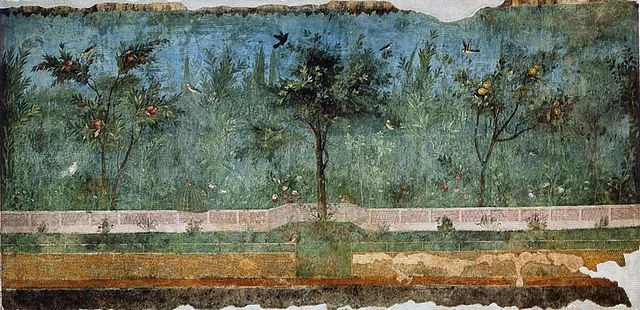
The outdoor dining room — the triclinium — was often positioned to face the best garden view, the sea, or the hills. Roman architects designed the whole house around the pleasure of eating outside. Guests reclined on cushioned couches arranged in a U-shape. Dishes arrived in courses. Wine was mixed with water in precise ratios (the unmixed kind was for barbarians). The host's collection of silver was on display. Musicians played. Conversation was the point.
The Romans also took it outside the villa entirely — into villa gardens, countryside estates, sacred groves. What we'd call a picnic, they'd have called a convivium. Literally: living together.
The Romans were in Somerset for nearly four hundred years. They ate in the gardens of villas looking out over the Mendips and the Quantocks. The hills you can see from a Somerset picnic blanket today were their view too.
→ The Roman story in full is in The Picnic Chronicles, Vol. II
Where the Word Actually Came From
The word picnic is French — and it's younger than you think.
Pique-nique first appeared in print in 1649, in a French satirical pamphlet. By the 1690s it meant a fashionable communal dinner where everyone contributed a dish. By 1748 it had crossed the Channel into English. By 1801, a group of wealthy Londoners had launched the Pic-Nic Society — meeting in rooms on Tottenham Street, entry requiring a dish and six bottles of wine, followed by amateur theatricals.
The playwright Richard Brinsley Sheridan called it a threat to public morality. The satirist James Gillray drew unflattering cartoons about it. Picnicking has been causing trouble, it seems, from the very beginning.
The outdoor picnic — food taken deliberately into nature, away from the formality of the house — developed gradually through the early 19th century, as the Romantics made nature somewhere you went on purpose, and the railways made the British countryside accessible to people who'd never had access to it before.
The Victorians: More Is More
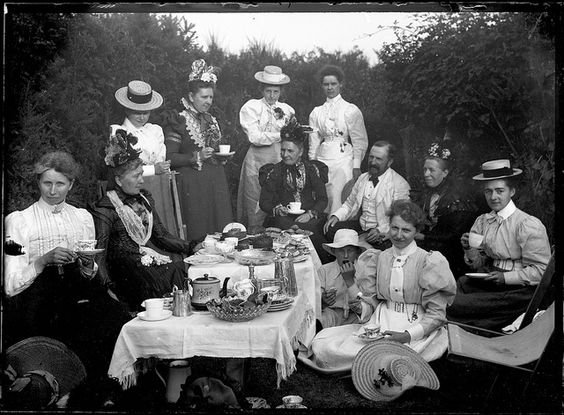
By the 1860s, the picnic had arrived. Mrs Beeton's Book of Household Management (1861) includes a "Bill of Fare for a Picnic for Forty Persons" that lists four roast ducks, two shoulders of lamb, a piece of cold roast beef, two dozen lobster claws, a gallon of strawberries, and enough champagne to ensure nobody cared what they were eating.
Simplicity, as I've noted before, was not the Victorians' strong point.
But the Victorian era also democratised the picnic. The railway made the countryside available to everyone for the first time. The day trip was invented. The wicker hamper was packed. Fortnum & Mason began supplying luxury provisions for race meetings, regattas, and country house picnics. The Scotch egg was perfected. The thermos was invented — on Christmas Day 1892, at the Royal Institution, by a Scottish physicist who didn't patent it.
→ The Scotch egg's full story is here
The Edwardians inherited all of this and took it to the logical extreme: butlers, footmen, silver service, fine china, all of it transported to a lawn somewhere beautiful and arranged as if the outdoors were simply a very large room.
Wind in the Willows was published in 1908. Its famous picnic scene — Ratty's hamper on the riverbank, cold chicken and pickled gherkins and everything a well-provisioned animal could want — is not just a children's book moment. It is a precise and loving portrait of a particular English summer afternoon. It endures because we recognise it.

The 20th Century: The Picnic Belongs to Everyone
The wars changed everything, and the picnic changed with them. Rationing simplified it. Austerity stripped back the ceremony. By the 1950s and 1960s, the British picnic had become what it is today: a checked cloth on the boot of a car, a flask of tea poured into the stopper-cup, jam sandwiches for the children, something slightly warm from a foil parcel for the adults.
No footmen. No silver. No forty-person bill of fare. Just the family, outdoors, together.
And this, it turned out, was the better version. Not because simple is always best, but because the stripping away of ceremony revealed what had always been underneath: the picnic was never really about the food. It was about the getting out. The sitting down. The being, briefly, away from the walls and the routine, with people you wanted to be with.

Why It's Never Going Away
In 2020, when we couldn't gather indoors, Britain went outside. Rule-of-six on the lawn. Christmas in the garden. New Year's Eve on someone's back step, flask between you. The picnic became, briefly and then permanently, a lifeline.
Because this is what the history shows, if you look at it from far enough away: every civilisation, in every era, has understood that eating outside together is different from eating indoors. It is not a lesser version of a proper meal. It is a different thing entirely. Something freer, something more present, something that asks you to pay attention — to the weather, the light, the ground under you, the people beside you.
The Egyptians knew it. The Romans built their houses around it. The Edwardians over-dressed for it. The Victorians over-provisioned for it. And every generation since has packed a bag and found a field.
You are part of something very long.
Ready to go deeper? The full Picnic Chronicles series explores every era in detail — from the Nile to the Mendips, ancient Egypt to the modern renaissance.
And if you'd rather start with the objects — the Pimm's, the Scotch egg, the thermos, the village fête — the Picnic Icons series has those stories too.
Subscribe to JoyMail — my Substack newsletter — for new pieces the moment they land, plus the notes and asides that don't make it into the posts.
With love (and a blanket), Gemma xx

The Piknic Club
Life is too short for boring picnics.
The Piknic Club is where the blanket-spreading, basket-packing, joy-seeking community lives. Seasonal boxes, curated picks, and the kind of picnic inspiration that makes you want to drop everything and go outside immediately.
Stay a while …
COME AND BE NOSY
The blanket is always out over on Instagram. Behind the scenes Picnicscapes, Somerset life as it actually happens, and the occasional opinion about gingham.