The Picnic Chronicles, Vol. I: Ancient Egypt — The Original Outdoor Feast
Part of The Picnic Chronicles — a journey through the entire human history of gathering, feasting, and eating outdoors. From ancient civilisations to the present day, this series traces the one instinct that has never changed: the urge to share food somewhere beautiful, with the people you love. Browse the full series below.
You thought picnics started with Mrs Beeton and a wicker hamper, didn't you.
I did too. For a while.
Then I started pulling at the thread — really pulling — and found myself four thousand years back, standing on the west bank of the Nile, watching an entire city pack up food, cross a river by boat, and sit down to eat beside their dead.
Which is, when you think about it, the most committed picnic anyone has ever organised.
Welcome to The Picnic Chronicles. We're starting at the beginning.
First things first: the Nile
Everything in ancient Egypt begins with the Nile. The food, the politics, the spirituality, the art — all of it was shaped by one river and its astonishing annual act of generosity.
Every year, it flooded. And when it receded, it left behind a strip of rich, black, impossibly fertile silt along its banks — the Egyptians called it Kemet, the Black Land — that made the surrounding desert bloom. Wheat, barley, onions, garlic, lentils, cucumbers, figs, pomegranates, dates, grapes. All of it, coaxed from the earth by a river that simply knew what it was doing.
The Nile also gave them fish in extraordinary abundance — catfish, perch, tilapia, mullet. For ordinary Egyptians, this was everyday sustenance. For the wealthy, it was something you ate at a feast but perhaps turned your nose up at slightly, preferring roasted duck, or a generous leg of ox.
Because yes. There was a hierarchy to Egyptian eating. A very particular, very strictly observed hierarchy. And it matters enormously to understanding their feasting culture.
What was actually on the table
Egyptian food tells you immediately where you sat in the social order. Not metaphorically. Literally.
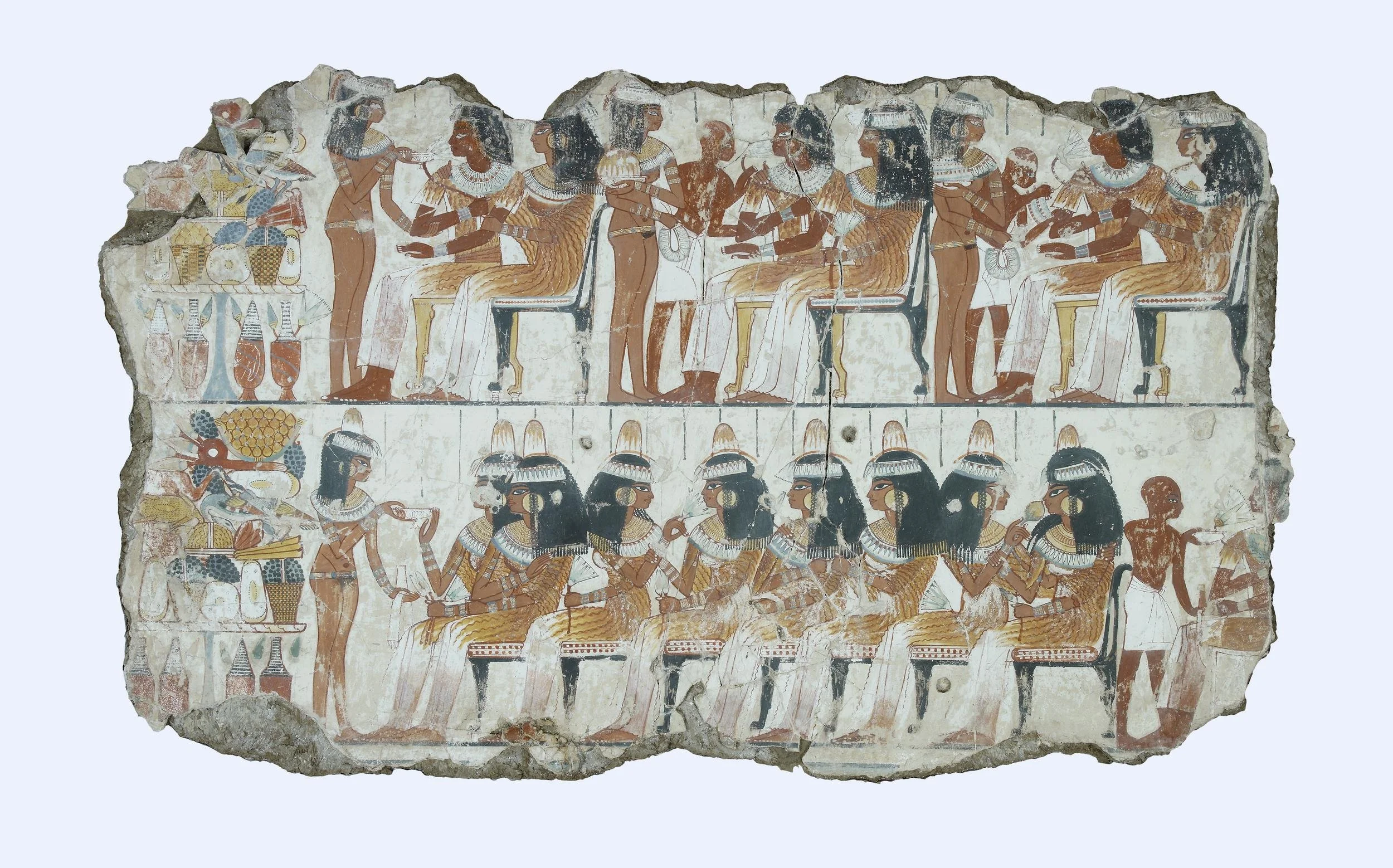
At a banquet, seating was decided entirely by status: the highest classes on proper chairs, those below them on stools, and the lowest in rank on the floor. The food followed the same logic.
The everyday Egyptian — the farmer, the craftsman, the pyramid builder — lived, above all else, on two things: bread and beer. Two meals a day. A morning meal of bread and beer, then a heartier evening meal with vegetables, more bread, and — yes — more beer. The bread was nothing like ours: made from emmer wheat (what we'd call farro today), ground by hand, sometimes with sand mixed into the mill to speed things up. That sand ended up in the bread, which ended up wearing down their teeth — something clearly visible in the mummies. Not ideal. But they got on with it.
The beer was thick and nutritious, closer to liquid porridge than anything you'd find at your local, and far less alcoholic than modern beer. Men, women, and children drank it daily — partly because fresh water wasn't always reliably safe, and partly because it was a genuine source of nutrition. It was also a form of currency. In a society without coins, food rations were how you paid your workers.
Move up the social ladder and things improve considerably. Vegetables, fruit, fish; occasionally a fattened goose or pigeon. At the very top — the noble, the priest, the pharaoh — the table was extraordinary. Honey-roasted wild gazelle. Whole roasted oxen. Elaborate stews. Fine wine — grape, date, fig, pomegranate. Cakes sweetened with honey. The workers who built the Great Pyramid at Giza, incidentally, ate meat — beef, sheep, and goat — with a regularity that was extraordinary for the ancient world. Archaeologists found the evidence in the remains of the workers' village: vast quantities of cattle, sheep, and pig bones, suggesting a workforce fed far better than anyone previously assumed. The builders of one of the world's greatest monuments were eating rather well.
What strikes me most, though, is this: at every level of Egyptian society, the meal was shared. Outdoors, often. In the garden, by the river, in the open air of a festival the whole city attended.
The food changed depending on who you were. The instinct to gather, eat together, and make a moment of it? That was everyone's.
The politics on the plate
Egyptian feasting was never, ever just about the food. Every communal meal — and especially the grand ones — was threaded through with politics, power, religion, and the careful performance of status.
The pharaoh's every official meal was an act of divine theatre. He ate to demonstrate that Egypt was abundant, that the gods were pleased, that Ma'at — the Egyptian concept of cosmic harmony, truth, and order — was being maintained. Food offered to the gods in temples was ritually presented by the pharaoh himself, even when a priest stood in his place. It wasn't lunch. It was a statement about how the world was ordered.
The politics extended well beyond royal ritual. The Amarna letters — a remarkable archive of diplomatic correspondence from the late Bronze Age — reveal how central feasting was to international relations. Rules of hospitality called for the wining and dining of foreign messengers in the actual presence of the king. A feast was a promise. A shared meal was a treaty written in roasted duck and fine wine rather than stone.
And within Egyptian society, the feast was the most visible way a middle-ranking official could announce his importance. The food on the table, the quality of the wine, the fineness of the linen worn by the guests — all of it spoke, loudly, to anyone paying attention. Which everyone was.
Some things, it turns out, have not changed at all.
Nebamun's party: the most famous feast in history
Let me introduce you to Nebamun.
He wasn't a pharaoh. Not a great noble. He was a middle-ranking scribe — a grain accountant at the temple of Amun at Karnak — who lived and died around 1350 BCE, a generation or so before Tutankhamun. Comfortably well-off by the standards of his day. Not spectacular. Not royal.
But Nebamun had his tomb painted.
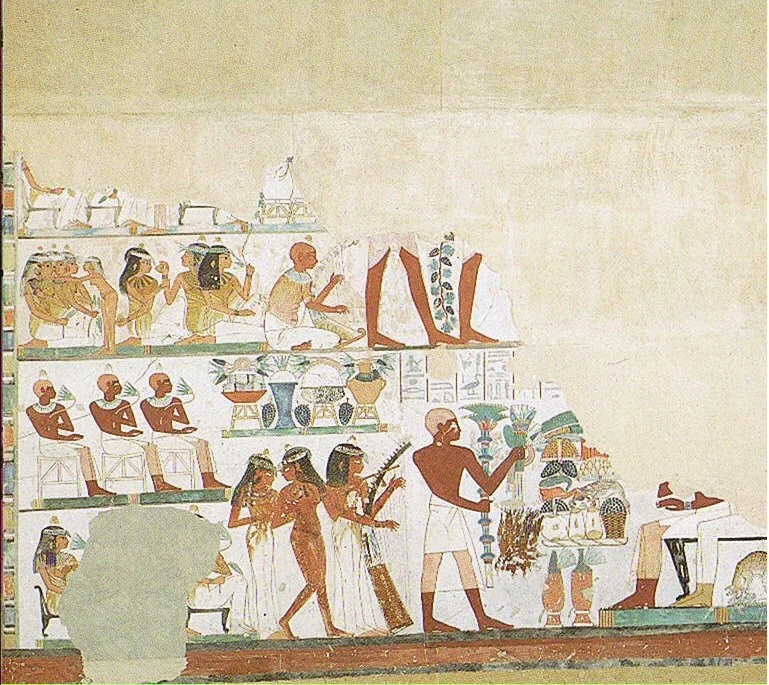
And those paintings — discovered around 1820, now displayed in Room 61 of the British Museum — are among the most extraordinary works of art to survive from the ancient world. They are also, for our purposes, the most vivid evidence we have of what an Egyptian feast actually looked like.
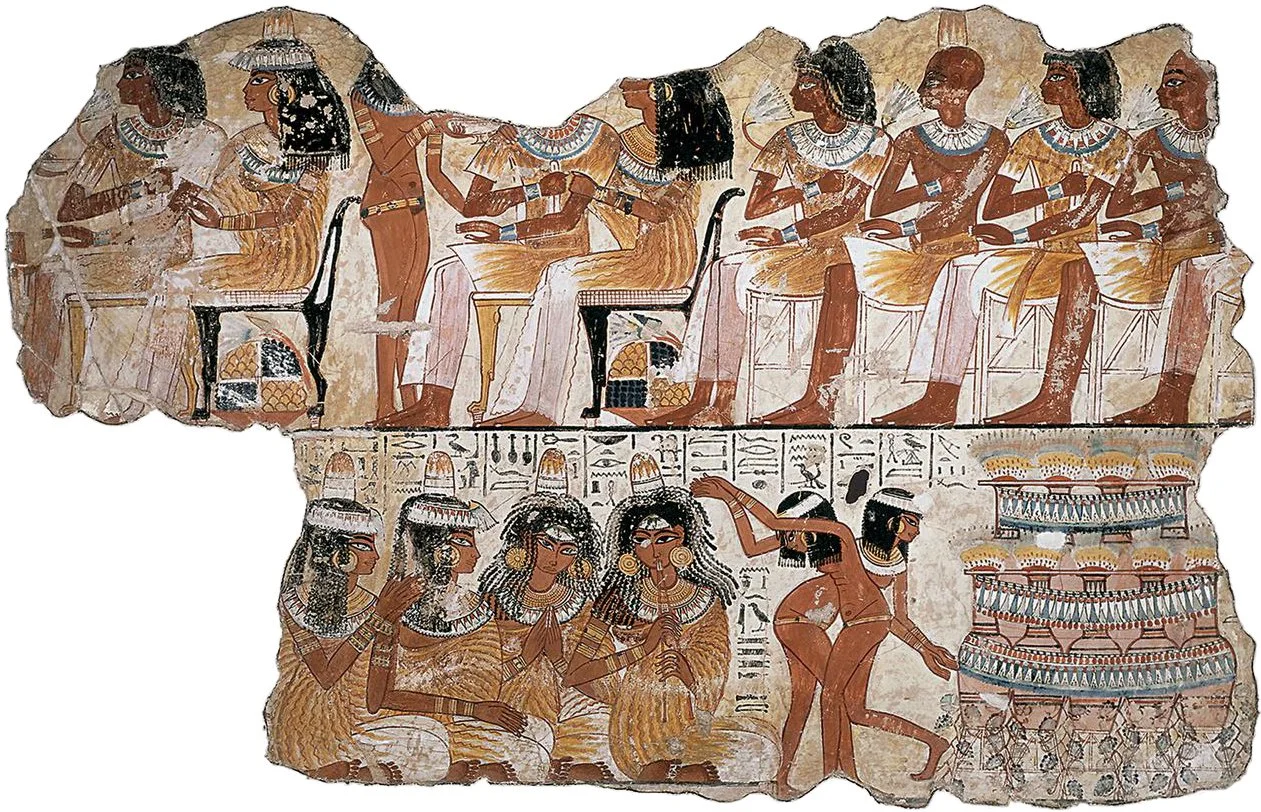
An entire wall showed a feast in honour of Nebamun. Serving girls and servants wait on his friends and relatives. All the guests wear elaborate linen clothes, painted as if transparent to show how very fine the fabric is. A rack of large wine jars is decorated with grapes, vines, and garlands of flowers. The guests wear more garlands and smell lotus flowers. Food offerings include sycamore figs, grapes, differently shaped loaves of bread, a roast duck, and joints of meat — luxuries that only the wealthy could afford.
Then there are the musicians. Four of them, frontally depicted — a deliberate break from the usual convention of Egyptian art, where everyone faces sideways. They are painted with such energy and rhythm that you can almost hear them.
The scene is a party. A genuinely warm, abundant, joyful party, painted with such love and precision that standing in front of it in the British Museum — which I have done, and which I urge you to do, because it is free and it will stop you in your tracks — you feel you could step straight into it.
What moves me most is why Nebamun painted it.
He didn't paint it to show off. He painted it because he believed that depicting the life he wanted would ensure it continued in the afterlife. The feast was not just a memory to be preserved. It was a future to be secured.
Gathering, for the ancient Egyptians, was not a moment to be consumed and forgotten. It was a moment worth making eternal.
Nebamun's party: the most famous feast in history
Let me introduce you to Nebamun.
He wasn't a pharaoh. Not a great noble. He was a middle-ranking scribe — a grain accountant at the temple of Amun at Karnak — who lived and died around 1350 BCE, a generation or so before Tutankhamun. Comfortably well-off by the standards of his day. Not spectacular. Not royal.
But Nebamun had his tomb painted.
And those paintings — discovered around 1820, now displayed in Room 61 of the British Museum — are among the most extraordinary works of art to survive from the ancient world. They are also, for our purposes, the most vivid evidence we have of what an Egyptian feast actually looked like.
An entire wall showed a feast in honour of Nebamun. Serving girls and servants wait on his friends and relatives. All the guests wear elaborate linen clothes, painted as if transparent to show how very fine the fabric is. A rack of large wine jars is decorated with grapes, vines, and garlands of flowers. The guests wear more garlands and smell lotus flowers. Food offerings include sycamore figs, grapes, differently shaped loaves of bread, a roast duck, and joints of meat — luxuries that only the wealthy could afford.
Then there are the musicians. Four of them, frontally depicted — a deliberate break from the usual convention of Egyptian art, where everyone faces sideways. They are painted with such energy and rhythm that you can almost hear them.
The scene is a party. A genuinely warm, abundant, joyful party, painted with such love and precision that standing in front of it in the British Museum — which I have done, and which I urge you to do, because it is free and it will stop you in your tracks — you feel you could step straight into it.
What moves me most is why Nebamun painted it.
He didn't paint it to show off. He painted it because he believed that depicting the life he wanted would ensure it continued in the afterlife. The feast was not just a memory to be preserved. It was a future to be secured.
Gathering, for the ancient Egyptians, was not a moment to be consumed and forgotten. It was a moment worth making eternal.
The cone on the head: Egypt's most wonderfully puzzling table manner
Right. We need to talk about the cones.
If you've ever looked at an ancient Egyptian tomb painting and thought: why does everyone appear to be wearing a small party hat? — you are in very good company. Scholars puzzled over this for the best part of two centuries.
The leading theory was that the cones were made of perfumed fat — myrrh, mostly — placed either on the shaved head or on top of a wig. As the afternoon wore on, the warmth of the room would cause them to melt slowly, releasing fragrance over the wearer. At a banquet, as the wine flowed and the musicians played, you were quite literally wearing slow-release perfume.
The original hair oil. Battery: unlimited.
More recent archaeology has complicated things slightly — actual cones excavated in burials at Amarna between 2009 and 2015, with findings published in 2019, appear to have been made of beeswax, were hollow, and showed no detectable perfume traces, though researchers note any scent may have fully evaporated over three thousand years. Whether the cones were functional, symbolic, or both remains genuinely unresolved.
The honest answer is: we're not entirely sure. Four thousand years of art history and we still can't say conclusively whether ancient Egyptians arrived at parties with melting hats or symbolic ones.
What we do know is that scent was absolutely central to every gathering. Before food was served, basins were provided for hand-washing, and flower-scented fat was burned to chase away insects and bad smells. The sensory experience of an Egyptian feast was carefully curated — the smell of the room, the smell of the food, the smell of the guests. All of it considered and intentional.
Which is an instinct we haven't lost at all. We just express it with candles, good wine, and that one fig diffuser we light before anyone comes over.
The Beautiful Feast of the Valley — history's longest-running outdoor supper club
Here is where things get genuinely extraordinary.
Imagine you live in ancient Thebes — what is now Luxor, in southern Egypt. Every year, in the second month of the harvest season, something remarkable happens.
The great temple at Karnak, on the east bank of the Nile, prepares for a procession. Priests carry golden statues of the three great Theban gods: Amun, Mut, and Khonsu. The procession moves from the east bank — the bank of the living, the rising sun — across the river to the west bank, the bank of the dead, the setting sun. The whole city follows.
On the west bank lie the necropolises, the royal mortuary temples, the tombs of everyone who has ever been buried there. And when the gods arrive, families gather at the tombs of their loved ones, bring flowers, food, and drink — and eat together. Beside the tombs. Among the dead. With music and dancing, wine and lotus flowers, in the warm Egyptian evening.
The wine was considered not merely a social pleasure but a ritual necessity. The Egyptians believed they needed to reach an altered state to truly commune with their departed loved ones. So they ate heartily and drank purposefully, as a spiritual act. Before the conversation with the dead could begin, there had to be a good old party.
There is also evidence from some tombs of people inhaling the scent of the blue lotus flower during these festivals — a plant now thought to have mild psychoactive properties. Whether the Egyptians knew this or simply found it beautiful and fragrant, we can't say. Either way, they weren't just decorating the table. They were very deliberately curating the experience.
The Beautiful Feast of the Valley is, in essence, the most ancient version of an idea we still recognise completely: that sharing food beside the people we've lost keeps something of them alive. The gathering itself is the remembrance. The meal is the connection.
It originated around 2000 BCE and continued — in one form or another — all the way to Roman times. Nearly two thousand years of annual outdoor feasting beside the Nile, in honour of those who had gone before.
History's longest-running al fresco supper club. And the invitation was open to everyone.
Packing for the afterlife: the original hamper
Here is the detail that stops me every time.
The ancient Egyptians were so genuinely committed to the idea that gathering and sharing food was fundamental to a good life that they made provisions for it after death.
The afterlife, in Egyptian theology, was not an abstract spiritual state. It was a continuation of life — with the same requirements. You would need food and drink in the afterlife, just as you did in this one. So you packed for it.
The dead could be buried with physical food offerings, stored in the tomb beside the mummy. Models of food and its preparation were also deposited, because the Egyptians had the rather elegant idea that a symbolic representation of the steps of food preparation would become magically real in the afterlife. As one archaeologist puts it: you didn't need to provide them with a recipe book; if you symbolically represented the steps, and left some of the ingredients in the tomb, everything would become magically ready for them in the afterlife.
In Tutankhamun's tomb alone, Howard Carter discovered over a hundred baskets containing wheat, barley, freshly baked loaves of bread, sycamore figs, dates, melons, and grapes. Wine in sealed jars. Mummified meat. A young king, buried with enough food for a feast that was never meant to end.
The simplest offering on many funeral stelae was bread and beer — the same food everyone ate every day, elevated by the act of offering it with love and intention. You didn't need to be a pharaoh for your family to pack you something for the journey.
The first pack-up picnic. For eternity.
How they ate: the etiquette of the Egyptian table
There were rules, of course. There are always rules.
The most fundamental: unmarried men and women were separated, and status determined your seat — chair, stool, or floor — with no ambiguity whatsoever. You knew where you belonged, and you sat there.
In wealthier households, servants brought courses one by one, placing them on small tables beside the diners. People ate with their fingers, rinsed between courses in basins of water. The basins arrived before the food, along with aromatics — flower-scented fat burned to make the room smell good and drive away insects. You didn't just think about what to cook. You thought about how the room would smell.
Music was not optional — it was structural. Professional dancers entertained, accompanied by musicians playing harps, lutes, drums, tambourines, and clappers. The goddess Hathor — goddess of joy, music, love, and beauty — was frequently invoked during feasts. You didn't simply host a good dinner. You invited a goddess to it.
And the lotus flower was everywhere. It appears in almost every Egyptian banquet scene — guests wear it, hold it, smell it deeply. The blue lotus in particular is now thought to have had mild psychoactive properties, possibly used to ease the boundary between the living and the spiritual. Whether they understood this fully or simply found it beautiful, the Egyptians were not decorating their tables with flowers for aesthetics alone.
They understood, in a way that feels very modern and very human all at once, that a great gathering is never just about the food.
© The Trustees of the British Museum. Shared under a Creative Commons Attribution-NonCommercial-ShareAlike 4.0 International (CC BY-NC-SA 4.0) licence.
You are doing the oldest thing humans do
I've been thinking about ancient Egypt and picnics for longer than is probably entirely reasonable.
What I keep coming back to is this.
The Egyptians understood — in their bones, in their theology, in the very way they buried their dead — that sharing food in the open air, with the people you love, is not ordinary. It is not a practical alternative to eating indoors. It is not a lifestyle choice or an aesthetic preference.
It was sacred.
Not solemn — their feasts were full of music, dancing, flowers, good wine, and melting myrrh hats. They were joyful. Exuberant, even. But they were also intentional. Deliberate. Set apart from ordinary daily eating by the effort, the presentation, the performance of abundance and gratitude. These were not ordinary meals. Everyone knew the difference.
That is not so very different from what happens when you lay a cloth on the grass, unpack the cheese, pour the wine, and your children start rolling down a hill and your friend says something that makes you laugh so hard you spill everything.
You are not "just having a picnic."
You are doing the oldest thing humans do.
Come and see
The feast scene from Nebamun's tomb chapel is in Room 61 of the British Museum, London — entry is free. Go on a weekday morning when it's quieter, and give yourself a proper moment with it. It is extraordinary.
The Metropolitan Museum of Art in New York also holds a wonderful collection of Egyptian food and feast artefacts, many available to view in high resolution on their website alongside their brilliant curatorial essay Food and Feasts in Middle Kingdom Egypt. Worth an afternoon down the rabbit hole, I promise you.
Next in The Picnic Chronicles: Ancient Rome — where they practically invented the picnic as social theatre, reclining in garden triclinia with philosophy, poetry, and an alarming quantity of something called garum. You'll want to come for that one.
With love, Gemma x
Further reading:
Smarthistory — Paintings from the Tomb-Chapel of Nebamun — beautifully written, free, and one of the best art history resources on the internet (smarthistory.org)
The British Museum, Room 61: Egyptian Life and Death — search "Nebamun" for the full feast scene in high resolution (britishmuseum.org/collection)
The Metropolitan Museum of Art: Food and Feasts in Middle Kingdom Egypt — their curatorial essays are exceptional and all free to read (metmuseum.org)
World History Encyclopedia: Festivals in Ancient Egypt — thorough, well-sourced, endlessly useful (worldhistory.org)
History Cooperative: Ancient Egyptian Food — More Than Beer and Bread (historycooperative.org)
National Geographic: Ancient Egyptian Head Cone Mystery Solved, 2019 — the cone revelation, properly explained (nationalgeographic.com)
The Curious Egyptologist: The Beautiful Festival of the Valley (thecuriousegyptologist.com)
Tastes of History: What Did the Ancient Egyptians Eat? (tastesofhistory.co.uk)
Wikipedia: Ancient Egyptian Cuisine; Beautiful Festival of the Valley; Head Cone — a genuinely good starting point with solid citations throughout
The Picnic Chronicles — the full series
A complete history of outdoor feasting, from the ancient world to the present day. Each post stands alone, but they're rather good together.
Vol. I — Ancient Egypt: The Original Outdoor Feast
Vol. II — Ancient Rome: The Civilised Outdoor Feast
Vol. III — Ancient Greece: When the Symposium Went Outside (coming soon)
Vol. IV — The Medieval Hunt Feast: Picnics for the Powerful (coming soon)
Vol. V — The Renaissance & The Fête Champêtre: Picnics as Art (coming soon)
Vol. VI — Georgian England: When Picnics Became a Word (coming soon)
Vol. VII — The Victorians: The Golden Age of the British Picnic (coming soon)
Vol. VIII — Edwardian & Early 20th Century: The Picnic at Its Peak (coming soon)
Vol. IX — Post-War to the 1970s: The Democratic Picnic (coming soon)
Vol. X — The 1980s–2000s: The Picnic Gets Complicated (coming soon)
Vol. XI — The Modern Picnic Renaissance: 2010 to Now (coming soon)
Stay a while …