The Picnic Chronicles, Vol. II: Ancient Rome — The Civilised Outdoor Feast
Part of The Picnic Chronicles — a journey through the entire human history of gathering, feasting, and eating outdoors. From ancient civilisations to the present day, this series traces the one instinct that has never changed: the urge to share food somewhere beautiful, with the people you love. Browse the full series below.
If Egypt gave us the instinct to gather outdoors and make it sacred, Rome gave us something arguably more dangerous. - It gave us standards.
The Romans didn't just eat outside. They thought very hard about it. They had opinions about it. They wrote letters complaining about friends who didn't show up to it. They built entire architectural wings of their villas specifically for it, angled to face the garden, the sea, or the best view of the Apennine hills. They had rules about who sat where, which wine you mixed with how much water, and whether it was vulgar to eat lying down.
(It was not. Lying down was, in fact, mandatory. More on this shortly.)
Ancient Rome is, I'd argue, where the picnic becomes not just a human instinct but a cultural institution. And it is considerably more chaotic, considerably more funny, and considerably more us than anything the history books usually let on.
The world that shaped the Roman table
Rome, at the height of the Empire, was a city of roughly one million people — an almost incomprehensible number for the ancient world. It was loud, crowded, stratified, and obsessed with food. Not just eating it, but what eating it said about you.
Maintaining the food supply to the city of Rome had become a major political issue in the late Republic, and continued to be one of the main ways the emperor expressed his relationship to the Roman people. Bread was power. Wine was diplomacy. The feast was theatre.
Trade networks across the Empire meant a Roman table could carry olives from Spain, garum from Portugal, spices from the east, oysters from Britain, wine from Gaul. The variety of foodstuffs available through the expanded trade networks of the Roman Empire transformed what Romans ate and what they expected when they sat down together.
For ordinary Romans — and most Romans were ordinary — meals were simple. Many lived in cramped apartment blocks with no kitchen and no open fire, buying food from street stalls and taverns. Seneca the Younger, writing from his apartment, complained about the constant noise from the street outside: the cakeseller with his varied cries, the sausageman, the confectioner, and all the vendors of food hawking their wares, each with his own distinctive intonation. Rome's streets were, essentially, one long permanent food market. Most people ate two meals a day: a morning snack of bread with olive oil, olives, or cheese, and then the main event — the cena — in the late afternoon, once the day's work was done and, if you were wealthy enough, the baths had been visited.
But it's not the street food we're really here for, is it.
The convivium: living together, eating together
The Romans had a word for their great communal gathering — the dinner party, the feast, the shared meal. They called it the convivium.
Which, if you translate it literally, means living together.
Not eating together. Not dining together. Living together. The Romans understood, in the word itself, that sitting down to share food was not a functional act but a human one. It was the thing that made you part of a community, a family, a society. It was, in the most precise sense, what life looked like when it was being properly lived.
A proper convivium had structure. Three courses: the gustatio (hors d'oeuvres), the mensae primae (main course), and the mensae secundae (dessert). Before any of it, guests arrived and were greeted with a bowl of water to wash their hands. They changed from outdoor shoes into lighter indoor sandals — a purification ritual that also prevented the soil of Rome's streets coming anywhere near a host's mosaic floors. The host then presented them with dining wreaths made of plants sacred to whatever gods were being honoured that evening. You didn't just arrive for dinner. You arrived for an occasion.
Music accompanied the meal — musicians, singers, poets, dancers, and on more spirited evenings, acrobats and mime actors. Conversation was expected to be sharp, engaged, and calibrated carefully to your position at the table. Guests were expected to contribute to the atmosphere but avoid speaking too much, especially if of lower status. Knowing how to engage without overstepping was a crucial social skill, and one that Romans took very seriously.
And then there was the wine. Romans drank their wine mixed with water — drinking it unmixed was considered the mark of a barbarian, which tells you everything you need to know about Roman cultural confidence. The Romans had a phrase for it — in vino veritas, truth in wine, recorded by Pliny the Elder and rooted in a much older Greek saying — though the ideal was always the warm loosening of conversation, not the loss of it. The goal was lucid enough to be witty, relaxed enough to be honest.
The lying-down problem: triclinium and the art of reclining
Now. I need to explain the furniture situation.
Romans, at formal dinners, did not sit upright at a table. They reclined. On couches. Leaning on the left elbow, lying at a slight angle toward the low table in the centre, propped on cushions, eating with the right hand.
This practice — adopted from Greek dining culture — had been considered slightly shameful for respectable women in the early Republic. By the Imperial period, women reclined alongside men at dinner parties. Some old conservatives still muttered about it disapprovingly, but they were losing the argument.
The room itself was called the triclinium — literally, the three-couch room. Three wide couches were arranged in a U-shape around a central table: the lectus imus (the low couch, where the host sat), the lectus medius (the middle couch, for the most honoured guests), and the lectus summus (the high couch, for the slightly less honoured). Each couch held three diners; nine people around one table was considered the ideal number. The middle position on the middle couch — the locus medius — was the seat of highest honour, positioned so you could speak easily with the host and look out at whatever view the room had been designed to frame.
Because the view mattered enormously. Dining rooms were frequently oriented toward a garden, creating an elegant visual connection between architecture and nature. Grander houses had a summer triclinium built outside — in the garden itself, or overlooking it — where the open air was part of the dining experience. The very wealthiest Romans had multiple triclinia for different seasons, different numbers of guests, different levels of intimacy.
This is outdoor dining not as a charming exception but as an architectural ambition. They built it into the house. They planned the sightlines. They thought about the light, the garden, the air, the view. They understood, in the way that only someone who has eaten a truly beautiful meal outside ever properly understands, that where you eat is part of what you taste.
What they actually ate — and some of it is alarming
Right. Let's talk about the food.
A proper Roman dinner for the affluent began simply enough. The gustatio — the appetiser course — might bring eggs, salted fish, olives, raw vegetables, and mulsum, a sweet wine mixed with honey. Civilised. Pleasant. The kind of opening course you could absolutely imagine now.
Then things escalate.
The main course at elite tables leaned toward the rare, the difficult, and the deliberately extravagant. Popular but costly fare included pheasant, thrush, raw oysters, lobster, venison, wild boar, and peacock. Foods that were actually forbiddenby sumptuary laws — laws designed to curb aristocratic excess — such as fattened fowl and sow's udders were flagrantly consumed at the most exclusive feasts. The breaking of the law was, rather wonderfully, part of the point.
The Roman gourmand Apicius — whose cookbook De Re Coquinaria is the oldest surviving culinary text in Europe, a document of such glorious excess that it reads as both a recipe book and a confession — gives us recipes for flamingo, ostrich, jellyfish, roast parrot, and sow's womb. He was also apparently very fond of something he developed called porcine foie gras — fattening pigs on dried figs and slaughtering them with an overdose of mulled wine, in imitation of the duck foie gras he'd encountered in Egypt. The story of Apicius's death, recorded by Seneca, is one of the great Roman cautionary tales: having spent the equivalent of 100 million sestertii on his kitchen over his lifetime, he looked at his remaining funds — a mere 10 million sestertii — and, unable to face the prospect of living modestly, poisoned himself.
Pliny the Younger gives us a rather more sobering picture of honest Roman entertaining. In a famous letter to his friend Septicius Clarus (Book I, Letter 15), he scolds him for skipping a dinner party: All ready were a lettuce each, three snails, two eggs, and a barley cake, with some sweet wine and snow — olives, beetroot, gourds, bulbs, and a thousand other things no less appreciated. You would have heard comic actors or a poetry reader or a lyrist — or, such is my generosity, all three. The friend, meanwhile, had gone somewhere else for oysters, sow's wombs, sea urchins, and dancing girls from Cadiz. Pliny is outraged. The letter is extremely funny. Nothing about Roman dinner party anxieties has changed in two thousand years.
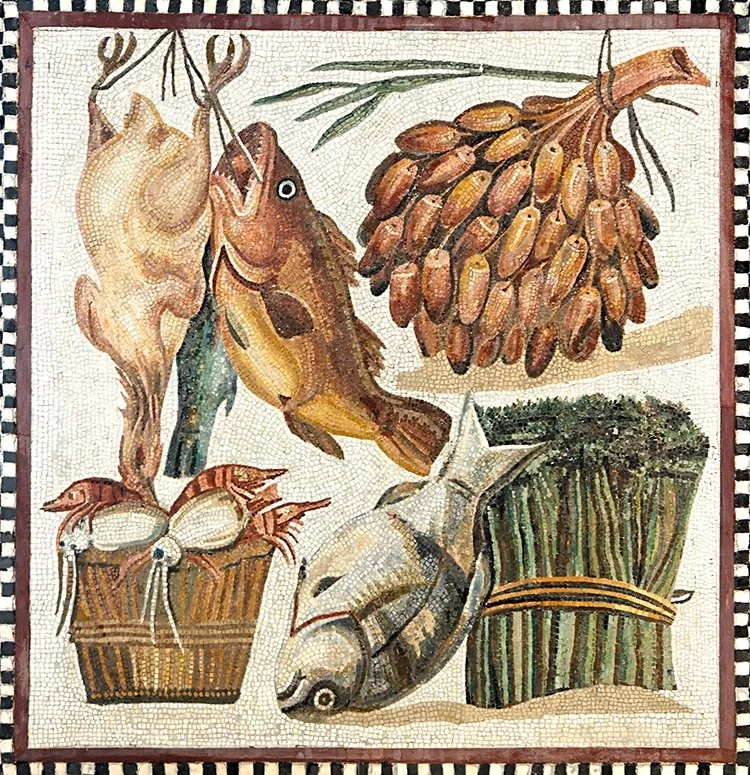
A 2nd century CE Roman mosaic showing a food still life, currently in the Vatican Museum. (Photo: Wikimedia Commons [Public domain])
Garum: the thing everybody's talking about
I promised you garum in the last post, and I will not disappoint.
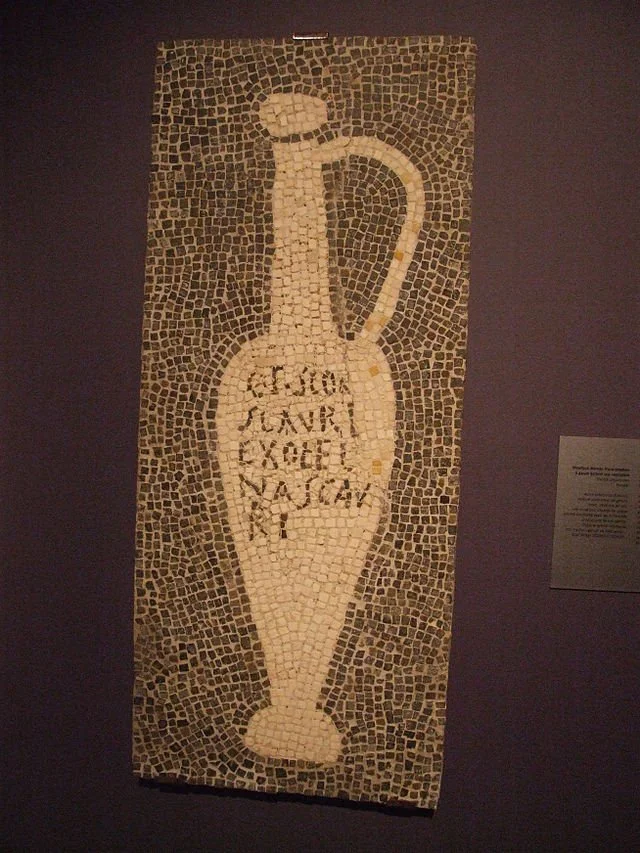
Garum was ancient Rome's most essential condiment. It appeared in almost every recipe in Apicius. It was on every table, in every house, at every level of Roman society. It was, to the Romans, what olive oil and soy sauce are to us today — the background note that made everything else taste more intensely like itself.
It was also fermented fish sauce, made by packing fish guts and salt together in large open vats and leaving them in the Mediterranean sun for up to three months to liquefy.
The smell of the factories was so powerful that they were legally required to be built outside city walls. Seneca wrote, with magnificent disdain, that garum was the expensive bloody mass of decayed fish that consumes the stomach with its salted putrefaction. He considered it a moral failing.
Pliny the Elder, on the other hand, thought the finest garum smelled like perfume.
These two positions describe, I think, the entire human experience of strong cheese, and I find them both completely relatable.
Here's the thing about garum: once researchers actually recreated it properly — scientists at the University of Cádiz, working from the remains of ancient factories at Baelo Claudia and ancient recipes — they discovered it smelled like a mixture of dried fish, seaweed, and spices. Concentrated, intense, but not offensive. And it tasted, unmistakably, of umami — the deep savoury fifth taste that we now associate with parmesan, soy sauce, and anchovies. Because garum isanchovies, essentially. The closest modern equivalent is Worcestershire sauce, which actually traces its origins directly back through the centuries to garum.
So the next time you splash Worcestershire sauce into your shepherd's pie or your Bloody Mary, know that you are participating in an unbroken culinary lineage that runs through medieval monasteries, through Byzantine kitchens, through the height of the Roman Empire, all the way back to an open vat of fermenting fish on the coast of Spain in 50 AD.
You're welcome.
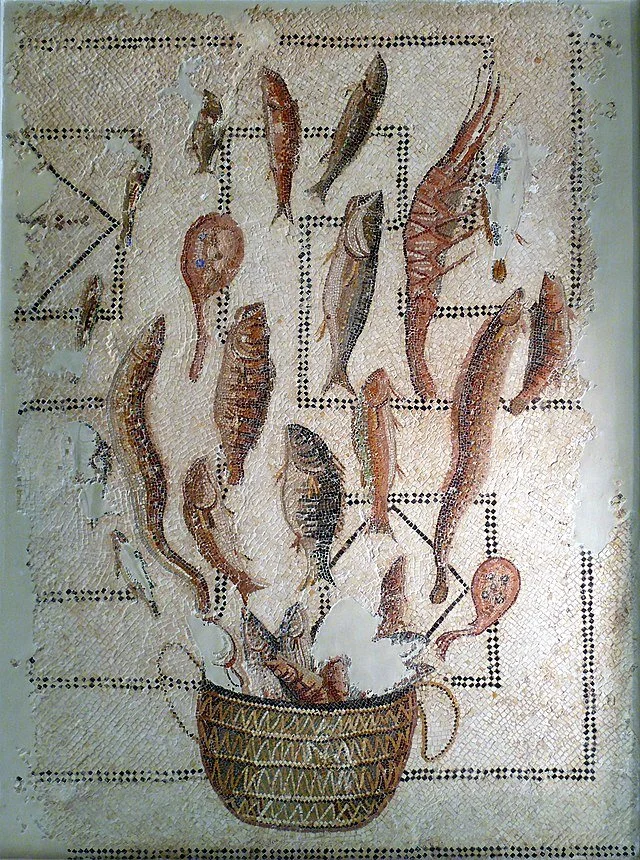
second-century-roman-house-mosaic-from-triclinium-sousse-musecc
Taking it outside: the Roman garden feast
Banquets were often held in the gardens (horti) or peristyles of patrician houses, where the open air and nature helped make the experience of food something deeper than mere nourishment.
Pliny the Younger's letters — among the most intimate documents to survive from ancient Rome — describe his beloved villa at Laurentum on the Italian coast in rapturous detail. He writes of a terrace fragrant with the scent of violets, warmed by the reflection of sun from a portico. Of a dining room with windows on both the garden side and the sea, so that the view could be shifted depending on where the wind was coming from. Of the soft sound of the sea at night reaching his bedroom while he slept. Of the mulberry and fig trees in the garden, the alley of vines soft enough to walk through barefoot.
This is not the description of a man enduring outdoor dining. This is the description of a man who has arranged his entire house — his entire life — around the pleasure of eating beautiful food in beautiful surroundings, with the garden visible, the sea audible, and the right friends present.
Seneca, who was generally suspicious of luxury, nevertheless described his own simple outdoor eating with quiet affection. He apparently picnicked regularly on bread and figs alone — and called it, with philosophical satisfaction, like having a New Year feast every day. The act of eating simply, outside, freely — without performance or obligation — was its own form of abundance.
And this is where we find the real heart of Roman outdoor dining. Not in Apicius's flamingo tongues or the peacock at Trimalchio's feast, but in the ordinary Roman with a hunk of bread, some olives, and a good view. The Romans feasted in sacred groves after hunts. They picnicked on beaches. The wealthy built garden triclinia to eat outdoors by design. The poor ate in the street because they had no choice, and found community there anyway.
Outside was always, for the Romans, better.
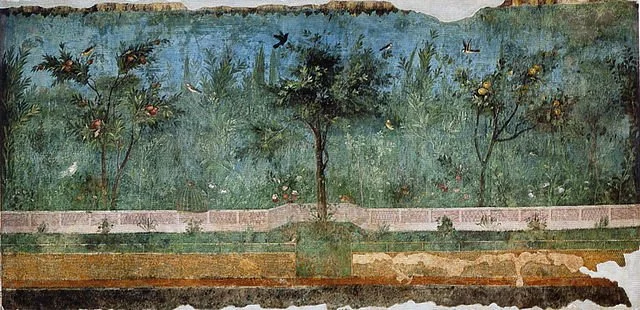
Roman garden fresco — from Pompeii's Villa of Livia
What Pompeii tells us — the most extraordinary picnic hamper in history
In October of 79 AD, Mount Vesuvius erupted and buried the city of Pompeii under metres of volcanic ash and pumice. It was a catastrophe that killed thousands.
It was also, for those of us obsessed with what people ate and how they gathered together, the most extraordinary accidental archive in human history.
The ash preserved everything. The food on the tables. The bread in the ovens. The jars of wine with fava beans settled at the bottom. The thermopolia — the Roman equivalent of a street-food counter, with large ceramic dolia jars set into the counters to keep food warm, exactly like a modern bain-marie — still mid-service when the mountain exploded.
Carbonised plant remains found at Pompeii, Herculaneum, and the Roman villa at Torre Annunziata reveal the actual Roman pantry: emmer wheat, millet, walnuts, pine nuts, chestnuts, hazelnuts, chickpeas, broad beans, olives, figs, pears, onions, garlic, peaches, carob, grapes, and dates. A Mediterranean diet so recognisable, so close to what we eat today, that it is quietly astonishing.
And in latrine deposits — which archaeology has, bravely, investigated — they found the jaw of a dormouse and the bones of a songbird. Luxury menu choices that would have technically fallen foul of Rome's sumptuary laws. Which tells you that even facing the buried evidence, Romans were doing exactly what the rich have always done at dinner parties: eating whatever they liked, regardless of what the rules said.
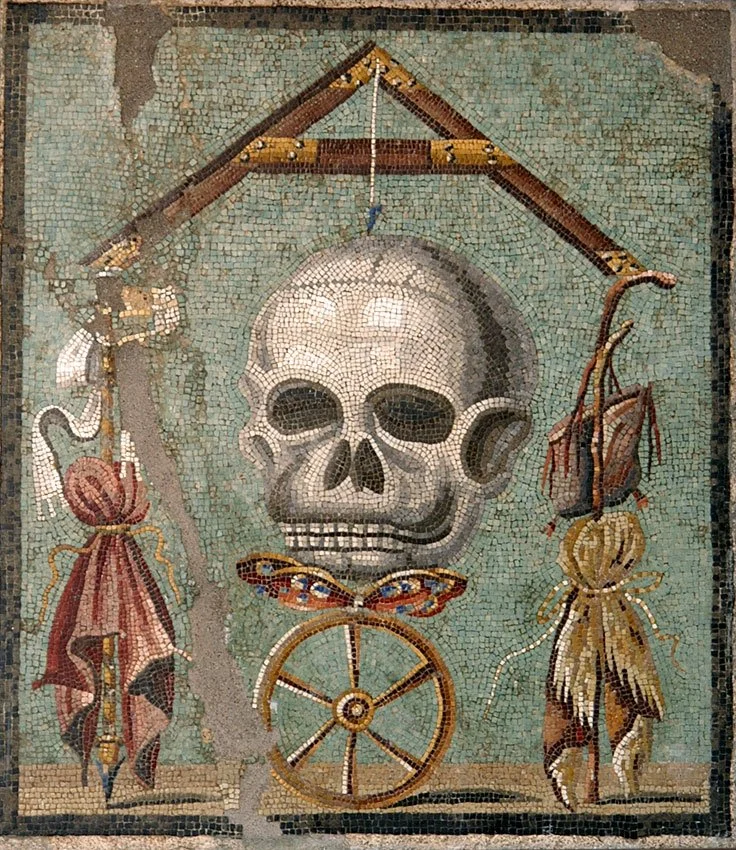
At the House of the Vestals in Pompeii, there was a floor mosaic of a skeleton carrying two wine jugs. It was laid beneath the dining room, visible to every guest. The phrase it was designed to evoke was memento mori — remember you will die. The Romans placed it at their feasts as a reminder to enjoy, fully, the meal and the company in front of them. Not morbidly. Joyfully. The skeleton was not a warning. It was a permission slip.
This is where I feel most connected to the ancient Romans. Not in the peacock or the garum. But in that mosaic. In the idea that the meal in front of you — this one, tonight, with these people — is worth every bit of your attention. Worth the good tablecloth. Worth the flowers. Worth the trip to the farm shop on Saturday morning. Worth stopping to notice.
The etiquette of the Roman table
The Romans, it will not surprise you to learn, had very strong opinions about table manners.
Correct posture was non-negotiable. Sitting upright was considered rustic — the mark of someone who didn't know better. Reclining while dining had been adopted from Greek custom and was firmly associated with civilised freedom. Slaves and those of lower class ate seated or standing. To recline was to announce, without saying a word, that you were a Roman of standing.
You ate with your right hand. Your left hand supported you on the cushion. There were specialist slaves for every task: the structores who carved the meat, the aqua venatores who poured the water, the nomenclatores who announced the names of arriving guests. Before eating, handwashing was provided. Between courses, more handwashing. The Romans were, for all their excesses, extremely clean at the table.
Wine protocol was equally precise. You mixed it with water — the ratio depending on the occasion and the company — and you drank in toasts. To drink too quickly was boorish. To drink nothing was suspicious. To know exactly how much to drink, and to remain witty and engaged while doing so, was the mark of a true Roman host.
Gift-giving was part of the ritual too. Hosts sometimes sent guests home with small gifts — called apophoreta — wrapped parcels of leftover food or small tokens. The tradition of the party bag, then, turns out to be entirely Roman. You are welcome to deploy this fact at your next children's birthday party.
And food itself was chosen for its power to impress. Exotic produce — things from wild animals, birds, and fish — were favoured at elite dinner parties because of their rarity, difficulty of procurement, and consequent high cost, which reflected the host's affluence. The provenance of ingredients was considered extremely important. Romans cared very much about where their food came from. They were, in this particular respect, remarkably modern.
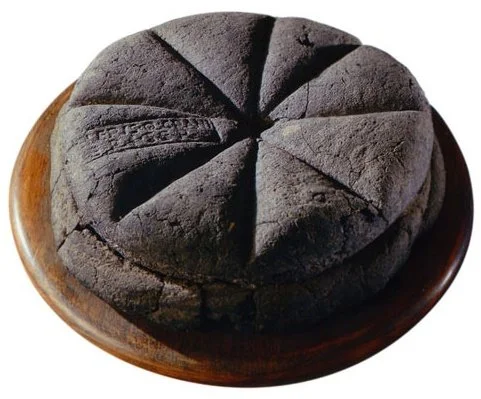
Carbonised bread from Pompeii
A short note on the people who couldn't recline
Rome was not — I should say this plainly — a society of equal gatherings. The convivium was a display of hierarchy as much as a celebration of community. Where you sat, what you were served, whether you reclined or stood — all of it was calibrated to reflect the social order. Hosts were known to serve different wine to guests of different ranks, a practice Pliny the Younger found deeply distasteful and wrote about with some heat.
The vast majority of Romans ate simply and ate standing up. Street food was the reality of Roman life for most people — the thermopolia that lined Pompeii's streets served hot food to workers who had no kitchens, no triclinia, no garden view. They ate quickly, at a counter, and got back to work.
And yet — and this is what I love — those thermopolia were also gathering places. Evidence of socialising, of community, of people who had no table of their own finding one together in the street. The instinct to eat alongside other people didn't require a mosaic floor or a garden triclinium. It required only other people.
What the Romans leave us with
Rome borrowed enormously from the cultures it conquered — the reclining couch from Greece, the garum from the Greeks and Phoenicians, the spices from the east, the vineyard techniques from Gaul. What it gave back was a systematic, expansive, gloriously opinionated culture of eating together that spread, via Roman roads, Roman legions, and Roman trade routes, across the entire known world.
Including Britain.
Including Somerset.
The Romans were in Somerset from roughly 43 to 410 AD. They built roads, villas, and bathhouses across the county. The city of Bath — Aquae Sulis — was a Roman spa town. There were Roman villas at Shepton Mallet, at Keynsham, at Wellow. The soldiers stationed here brought their food culture with them: olives, wine, garum, the habit of the garden feast. The Corinium Museum in Cirencester holds extraordinary evidence of Romano-British dining — mosaics, tableware, food remains.
The Romans ate in the gardens of their Somerset villas, looking out over the same hills I drive past on my way to the farm shop. The Mendips, the Quantocks, the Somerset Levels — all of them witnessed, at some point, a Roman reclining on a cushion, eating olives out of a ceramic bowl, watching the late afternoon light.
The picnic did not begin here. But here, in Rome, it found its confidence. It became deliberate. It became something people arranged their houses around, wrote letters about, argued the etiquette of, and named with a word that means living together.
That word still works rather well.
Where to go next
The Ashmolean Museum in Oxford held an extraordinary exhibition called Last Supper in Pompeii — if it travels again, go immediately. The carbonised bread alone is worth the trip.
The Roman Baths in Bath are thirty-five minutes from most of Somerset and are a genuinely wonderful afternoon. Stand at the water and think about a Roman soldier eating olives in your county, 1,800 years ago, thinking it was cold and missing home.
Apicius: Cookery and Dining in Imperial Rome, translated by Joseph Dommers Vehling, is available free on Project Gutenberg and is one of the strangest and most entertaining afternoons of reading you will ever have.
Next in The Picnic Chronicles: Ancient Greece — where the symposium went outside, philosophy met olives, and the picnic became intellectual.
And after that: The Medieval Hunt Feast — which is exactly as dramatic as it sounds.
With love Gemma x
The Duchess of Picnics
Further reading
The Metropolitan Museum of Art: The Roman Banquet — one of the best free essays on Roman dining culture anywhere online (metmuseum.org)
Getty Iris: Reclining and Dining (and Drinking) in Ancient Rome — wonderfully detailed on the triclinium and seating protocol (blogs.getty.edu/iris)
Pompeii Archaeological Park: Baking, Banquets, and Boiling Pots — the food evidence from Pompeii, written by the people who dug it up (pompeiiarchaeologicalpark.com)
Smithsonian Magazine: From Baked Dormouse to Carbonized Bread — the Ashmolean exhibition piece, brilliantly written (smithsonianmag.com)
National Geographic: What Is Garum? — the full story of Rome's most essential and most alarming condiment (nationalgeographic.com)
The Conversation: Why Ancient Romans Loved Fermented Fish Sauce — the science of garum, accessibly explained (theconversation.com)
Neel Burton: The Roman Dinner Party — a short, sharp, extremely good read (neelburton.com)
Pliny the Younger: Letters — free on Project Gutenberg; the dinner party letter is Book II, Letter VI. Worth every minute (gutenberg.org)
Apicius: Cookery and Dining in Imperial Rome — the oldest surviving European cookbook, also free on Project Gutenberg. Strange, magnificent, unmissable (gutenberg.org)
Wikipedia: Food in Ancient Rome; Triclinium; Garum; Convivium — solid foundations, well cited

The Picnic Chronicles — the full series
A complete history of outdoor feasting, from the ancient world to the present day. Each post stands alone, but they're rather good together.
Vol. II — Ancient Rome: The Civilised Outdoor Feast (you are here)
Vol. IV — The Medieval Hunt Feast: Picnics for the Powerful (coming soon)
Vol. V — The Renaissance & The Fête Champêtre: Picnics as Art (coming soon)
Vol. VI — Georgian England: When Picnics Became a Word (coming soon)
Vol. VII — The Victorians: The Golden Age of the British Picnic (coming soon)
Vol. VIII — Edwardian & Early 20th Century: The Picnic at Its Peak (coming soon)
Vol. IX — Post-War to the 1970s: The Democratic Picnic (coming soon)
Vol. X — The 1980s–2000s: The Picnic Gets Complicated (coming soon)
Vol. XI — The Modern Picnic Renaissance: 2010 to Now (coming soon)

![[Public domain])](https://commons.wikimedia.org/wiki/File:Still_life_Tor_Marancia_Vatican.jpg)
The Piknic Club
Life is too short for boring picnics.
The Piknic Club is where the blanket-spreading, basket-packing, joy-seeking community lives. Seasonal boxes, curated picks, and the kind of picnic inspiration that makes you want to drop everything and go outside immediately.
Discover more …

Come and be nosey …
The blanket is always out over on Instagram. Behind the scenes Picnicscapes, Somerset life as it actually happens, and the occasional opinion about gingham.