
We Were Never Meant to Eat Alone
The biology of gathering — and why your picnic blanket might be the most radical thing in your house.
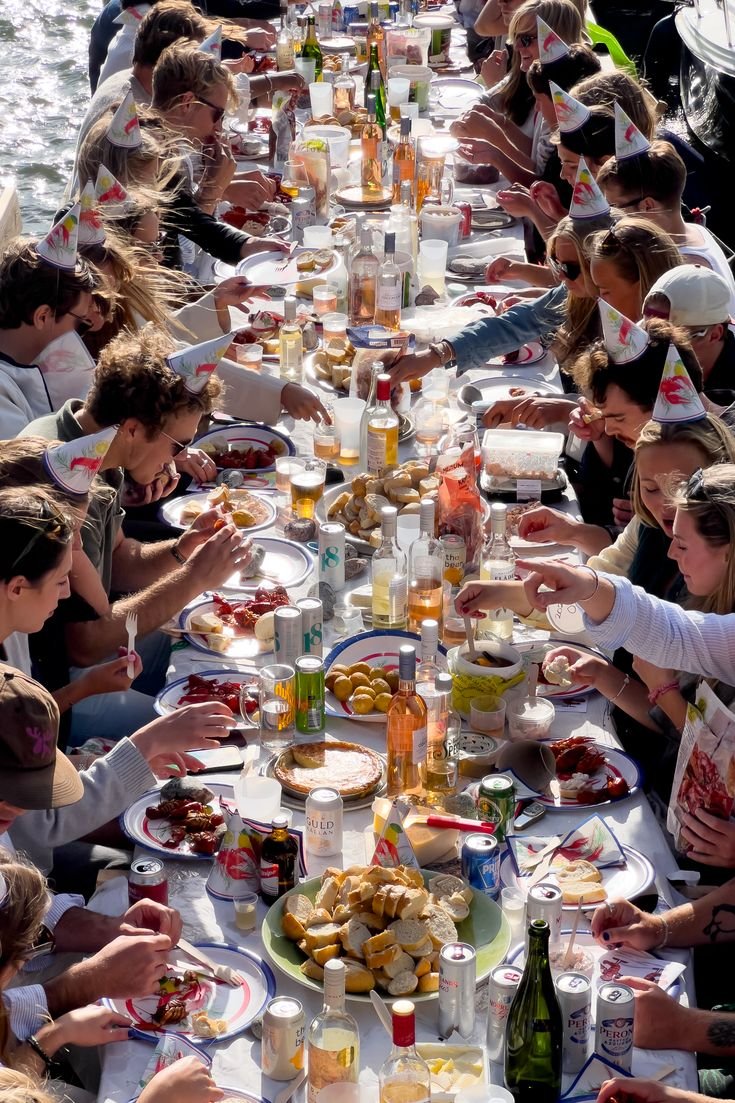
Part of The Joy of Gathering — a series exploring the science, the soul, and the practical art of coming together.
There's a study I keep returning to.
Researchers at the University of Oxford asked a large group of people a simple question: think about a recent meal you shared with others. Now think about a recent meal you ate alone. Which felt better?
The answer was unanimous. Obvious, even. The shared meal, every time - more enjoyable, more nourishing, more memorable. Not because the food was better. Because the company was there.
Here's what gets me though. We already knew that. We have always known that. We've known it since before we had language for it, since long before we had research papers confirming it in peer-reviewed journals. We feel it in our bones, in the particular warmth of a table that has people around it, in the way food tastes different when someone passes it to you.
And yet.
We eat at our desks. We scroll through dinner. We order something delivered and eat it in front of something we're only half-watching, in a room by ourselves, in a house full of people who are also, technically, in rooms by themselves.
We know gathering matters. We do it less than any previous generation in recorded history.
So what's actually going on? And - this is the bit I find genuinely fascinating - what is happening to our bodies when we finally, actually, properly sit down together?
We Are Wired for This
Let me take you back considerably further than the Oxford study. About 300,000 years, give or take.
Homo sapiens didn't survive because we were the biggest, or the fastest, or the most individually impressive. We survived because we gathered. We cooked together, ate together, moved together in groups that kept each other fed, warm, and alive. The communal fire was not a lifestyle choice. It was survival infrastructure.
Professor Robin Dunbar at Oxford - yes, Oxford again, they are really committed to this question - has spent decades studying the evolutionary biology of social bonding. His work on what we now call Dunbar's Number famously suggested that humans can maintain roughly 150 meaningful social relationships. But his research into shared eating goes further than headcounts.
Dunbar found that eating together triggers the release of endorphins - the same neurochemicals released during exercise, laughter, and physical touch - at a rate and consistency that eating alone simply does not replicate. Not because we consciously enjoy the company (though we do). But because our bodies were designed for this. The shared meal is not a cultural nicety. It's a biological event.
We were, in the most literal sense, built to gather around food.
And somewhere between the rise of the ready meal, the desk lunch, and the algorithm that serves us just enough stimulation to make sitting alone feel fine - we quietly, politely forgot.

What Happens When You Finally Sit Down Together
Here's the part that should probably be on the national curriculum.
When you gather with people - really gather, present and unhurried, food involved, phones not - a cascade of things happens in your body that no supplement, no self-care routine, and absolutely no amount of optimised sleep tracking can replicate.
Oxytocin rises. Sometimes called the bonding hormone - though it does considerably more than its nickname suggests - oxytocin is released during face-to-face social contact, shared laughter, and physical proximity. It reduces cortisol, which is the stress hormone your body has been quietly marinading in since approximately 2020. It increases trust. It makes you feel, in the most biological sense of the word, safe.
Your nervous system shifts gears. Polyvagal theory - developed by neuroscientist Stephen Porges and now one of the most exciting frameworks in psychology — describes a state called ventral vagal activation. This is your nervous system's rest-and-connect mode: the state in which your body registers that it is with people it knows, that there is no threat, that you can exhale properly. It's the physiological opposite of low-level anxiety, and it is specifically, evolutionarily triggered by the presence of safe others. By a face you recognise. By the sound of someone you love eating near you.
Cortisol drops. Multiple studies confirm that brief, positive social interactions reduce cortisol levels measurably. Not after a week of consistent socialising. After one meal. One conversation. One hour outside with people and a blanket on the ground.
Mirror neurons do their quiet, extraordinary work. When you sit with someone who is relaxed, your neurons fire in patterns that mirror their state. When they laugh, you're primed to laugh. When they let their shoulders drop, something in you follows. This is not emotional weakness or susceptibility. This is your brain doing exactly what it was designed to do: read the room, sync up, and regulate through connection.
Barbara Fredrickson at the University of North Carolina calls this positivity resonance - the moments when two people are genuinely, synchronously present with each other, and something passes between them that is measurably different from being near each other without connecting. She has spent her career demonstrating that these moments - brief, ordinary, gloriously unremarkable - are the actual building blocks of human wellbeing.
Not the big holidays. Not the grand gestures. The moment someone passes you the bread. The moment a child leans against your arm. The moment the conversation quiets and you're both looking at the same view, and neither of you feels the need to say anything.
Those moments, repeated, are the closest thing to a formula for a joyful life that science has managed to produce.
The Loneliness Paradox
We are the most connected generation in human history. We carry communication devices in our pockets. We can speak to anyone, anywhere, at any moment.
We are also, according to Julianne Holt-Lunstad's landmark meta-analysis of 148 studies covering 300,000 people, experiencing loneliness at levels that represent a significant public health crisis - with effects on mortality comparable to smoking 15 cigarettes a day.
Let that land for a moment.
The loneliness that is shortening lives is not happening to people who are isolated on remote islands. It is happening in full, connected, notification-rich, chronically busy lives. It is happening in houses full of people. It is happening to people who spend twelve hours a day communicating, who have hundreds of followers, who haven't had a quiet evening in weeks.
Because the connection we have - fast, screen-mediated, asynchronous, largely performative - is not the connection our bodies are asking for.
What our nervous systems are asking for is something much simpler, much older, and considerably more inconvenient to fit into a modern schedule.
A face. A shared table. Some food. Preferably outside.
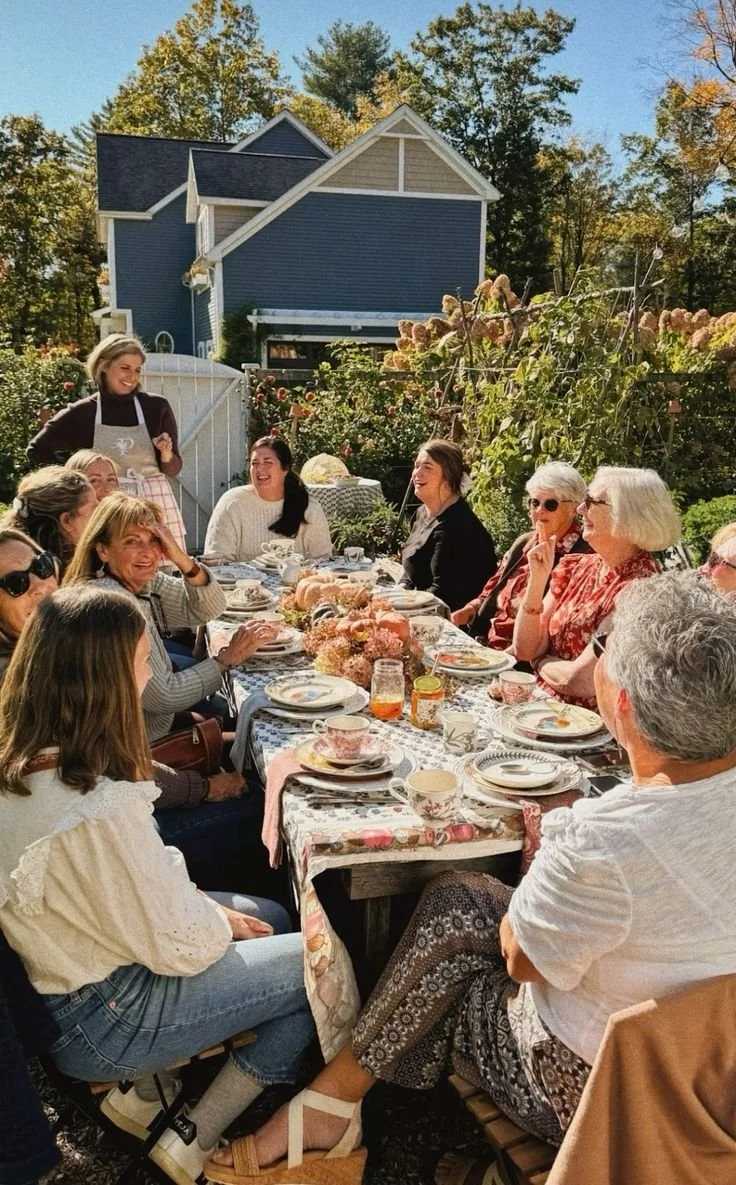
Why We Stopped
If gathering is this good for us - and the science is not equivocal on this, it is emphatic - why have we done so much less of it?
A few things happened, roughly simultaneously, and they were all perfectly reasonable at the time.
We got busy. Both parents working, school runs extending their tentacles across entire afternoons, the endless logistics of family life demanding calendar-management skills that would impress a military operations centre. Gathering took time we no longer had.
We got comfortable alone. Streaming services arrived, and the evening that once required other people to feel bearable was suddenly complete with a sofa, a remote control, and the reasonable argument that you've earned this. And you had. You just didn't know what you were trading.
We moved the food elsewhere. Desk lunch became normal. Breakfast became a commute activity. Dinner fragmented across different mealtimes, different rooms, different devices. The table stopped being the default location for the family and became, gradually, a surface where things got put down and not always collected again.
And then social media arrived and gave us the sensation of connection - the dopamine hit of a reply, a like, a message that says seen - while quietly, efficiently substituting for the real thing.
Robert Putnam documented the beginning of this drift in Bowling Alone in 2000. He was watching community organisations, civic clubs, and shared activities decline steadily across America. What he identified then has since accelerated, crossed the Atlantic, and settled into ordinary British life with all the unobtrusive permanence of damp.
We didn't decide to stop gathering. We just kept finding easier things to do instead. And then, one unremarkable Tuesday, we looked up and realised we couldn't remember the last time we'd eaten with someone without one of us checking our phone.
The Before and The After
Before: you're busy, vaguely disconnected, eating something at the sink because there wasn't time to sit down, feeling that low-level hollowness that's hard to name but unmistakably present, telling yourself you'll make more time for people when things calm down.
After: it's a Thursday evening, nothing special, someone's brought something, there's a cloth on the ground or a table that's been laid properly, and you're outside or you might as well be, and the conversation goes somewhere you didn't expect, and at some point you notice - properly notice - that you feel entirely different from how you felt an hour ago.
That's not sentiment. That's oxytocin and endorphins and your ventral vagal system finally, briefly, switching off the alarm.
The bridge between those two states is not complicated, and it costs almost nothing.
It's just a decision to gather.

On Picnics, Specifically
You knew I'd get here eventually.
There is a reason the picnic, of all the gathering formats available to us - dinner parties, drinks, restaurants, event spaces with minimum spends and mandatory gratuities - produces a disproportionate amount of joy relative to its effort.
It forces the things that matter. You're outside, which means the cognitive benefits of nature exposure (attention restoration, cortisol reduction, sensory engagement) compound the social ones before a single sandwich has been opened. You're on the ground, or close to it, which democratises the space - no head of the table, no hierarchy, everyone at the same level, children genuinely welcome rather than technically tolerated. You're committed - there's no kitchen to disappear into, no separate room to drift to, no half-excuse to check something quickly. You packed the thing. You came here. You're present by circumstance if not entirely by intention.
And you're sharing food you prepared - or at least assembled - with some degree of thought. Research on communal eating consistently shows that the process of sharing food that has been made for someone, passed to someone, chosen for someone, activates the social bonding mechanisms more strongly than food that simply appears.
The picnic is not a quaint British relic. It is, in the most current understanding of what makes humans well, an extraordinarily effective gathering technology.
We've just been slightly under-selling it.
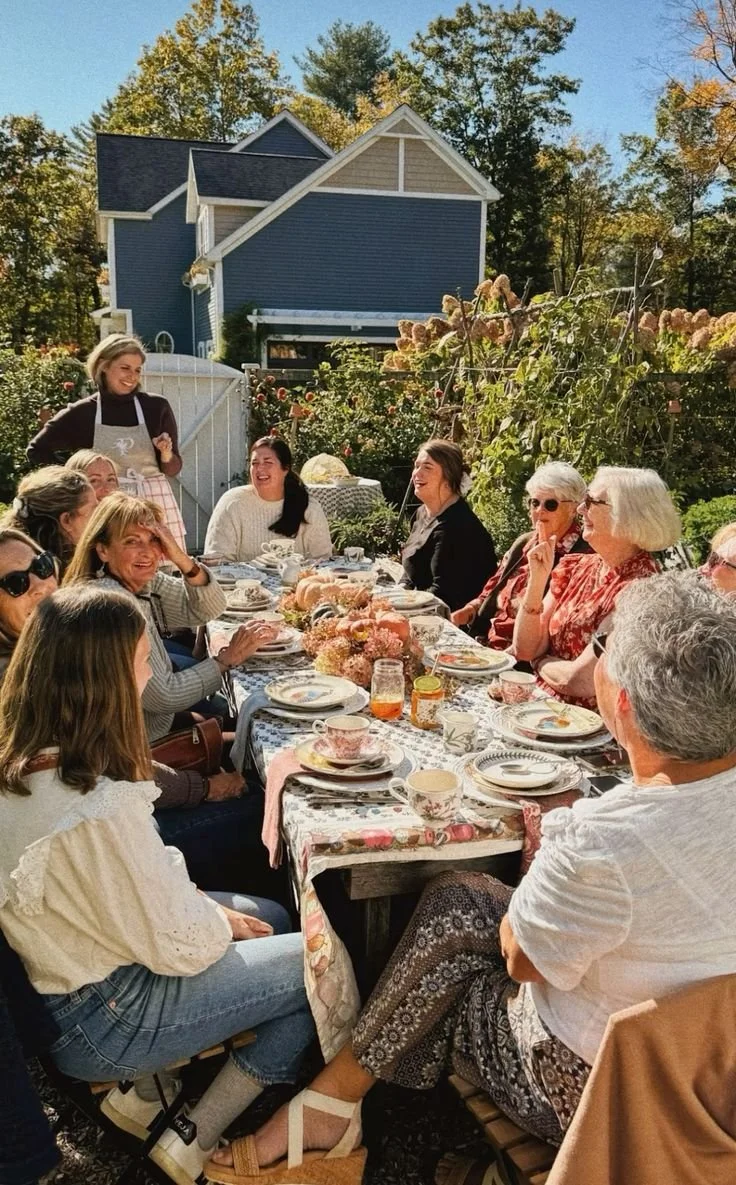
The Tiny Experiment
I'm not suggesting you overhaul your social life. I'm not suggesting dinner parties every weekend, or any dinner parties at all if the thought fills you with low-level dread (there is a post coming for you specifically, don't worry).
I'm just asking you to do one thing, once, before the end of this month.
Gather with someone. Outside if you possibly can. Food involved, even if it's just something you grabbed on the way. Not a performance. Not an occasion. Just two people — or three, or four — sitting somewhere together, with the phone in the bag, and the full understanding that this, right here, is the point.
Notice how you feel an hour later.
Then notice how long that feeling stays.
The Oxford researchers, when they published their work on shared meals and wellbeing, concluded with something I've been thinking about ever since. The single greatest predictor of a happy meal, they found, was not the quality of the food. It was not the setting, the occasion, or the aesthetic of the table.
It was whether there were other people at it.
We have always known this. Our bodies know it even when our schedules argue otherwise.
We were never, not once in 300,000 years of trying, meant to eat alone.
Now go find someone to sit with. I hear outside is lovely.
With love, Gemma x
P.S. Come and find me on Instagram — I'd love to know where you gathered this month.
P.S.S. All images found on Pinterest and are saved to my Gathering Board - A place where you can feel the pure joy from ‘Gathering’
This post is part of The Joy of Gathering - a series exploring the science, the seasons, and the practical art of coming together.
Read the series: We Were Never Meant to Eat Alone (Post 1) · The Lost Art of Gathering (Post 2) · What Happens to Your Body When You Gather (Post 3) · More coming monthly throughout 2026.

Research & Further Reading
Dunbar, R. I. M. (2017). Breaking Bread: the Functions of Social Eating. Adaptive Human Behavior and Physiology, 3, 198–211.
Fredrickson, B. L. (2013). Love 2.0: How Our Supreme Emotion Affects Everything We Feel, Think, Do and Become. Hudson Street Press.
Holt-Lunstad, J., Smith, T. B. & Layton, J. B. (2010). Social Relationships and Mortality Risk: A Meta-Analytic Review. PLOS Medicine, 7(7).
Porges, S. W. (2011). The Polyvagal Theory: Neurophysiological Foundations of Emotions, Attachment, Communication, and Self-Regulation. W. W. Norton.
Putnam, R. D. (2000). Bowling Alone: The Collapse and Revival of American Community. Simon & Schuster.
Dunbar, R. I. M. (1998). The Social Brain Hypothesis. Evolutionary Anthropology, 6(5), 178–190.
There's a particular kind of summer afternoon that Somerset does better than anywhere else. It starts in the mid-afternoon — later than you intended, as always — when someone finally says right, let's go, and you pack the blanket and the children and something cold to drink and you leave.