Why the Village Fête Lives in Us Forever
The smell of cut grass, the sound of country dancing anthems, and the ordinary magic we carry without knowing.
Paula Sutton of Hill House Vintage wrote something recently in Country Living that stopped me mid-cup of tea.
She was writing about her Norfolk village fête — the bunting politics, the cake competition, the particular passive-aggressive undercurrent of a judge who once borrowed a hedge trimmer from a competitor and will never, ever fully escape that fact. And at the very end, she wrote this:
"Everyone leaves slightly sunburnt or mildly damp and carrying a plant they hadn't planned on buying."
I read it three times. And thought about it for the rest of the week.
Because that one perfectly observed, entirely specific sentence is the most accurate description of what good gathering does that I think I've ever read.
It gives you something you didn't know you needed. It sends you home different from how you arrived.
And it took me straight back to Nunney. There is a smell I associate with pure joy.
It isn't expensive. It isn't complicated.
It's the particular combination of sunscreen, cut grass, a bbq, warm tea and the faint waft of a candyfloss machine.
It's the school summer fête.
And every time I catch even the edge of that smell — at a garden party, at a fairground, drifting over a Somerset hedgerow on an August afternoon — something in my chest does a thing I can only describe as remembering all the way down.
If you don't know it: Nunney is a village in Somerset, three miles from Frome, population under a thousand, and home to a genuine moated medieval castle that sits in the centre of the village as if it simply forgot to leave. Built in 1373. Survived a Civil War siege. Has ducks in the moat.
We thought it was completely ordinary. We walked past it nearly every day.
Every year, two things happened that felt like the axis the whole year turned on.
The first was the school summer fête. Maypoles. Country dancing — the kind where someone's mum is running the tape recorder, the class has been practising since March, and at least one child forgets to go under the ribbon. It doesn't matter, because the parents are crying anyway. Face painting. Donkey rides. Whack-a-rat — which is exactly what it sounds like and considerably more thrilling than it has any right to be. The coconut shy, where success felt like a genuinely significant life achievement.
And bunting. Always bunting. So much bunting that the village became a bunting-based weather system for the afternoon.
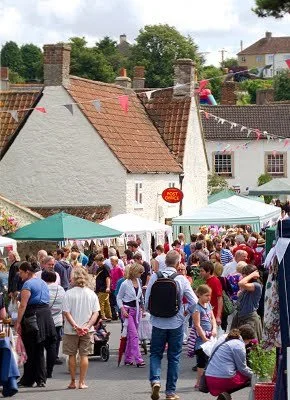
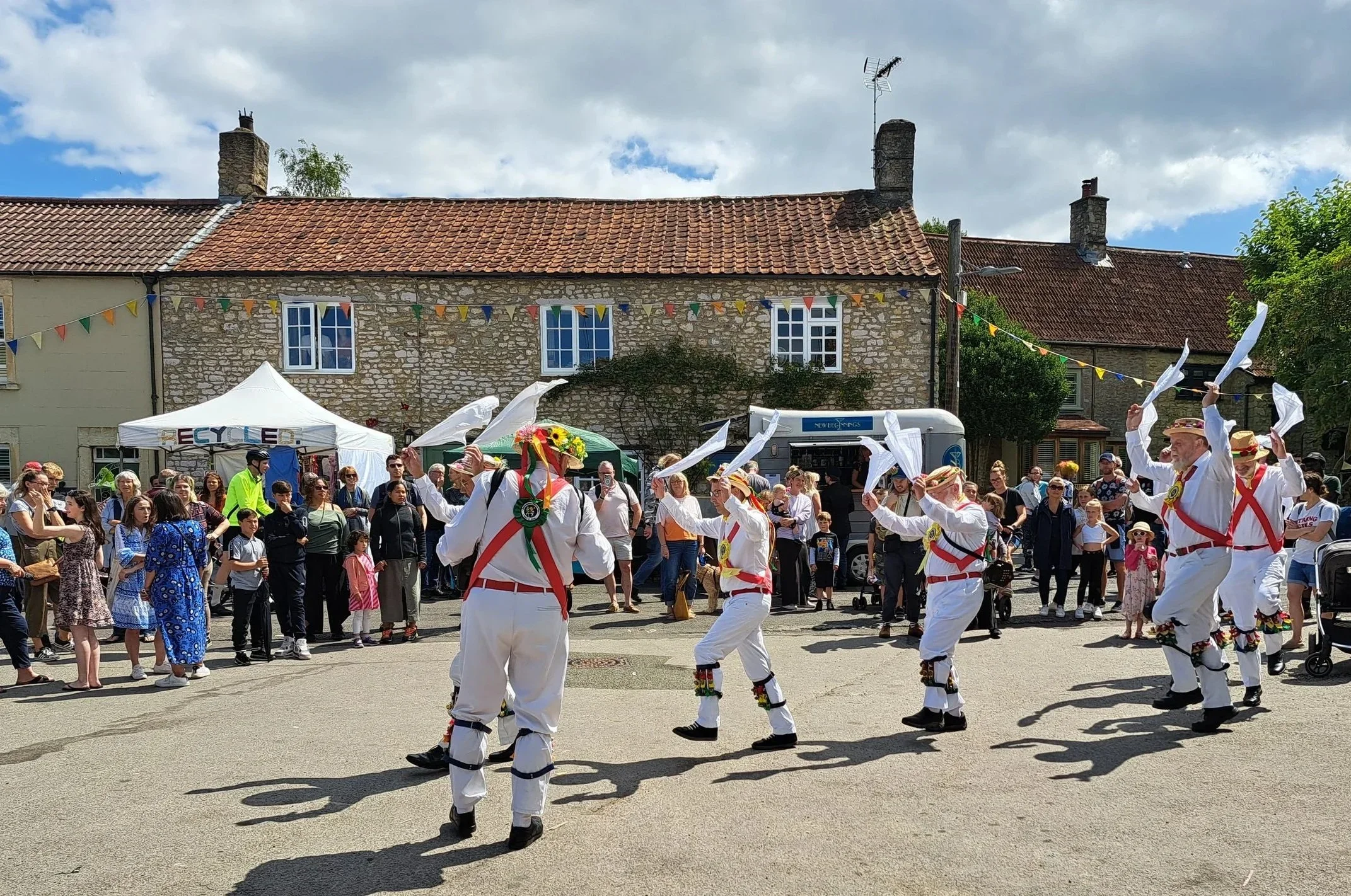
The second was the Nunney Street Fayre. The whole village came alive. Over a hundred stalls filling the lanes. The George Inn heaving. The WI taking over the village hall with the quiet authority of people who have been doing this since before you were born and will be doing it long after you're gone — and good luck to anyone who suggests changing the arrangement. Cream teas in the church. Morris dancers in the street. And somewhere near the castle, music.
What I didn't know as a child — what I find rather extraordinary now — is that the Nunney fayre goes back to a royal charter granted by King Henry III in 1260. We were just one summer afternoon in a 760-year story of a community gathering itself together.
I still think it might be the best day of the year.
We walked past a medieval castle on the way to school and thought it was completely ordinary. The fête, though. The fête was something.
What the Scientists Say (Bear With Me — It's Cheerful)
Here's the thing about those memories. The ones that ambush you on an ordinary Tuesday, mid-rinse at the kitchen sink.
They are doing something. Something measurable.
The hippocampus — the brain's memory keeper — and the amygdala — its emotional processor — work together to encode memories that carry strong feeling. Events tied to joy, safety, and belonging get filed differently to ordinary information. They go in deep and warm, and they arrive with their own sensory package: the smell of sunscreen, the scratch of face paint drying on your cheek, the sound of a brass band playing slightly too loud on a village green.
When something in the present catches that sensory package — even just a fragment — your brain doesn't simply recall the event. It replays the emotion. Dopamine and serotonin release. You don't just think about the school fête. You briefly, bodily, feel what it felt like to be nine years old and wildly successful at whack-a-rat.
Cognitive psychologists also have something wonderful called the reminiscence bump — the finding that when asked to recall memories from across their lives, people consistently pull a disproportionate number from the ages of roughly ten to twenty-five. Those years are encoded with unusual intensity. The brain is still developing. Everything is a first. First sense of belonging somewhere beyond the family. First community that you chose, even a little.
The school fête sits right in that window.
Which is why it hits like it does.
Nostalgia had a bad reputation for a long time. The word was coined in 1688 by a Swiss physician who classified it as a neurological disease — a debilitating homesickness for somewhere you couldn't return to.
We've come a long way.
Modern research is emphatic: nostalgia is a psychological resource. It strengthens social bonds. It connects our past selves to who we are now. Studies show it increases optimism, raises self-esteem, and makes us more generous, more empathetic, more likely to act on what actually matters to us.
All of this. From a memory of a donkey ride and a tombola.
But here's what I think is more interesting than the science.
Looking back at the Nunney fête — at all of it — what strikes me is how much it was teaching us, without ever using the word teaching.
It was teaching us belonging. That we were part of something larger than ourselves. Something with roots.
It was teaching us that community is a verb, not a noun. Not something you have — something you do.
It was teaching us that joy doesn't require perfection.
The donkey doesn't always cooperate. The weather is British. The country dancing goes slightly wrong in the second verse. And none of that — not one bit of it — diminishes the afternoon. It deepens it.
The wobbles are the memory. The wobbles are the point.
I think about it because gathering has become complicated.
We plan it perfectly or we don't do it at all. We wait until the house is tidy enough, the food impressive enough, the timing right enough. We push the blanket to the back of the cupboard and say soon, when things calm down a bit.
Things do not calm down. I suspect you know this.
And all the while, somewhere in Somerset, the Nunney Community Fayre is being quietly planned by volunteers who just want to fill the village lanes with stalls and music and something warm from a paper bag. The WI is confirming their slot. The Morris dancers are checking their calendars. Someone is ordering more bunting than is strictly necessary.
Not because it will be perfect.
Because it will be there.
Here is what the village fête has always understood — what every great gathering understands — that we keep forgetting:
The point is not the Victoria sponge.
The point is not the perfectly laid table or the colour-coordinated picnic basket or the Instagram moment that captures the golden light at exactly the right angle.
The point is that you showed up.
That you bought the raffle ticket. That you let your children have their faces painted. That you stood on a bit of slightly damp Somerset grass with people you love — or people you've just met — and were, for one afternoon, entirely, simply here.
That is what your brain files as joy. Not the perfect version.
The present version.
Go to the Fête This Summer …
The Nunney Street Fayre is back this July — over a hundred stalls, live music by the castle, and fifty-plus years of a village simply refusing to stop showing up for itself. The Times once called it one of the best village fêtes in the country. I grew up going. I'd go back in a heartbeat.
But wherever you are in Somerset — wherever you are in Britain — there is a fête near you this summer. With bunting that isn't quite right. A cake that didn't win. A coconut shy run by someone who has been doing it since before you could walk.
Go.
Not to photograph it. Not to arrive at the optimal time with the optimal outfit.
Just go.
Leave slightly sunburnt, or mildly damp.
Carrying a plant you didn't plan on buying.
Feeling, if only for an afternoon, like you have the whole summer ahead of you.
Paula was right. It gives you something you didn't know you needed.
It is, I promise, one of the best things still available to us.
If you grew up going to a village fête that still lives in you — I'd love to know where. Drop it in the comments. Let's build a list of the good ones.
And for the full history — from medieval charter fairs to post-war Somerset and why the fête is newer than you think — read The Surprising History of the British Village Fête
With love (and a blanket), Gemma xx
The Piknic Club
Life is too short for boring picnics.
The Piknic Club is where the blanket-spreading, basket-packing, joy-seeking community lives. Seasonal boxes, curated picks, and the kind of picnic inspiration that makes you want to drop everything and go outside immediately.
Stay a while …

Come and be nosey …
The blanket is always out over on Instagram. Behind the scenes Picnicscapes, Somerset life as it actually happens, and the occasional opinion about gingham.