The History of Pimm's: Britain's Most Beloved Bottle of Summer
Part of The Picnic Icons Series — because every great picnic has a story. This series explores the history behind the objects, drinks, and traditions that make the British outdoor feast what it is. We've done Pimm's, and next we're coming for the scotch egg, the Thermos, the gingham cloth, and the picnic basket itself.
Picture the scene. It's around 1840, in the City of London. Not the gleaming glass-and-steel City of today, but the cobbled, fog-soaked, intensely smelly original — all counting houses, coffee shops, and the ever-present rumble of commerce. A man named James Pimm runs an oyster bar near the Bank of England. He's been there since 1823, when he arrived from Kent with shellfish, ambition, and a farmer's son's appetite for hard work. His customers are bankers, brokers, merchants, men in a hurry between transactions. And in a flash of genius that would echo through two hundred years of British summers, he starts serving them a drink.
A little cup. An aperitif. Something to aid digestion after all those oysters. He calls it his house cup. He doesn't yet know — he cannot possibly know — that one day this drink will be inseparable from strawberries, cucumber, warm afternoons, and the unmistakable sound of leather on willow.
He just knows it tastes rather good.
The Man, the Myth, the Oyster Bar
James Pimm was born on 9 November 1798, the son of a tenant farmer in Newnham, Kent. In his early twenties he came to London, establishing himself first as a shellfish monger on Lombard Street from around 1823, before moving to No. 3 Poultry — a short street running directly to the Bank of England, in the very heart of the City. By the late 1830s, records confirm him there as the proprietor of an oyster warehouse and eating house that served the working City lunch crowd with no-nonsense efficiency.
Victorian City men ate oysters the way we now eat sandwiches. They were cheap, plentiful, quick, and the City's oyster bars were the fast food restaurants of their age. But oysters, consumed enthusiastically by the dozen, had a downside. They were heavy. Rich. The sort of thing that sat in a man's stomach during an afternoon of ledger work and made his waistcoat feel unreasonably tight.
Pimm's solution was pragmatic rather than poetic: a gin-based digestive cup, served in a small tumbler, infused with a proprietary blend of herbs, liqueurs, and fruit. The recipe — which he guarded obsessively and never fully disclosed — was drawn from the long Victorian tradition of medicinal tonics. Bitters, botanicals, quinine. The Victorians genuinely believed that a well-constructed herbal drink was medicine as much as pleasure. Pimm was simply giving his customers what they wanted: something that felt good and tasted even better.
The "No. 1 Cup" designation came later, when Pimm's range expanded to include cups based on different spirits. No. 1 was gin. No. 2 was Scotch whisky. No. 3 brandy. No. 4 rum. No. 5 rye whisky. No. 6 vodka. Six cups in total, each served in identical small tankards — originally referred to as "No. 1 Cups" after the vessel they were served in rather than the drink itself. Today only No. 1 and No. 6 survive commercially, though the original No. 1 is so dominant that when most people say "Pimm's" they mean exactly that: the amber, herbal, completely singular gin cup that James Pimm first served around 1840 at his oyster bar on Poultry.
He never wrote the recipe down in any publicly surviving form. The precise blend of botanicals remains, even now, known only to six people at any given time. Six. The world's most secretive bottle of summer.
From Oyster Bar to Empire: The Victorian Expansion
Pimm's success in his own establishment led, naturally, to the question every successful Victorian businessman faced: how to scale. By 1851 — the year of the Great Exhibition, when the world came to Hyde Park and Britain showed off — Pimm's had begun large-scale commercial production, supplying the drink to other bars and establishments across London. It was bottled for the first time commercially in 1859. Then in 1865, Pimm sold the business and the right to use his name to a man named Frederick Sawyer. He died the following year, on 16 August 1866, and is buried at Holy Trinity Church in East Peckham, Kent — the county he came from and the county he never really left. Which is, frankly, exactly right.
Under Sawyer, and subsequently through various Victorian business hands, Pimm's began to spread beyond the City. By the 1860s it was available in bottles for the first time, not just on draught in the bar. This was significant. The bottled Pimm's meant that the drink could travel — that it could appear at events, at parties, at gatherings that were not James Pimm's original chop house. And in the 1860s, Britain was in the full fever of its outdoor entertaining moment.
This is where Pimm's and the picnic first shake hands.
The Victorian outdoor feast — which I've written about at length in this series — was a serious, rather magnificent affair. Mrs Beeton's 1861 Book of Household Management lists picnic provisions for forty people that include four roast ducks, two shoulders of lamb, a piece of cold roast beef, and enough bread, salads, and condiments to start a small delicatessen. These were not casual affairs. They were productions. And productions need a drink.
Pimm's — complex, refreshing, transportable in its bottles, and carrying the reassuring Victorian imprimatur of being "good for digestion" — fitted perfectly. It was sophisticated without being showy. It was British. It was, crucially, suitable for ladies, who could not be seen drinking straight spirits but could absolutely be offered a cup of something herbal and frothy without social catastrophe.
The Gardens and the Golden Age of Outdoor Drinking
To understand how Pimm's embedded itself in British outdoor culture, you need to understand the Victorian and Edwardian pleasure garden — and its successors. Vauxhall Gardens in London (which closed in 1859, just as Pimm's was hitting its commercial stride) had established the template: a beautiful outdoor space, music, promenading, elaborate food stalls, and drinks. The pleasure garden was where respectable Victorian Britain went to be seen, to eat outside, to enjoy a warm evening in company.
As Vauxhall declined, other outdoor venues stepped into the gap. The great sporting events became the new pleasure gardens: Henley Royal Regatta (established 1839), Ascot (ancient but reaching its zenith in the Edwardian era), the Eton and Harrow cricket match at Lord's. Each of these events had one thing in common: they took place outdoors, in summer, with lavish picnics consumed before, during, and often after the main event.
And Pimm's, by the Edwardian era, was becoming the drink of choice.
The Edwardian press is full of breathless descriptions of Henley and Ascot: the hampers, the hired boats, the elaborate picnics consumed on the riverbank while the racing passed by. Period photographs of Henley from the 1900s and 1910s show exactly the scene you'd imagine — parasols, linen, silver on tablecloths — and in virtually every one, somewhere in the frame, a tall jug, its contents distinctively dark amber. The "herbal cup" had by this point become the recognised language for Pimm's in polite company. Magazines of the era advertised it as the essential companion to outdoor entertaining; to arrive at Henley without it was, increasingly, to mark yourself out as someone who didn't quite know how things were done.
The Edwardians were magnificent outdoor entertainers. The motor car had arrived — at least for the wealthy — opening up the countryside for the first time to picnics that were not dictated by the railway timetable. Edwardian photographs of motor picnics are extraordinary documents: women in enormous hats with forty-foot brims sitting on folding chairs in the middle of a Surrey lane, a full silver service laid on a linen tablecloth, with hampers unpacked around them as if the car had exploded elegantly. And in the foreground, almost always, a jug. Probably Pimm's.
The Twentieth Century: When Marketing Became Memory
Here is the truth that the history books — and the Pimm's marketing department — would rather you didn't examine too closely.
For all that Pimm's feels ancient and inevitable, its association with specific British summer events is, in large part, a twentieth-century construction. A very good one, beautifully executed, so successful that the marketing became the memory and the memory became the tradition. But constructed nonetheless.
The key moment came in 1970. The Distillers Company took control of Pimm's, promptly phased out cups Nos. 2 through 5, and set about repositioning what remained. The following year — 1971 — the first dedicated Pimm's Bar opened at the Wimbledon Championships. It was, by all accounts, an immediate and overwhelming success.
Pimm's had been present at Wimbledon before 1971, but the cultural association — the idea that Wimbledon and Pimm's were inseparable, that one could not exist without the other — was the product of that formal partnership and the sustained, clever marketing that followed. The Distillers Company was subsequently bought by Guinness in 1986; Pimm's became part of Diageo when Guinness and Grand Metropolitan merged in 1997. By the 1990s the campaign was simply brilliant: Pimm's leaned into its Britishness, its summer exclusivity, its whiff of garden party nostalgia. The adverts were all dappled light, white linen, and the sound of ice clinking in a tall glass. They sold not a drink but an afternoon.
It worked. It worked so well that today, Pimm's sells the vast majority of its annual volume between June and August. Outside of summer, it practically disappears from supermarket shelves. Which is extraordinary, if you think about it: a drink with a two-hundred-year history that is, commercially speaking, a three-month product.
At Wimbledon, the numbers are staggering. Over 80,000 pints of Pimm's are sold to spectators every year — that's more than 300,000 glasses across the fortnight — consumed with strawberries and cream and the sound of rain beginning to fall, as it reliably does, at some point during the second week.
James Pimm, in his oyster bar on Poultry, could not have imagined it.
What's Actually In It? The Botanical Mystery
The recipe for Pimm's No. 1 is, as I mentioned, one of Britain's better-kept secrets. Only six people at any given time know the precise formulation. The spirit is gin. The colour comes from a blend of caramelised sugar and the botanicals. The taste — that distinctive amber-sweet, slightly medicinal, completely addictive flavour — comes from a combination of ingredients that have been the subject of considerable forensic investigation by drinks writers, historians, and extremely dedicated amateurs.
The generally accepted botanical components include: quinine (that bitter, medicinal note you recognise from tonic water), various citrus peel, herbs including something in the mint family, and what are usually described as "spices" — which is, obviously, as helpful as saying a paint contains "colours."
What we know for certain is that Pimm's No. 1 is 25% ABV, which makes it relatively gentle by spirits standards. The original No. 1 Cup served in Pimm's oyster bar was almost certainly stronger — Victorian "medicinal" preparations did not shy away from alcohol content. The current formulation was stabilised in the mid-twentieth century and has remained largely consistent since.
There have been limited edition versions over the years. Pimm's Winter (with clove and cinnamon, essentially a mulled wine in a bottle), Pimm's Blackberry & Elderflower, and briefly, Pimm's Strawberry. None of them have come close to dislodging No. 1. Britain knows what it wants, and what it wants is the original.
The Perfect Pimm's: A Brief and Opinionated History of the Garnish
The question of what goes in a Pimm's is, in my experience, capable of provoking the kind of heated debate that Britons usually reserve for Brexit, the correct way to make a cup of tea, and whether scones take cream first or jam first (cream first, obviously, this is Somerset and I will not be moved on this).
The original Pimm's Cup was served, in James Pimm's establishment, in a small tankard with ice. No fruit. No mint. No cucumber. Just the cup itself, neat or perhaps with soda, over ice. The garnishing tradition came later — probably with the Edwardian outdoor entertaining culture, where the visual drama of a well-dressed drink was considered as important as its taste.
By the 1920s, lemonade had become the standard mixer. This lightened the drink considerably and made it more suitable for warm-weather consumption in quantity. The fruit garnish — orange slices, strawberries, borage flowers — appeared through the interwar period, partly for aesthetics and partly because warm-weather entertaining had always involved beautiful presentation.
The cucumber. Ah, the cucumber. The single most controversial strip of vegetable in the British culinary landscape.
Cucumber in Pimm's appears definitively from the mid-twentieth century, probably the 1950s or early 1960s. Its origins are debated. Some food historians suggest it was a natural extension of the Victorian cucumber sandwich tradition — the cucumber as the quintessential British summer vegetable, cool, subtle, inescapably English. Others suggest it was a marketing addition, something visual and unexpected that made a Pimm's look immediately distinctive and Instagrammable before Instagram existed.
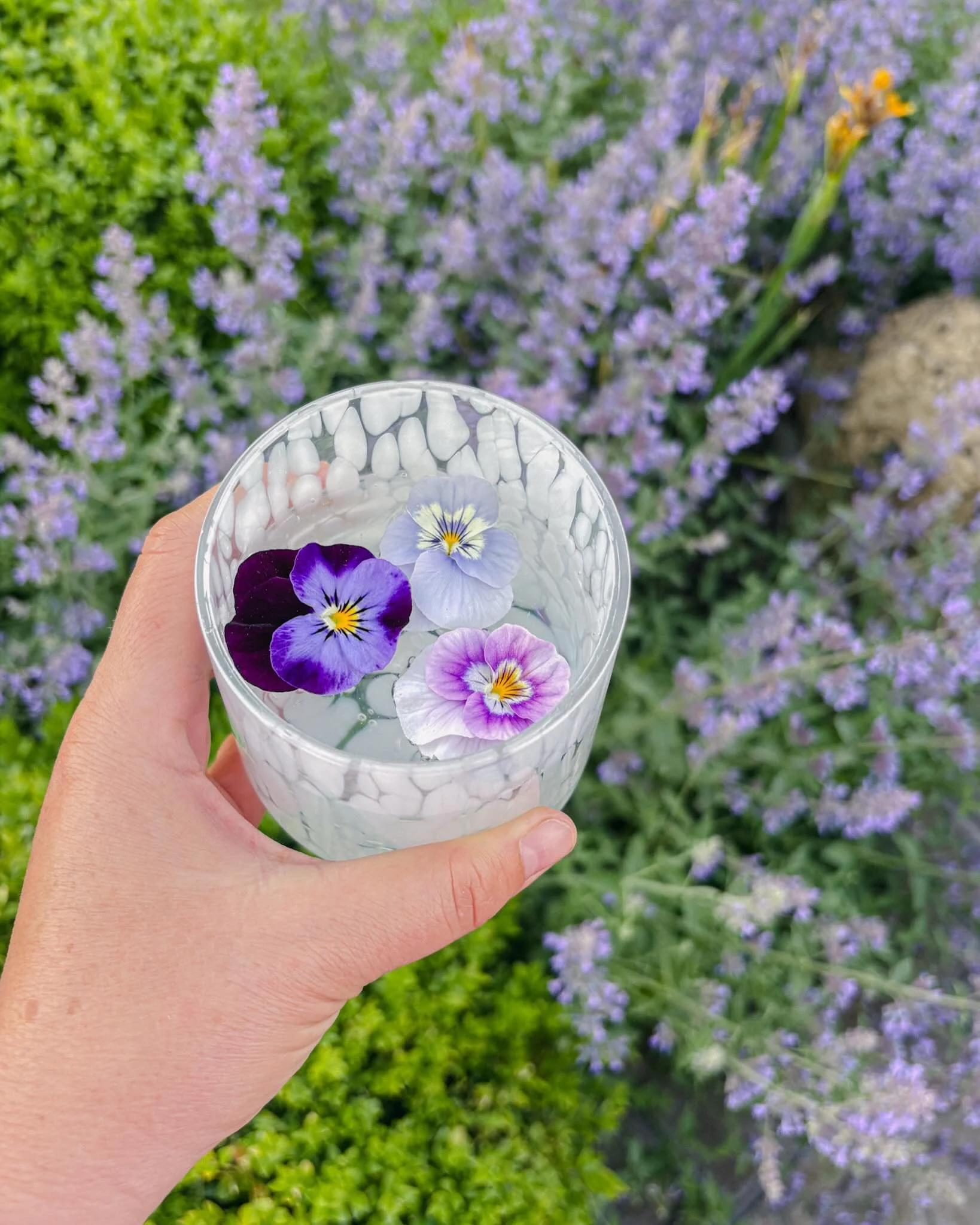
The mint — fresh mint, ideally just slightly bruised — appeared around the same time. And the borage flowers, those tiny blue stars that float on top of a properly made Pimm's, were traditional garnishes from at least the Edwardian era. Borage has been cultivated in Britain for centuries; the flowers were dropped into drinks as decorations and are very mildly medicinal (herbalists have used borage for its calming properties since at least the sixteenth century).
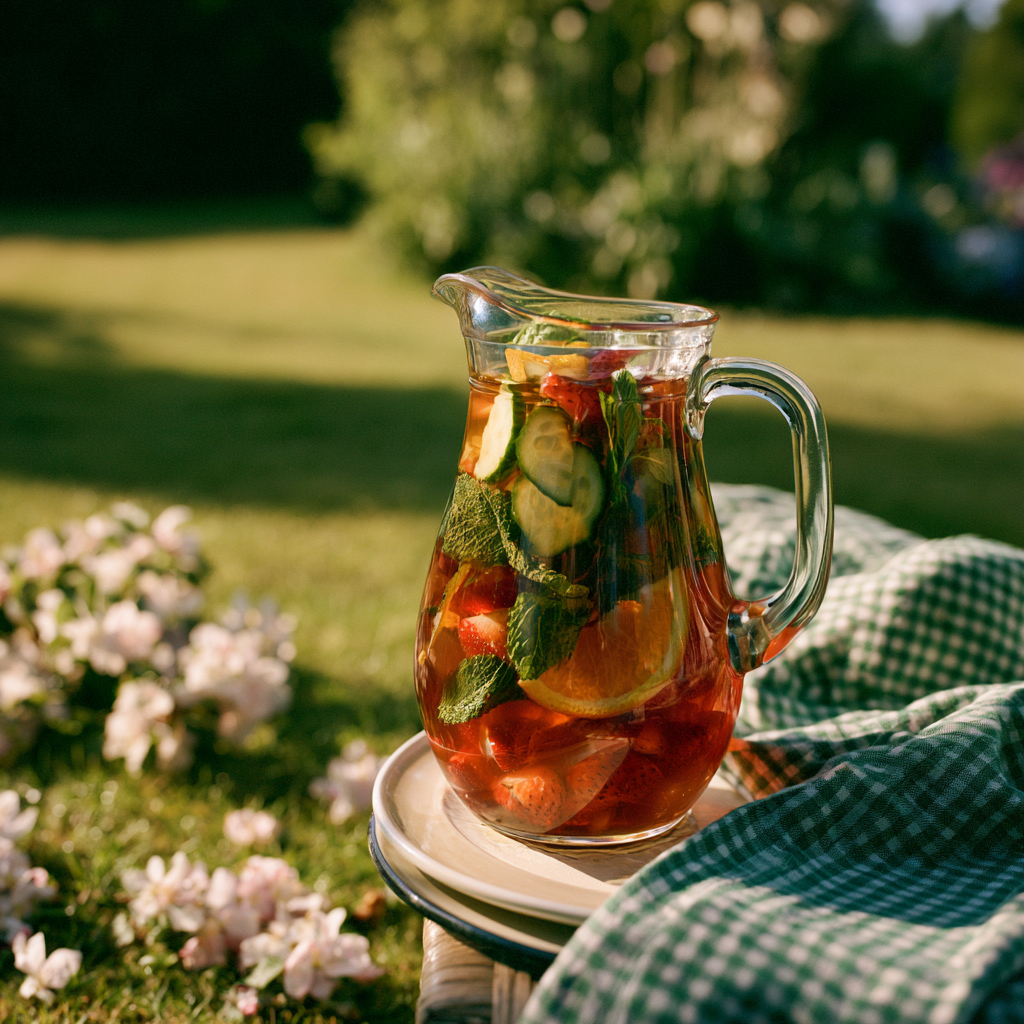
Today, the "correct" Pimm's Cup contains: Pimm's No. 1, lemonade (in a 1:3 ratio), ice, cucumber slices, orange slices, strawberries, fresh mint, and — if you can find them, and if you have any self-respect — borage flowers. This is not negotiable. Anyone offering you a Pimm's without cucumber is offering you something technically in the family of Pimm's but not, quite, the thing.
Pimm's in Literature, Art, and the British Imagination
A drink that becomes embedded in a culture leaves traces in its art. Pimm's is everywhere in twentieth-century British fiction and culture, though sometimes under the code of "a long summer drink" or "a cup" or simply the implied ritual of summer entertaining.
Evelyn Waugh's Brideshead Revisited (1945), set in the glamorous 1920s and 1930s, is saturated with the culture of outdoor eating and elaborate summer entertaining that Pimm's was already servicing. The strawberries and wine consumed by Charles and Sebastian in the opening Oxford chapters — that specific language of eating and drinking as the grammar of friendship and longing — is the same instinct that makes a Pimm's at a garden party feel like more than a drink.
P.G. Wodehouse, who understood the English summer party better than almost anyone, populated his Bertie Wooster stories with outdoor entertainments where long, iced drinks circulated perpetually. Wodehouse doesn't mention Pimm's by name with any great frequency — like all good novelists, he tends to gesture at the thing rather than brand it — but the summer cup at a garden party, the jug on the trestle table at a cricket match, is Pimm's, every time, in everything but name.
More recently: Nick Hornby, Jilly Cooper, and the entire genre of British summer fiction has Pimm's running like a thread through it. In Rivals — Cooper's magnificent, breathless saga of English country life — characters drink Pimm's at point-to-points, at polo matches, at the sort of summer parties where things go magnificently wrong in the sunlight. The drink is shorthand, in British fiction, for a particular world: affluent, outdoor, aspirational, slightly chaotic, fundamentally optimistic.
There is also the matter of Wimbledon (the 2004 film, not the tournament), where a Pimm's appears in approximately the background of three scenes and yet still somehow communicates everything you need to know about the world it depicts.
The Recipe: Pimm's No. 1 Cup, Properly
Look, I considered giving you something wildly creative here. A Pimm's granita, perhaps, or a Pimm's jelly. But honestly? The recipe that has survived two hundred years of British summers, been consumed by kings and commoners and approximately every person who has ever sat in a deckchair with grass under their feet and sun on their face — that recipe doesn't need improving.
Here it is. Properly done. No shortcuts.
For a jug serving 4-6 people:
250ml Pimm's No. 1
750ml good quality lemonade (not fizzy water — actual lemonade, properly sweet)
A large handful of ice, the bigger the cubes the better (they melt slower)
½ cucumber, sliced on the diagonal
1 orange, sliced into half moons
A good handful of strawberries, hulled and halved
A small bunch of fresh mint, leaves picked and very lightly bruised
Borage flowers if you can find them (your local farmers' market or a decent garden centre in summer — worth it)
The method:
Fill the jug with ice first. Always ice first. Pour the Pimm's over the ice, then the lemonade. Add the cucumber, orange, and strawberries. Add the mint. Give it one gentle stir — not enthusiastic, just one quiet, deliberate rotation with a long spoon. If you have borage flowers, drop them on top.
Serve immediately, in tall glasses. If you're doing this at a picnic, transfer the whole thing into a wide-mouthed flask or a good Kilner jar with a lid. It travels better than you'd think.
A note on the lemonade: Fever-Tree makes an excellent Premium Lemonade for this, with real citrus and enough sweetness to balance the Pimm's without overwhelming it. In a perfect world, make your own — a simple sugar syrup with lemon juice topped with sparkling water. In a realistic world, Fever-Tree is the answer.
A note on the ratio: The official Pimm's guidance is 1 part Pimm's to 3 parts mixer. Historically, I've found the best results at a slightly stronger 1:2.5, especially on a warm day. You're making summer happen in a glass. Don't water it down.
Pimm's in Somerset: A Personal Note
I cannot write about Pimm's without telling you about the first time I truly understood it.
I was about nine, I think. A garden party somewhere in Somerset — the sort of gathering that happens on a good June afternoon when someone has the nerve to tempt fate by actually setting up chairs on the lawn. There were adults with glasses of something amber and fizzy, garnished with what I can only describe, from child height, as a small garden on top of the drink. The ice clinked. The conversation lapped. Someone was playing cricket on the other side of the hedge. The grass was the specific shade of green that only exists in Somerset in early summer, after all the rain.
I wasn't allowed a Pimm's, obviously. I had squash. But the smell — that particular warm, herbal, citrus-and-mint smell — drifted across the garden all afternoon. It smells like permission. Like adulthood. Like the particular joy of doing nothing in a beautiful place with people you love.
I've been chasing that smell on summer afternoons ever since.
If you're in Somerset and you're making a Pimm's this summer, try to get your strawberries from a local pick-your-own — there are several brilliant ones across the county, and the Somerset strawberry is, I will argue until I'm blue in the face, the finest strawberry in England. The flavour is more intense, less watery, properly red all the way through. Drop them in your Pimm's. They'll still be delicious when you fish them out at the bottom of the glass. Actually, possibly more delicious. This is not me being sentimental. This is taste.
The Legacy: What Two Hundred Years of Summer Looks Like
James Pimm died on 16 August 1866, at Bush Farm in East Peckham, Kent. He had sold the rights to his name and recipe to Frederick Sawyer the year before, and died listed in his records as "formerly a fish factor." Not a drinks pioneer. Not a brand founder. A fish factor, formerly of Cheapside. He did not know what he had started. He did not know that his little digestive cup would one day be served by the hundreds of thousands at a tennis tournament in South London, that it would be the unofficial drink of the English summer party, that it would be the subject of heated argument about cucumber, that people all over Britain would greet its reappearance on supermarket shelves in May as a genuine sign of hope.
He just made something that tasted good and helped his City lunch crowd get through the afternoon.
That, in its way, is the whole of British food culture in miniature. Not grand ambition. Not artistic declaration. Just: here is something nice, let's share it.
The next time you're sitting on a blanket in a field — or a garden, or beside a river, or on the kind of damp Somerset grass that leaves a green stripe on your trousers that no amount of washing will entirely remove — and you've got a glass of Pimm's in your hand and the sun is doing that thing it does in the English summer where it's warm on your face but there's a breeze coming over the hedgerow that keeps everything from getting too comfortable, and someone nearby is laughing, and the ice is clicking against the glass, and the mint smells exactly the way mint should smell —
That's James Pimm's legacy. Not a corporation. Not a marketing campaign. That afternoon.
Two hundred years. Six secret ingredient keepers. One very good drink.
Where to Go Deeper
Fancy going down the rabbit hole? Here's where to start:
The Pimm's Company Archive — Diageo holds significant historical records; their heritage site has a surprisingly good timeline of the brand's development.
The Worshipful Company of Distillers — London's guild of the distilling trade has records going back centuries and context for how Pimm's fits into the Victorian drinks landscape.
Martyn Cornell's Amber, Gold & Black: The History of Britain's Great Beers — not specifically about Pimm's but essential context for Victorian drinks culture.
The Fortnum & Mason Archive — Fortnum's and Pimm's have been fellow travellers in the British outdoor entertaining world for 150 years; their archive is fascinating.
The Wimbledon Museum (aeltc.com/wimbledon/museum) — Has an excellent display on the social history of Wimbledon, including the evolution of its food and drink culture.
The British Library Newspaper Archive — Search "Pimm's Cup" in Victorian and Edwardian newspapers and you will find, genuinely, hours of pleasure. The advertisements alone are extraordinary.
Jilly Cooper's Rivals — Not a history book. Absolutely worth it for the cultural Pimm's immersion.
Next in The Picnic Icons Series: The Scotch Egg — a study in why a pickled meat, encased in sausage, covered in breadcrumbs, and sold in a petrol station represents approximately five hundred years of British ingenuity. Coming soon.
Subscribe to JoyMail — my Substack newsletter — for the first look at every new piece, plus the notes, the asides, and the things I find too good not to share. Link in bio, or find me at gemmaduck.com.
With love (and a very garnished glass), Gemma x
Further Reading & Sources:
Cornell, M. (2010). Amber, Gold & Black: The History of Britain's Great Beers. The History Press.
Beeton, I. (1861). Mrs Beeton's Book of Household Management. S.O. Beeton Publishing.
Waugh, E. (1945). Brideshead Revisited. Chapman & Hall.
Wilson, C.A. (1973). Food and Drink in Britain: From the Stone Age to the 19th Century. Constable.
McConnell, A. (2005). 'Pimm, James'. Oxford Dictionary of National Biography. Oxford University Press.
Wikipedia contributors / London Street Views archive (londonstreetviews.wordpress.com) — Tallis's 1839 Street View records confirming James Pimm at 3 Poultry.
Diageo Heritage Archive, Pimm's Brand History documentation
Spencer, C. (2002). British Food: An Extraordinary Thousand Years of History. Grub Street.
Davidson, A. (1999). The Oxford Companion to Food. Oxford University Press.
Cooper, J. (1988). Rivals. Bantam Press.
Wodehouse, P.G. (1934). Right Ho, Jeeves. Herbert Jenkins.
The Piknic Club
Life is too short for boring picnics.
The Piknic Club is where the blanket-spreading, basket-packing, joy-seeking community lives. Seasonal boxes, curated picks, and the kind of picnic inspiration that makes you want to drop everything and go outside immediately.
Stay a while …



Come and be nosey …
The blanket is always out over on Instagram. Behind the scenes Picnicscapes, Somerset life as it actually happens, and the occasional opinion about gingham.